How to Reach a Live Person at the IRS!

Although the topic of this blog isn’t specifically insurance-related, I thought I’d pass this information on as a “public service announcement.”

IRS

Fortunately, I don’t usually have to call or deal with the Internal Revenue Service (IRS) much, but something unexpected came up with my social security, and I had to call the IRS. I was literally on the phone for hours pushing buttons and listening to a myriad of endless options. I was unable to speak with a live person, which is why I called in the first place.

Finally, out of frustration, I tried googling different ways to contact the IRS, and I found that a lot of other people were having the same problem that I was having. It seems that the IRS wants to make it as difficult as possible for someone to be able to reach one of their phone representatives.

IRS2

I know that most people don’t need to call the IRS on a frequent basis, but in case you ever need to call them, here are the steps that you need to follow to actually speak with a real live human being at the IRS:

  1. Call the IRS at 1-800-829-1040 between the hours of 7 AM – 7 PM local time, Monday through Friday.
  2. Choose your language.
  3. Choose option 2 for “personal income tax.” (Do NOT choose option 1 for refund information. If you choose refund information, it will send you to an automated phone line.)
  4. Press 1 for “form, tax history, or payment.”
  5. Press 3 “for all other questions.”
  6. Press 2 for “all other questions.”
  7. When asked to enter your social security number (SSN) or employment identification number (EIN) to access your account information, don’t enter anything. (After it asks you twice, you will get another menu.)
  8. Press 2 for “personal or individual tax questions.”
  9. After that, you should be transferred to an IRS agent.

I also tried calling a couple of “local” IRS offices, but it was just as challenging trying to talk with a live person. I tried the steps shown above, and they work! I hope that you don’t have to call or deal with the IRS, but if you need to call them, I think that you will find these steps to be helpful.

You can also access a lot of useful information on the IRS website, which is www.irs.gov.

medicare-supplement-piece-1

Do You Have a Medicare Supplement Plan?

If you have a Medicare Supplement plan, contact me for a free quote! As an independent insurance agent, I work with all the major insurance carriers, and more than likely, I can save you hundreds of dollars on your Medicare Supplement premiums for the same exact plan and coverage!

If you have any questions or comments, please let me know!

Thanks!

Ron Lewis

Ron@RonLewisInsurance.com
www.MedigapExpress.com

Why You Should Replace Your Medicare Advantage Plan with a Medicare Supplement

The Annual Enrollment Period (AEP), which is from October 15th through December 7th each year, is almost here!

If you currently have a Medicare Advantage (MA) plan, you should switch back to Original Medicare and get a Medicare Supplement plan instead!

IMPORTANT: If you have a Medicare Supplement plan (aka “Medigap” because it picks up the “gap” in Medicare coverage) the AEP does not apply to you unless you want to enroll in or change your Prescription Drug Plan (PDP).

Why Medicare Supplement Plans Are Better

With Original Medicare (Part A and Part B) and a Medicare Supplement, you have much more freedom of choice and lower costs than you do with an MA plan!

NOTE: Medicare Part A is hospital insurance and Part B is medical insurance.

Which Plan Gives You the Most Freedom?

With an MA plan, you are locked into the plan’s network of doctors, specialists, hospitals, and care facilities. If you want to see a specialist, you often have to see your preferred care provider first, who acts as a gatekeeper, before you can see a specialist within your network. If you want to see a specialist or doctor that is outside of your network, good luck! That will cost you a lot more in out-of-pocket (OOP) costs.

gatekeeper_

With a Medicare Supplement plan, you can go to ANY doctor, specialist, hospital, or care facility in the US as long as they accept Medicare!

For example, the MD Anderson Cancer Treatment Center in Texas accepts Medicare and therefore, they accept ALL Medicare Supplement plans. They don’t, however, accept most MA plans!

Which Plan Has Lower Out-Of-Pocket Costs?

With an MA plan, your OOP costs can be as high as $6,700 per calendar year and even higher if you go to doctors and/or care facilities that are outside of your network! With a Plan F or Plan G Medicare Supplement (the two best Medigap plans), the most you would normally pay in OOP costs in a calendar year is either $0 with Plan F or $183 with
Plan G!

out of pocket costs

NOTE: The $183 is the Medicare Part B (Medical) deductible, which is $183 per calendar year in 2017. That amount can change from year to year, but historically, it has always been very stable.

Maximum Out-Of-Pocket Costs for MA Plans in San Diego

The following data was obtained from the Medicare.gov website and shows the current OOP costs for MA plans in the 92009 zip code in San Diego. These costs currently range from $3,300 to $6,700 per calendar year!

If you go out-of-network with your MA plan, your OOP costs will be even higher!

Current (in-network) Maximum OOP Costs for MA Plans in the 92009 Zip Code:

  • AARP MedicareComplete SecureHorizons Essential (HMO) – $4,900
  • AARP MedicareComplete SecureHorizons Plan 4 (HMO) – $3,400
  • AARP MedicareComplete SecureHorizons Premier (HMO) – $4,300
  • AARP MedicareComplete SecureHorizons Value (HMO) – $5,300
  • Aetna Medicare Choice Plan (PPO) – $6,000
  • Aetna Medicare Select Plan (HMO) – $3,400
  • Anthem MediBlue Coordination Plus (HMO) – $6,700
  • Anthem MediBlue Plus (HMO) – $3,400
  • Blue Shield 65 Plus (HMO) – $3,400
  • Brand New Day Classic Care Drug Savings (HMO) – $3,400
  • Brand New Day Classic Choice for Medi-Medi (HMO) – $6,700
  • Care1st AdvantageOptimum Plan (HMO) – $3,400
  • Coordinated Choice Plan (HMO) – $6,700
  • Health Net Healthy Heart (HMO) – $3,400
  • Health Net Seniority Plus Sapphire (HMO) – $6,700
  • Health Net Seniority Plus Sapphire Premier (HMO) – $6,700
  • Humana Gold Plus H5619-016 (HMO) – $4,900
  • Humana Value Plus H5619-037 (HMO) – $6,700
  • Kaiser Permanente Senior Advantage San Diego (HMO) – $4,900
  • Scripps Classic offered by SCAN Health Plan (HMO) – $3,400
  • Scripps Plus offered by SCAN Health Plan (HMO) – $6,700
  • Scripps Signature offered by SCAN Health Plan (HMO) – $4,000
  • Sharp Direct Advantage Gold Card (HMO) – $3,400
  • Sharp Direct Advantage Platinum Card (HMO) – $3,300
  • Sharp SecureHorizons Plan by UnitedHealthcare (HMO) – $3,400

In contrast, in a calendar year, your maximum OOP costs are either $0 with a Plan F Medicare Supplement or $183 with a Plan G Medicare Supplement!

Is Your MA Plan’s Maximum OOP Costs Really No More Than $6,700 Per Year?

If you stay within your MA plan’s network, your maximum OOP costs are not supposed to be more than $6,700 per calendar year. However, if you go outside of the plan’s network, your OOP costs can be significantly higher than that!

Suppose that you get really sick and need expensive treatment such as Chemotherapy, etc. in the second half of the year. You could end up paying up to $6,700 (or whatever your plan’s maximum OOP cost is) by the end of the calendar year and guess what? Your OOP maximum zeros out in January, and it starts all over again!

If you are still receiving expensive medical care in the beginning of the year, you could potentially end up paying your maximum OOP cost two different times in a
12-month period! For example, if your maximum OOP cost is $6,700, your total OOP cost in a 12-month period, not a calendar year, could be more than $13,400!

Which Plan Has Lower Co-Payments?

If you have an MA plan, you will make a co-payment almost every time you go to the doctor, see a specialist, a physical therapist, etc. With most Medicare Supplement plans, there are no co-payments for doctor’s visits, etc.

Co Payment

How Difficult is it to Switch From an MA Plan to Original Medicare and a Medicare Supplement Plan?

That depends if you are in a Special Enrollment Period (SEP).

Special Enrollment Period

If you currently have an MA plan, and you are in a SEP, you can switch to Original Medicare and to any six of the 10 “standardized” Medicare Supplement plans any time of the year, REGARDLESS of your health.

The six “guaranteed issue” Medicare Supplement plans are plans A, B, C, F, K, and L. In other words, if you are in a SEP, you are guaranteed the right to get a Plan F Medicare Supplement, but not a Plan G supplement, etc.

NOTE: You could apply for Plan G, but you would be medically underwritten, and you could be turned down for certain medical conditions.

The 10 Standardized Medicare Supplement Plans

Nationwide, there are 10 “standardized” Medicare Supplement plans to choose from (Plans A through N). The term “standardized” means that the benefits and coverage for every Plan F, Plan G, etc. is exactly the same with every insurance carrier. Unlike MA plans, which are not standardized, it’s much easier to compare “apples with apples” with Medicare Supplement plans.

Medicare Supplement rates are not standardized. They vary significantly between insurance carriers. For that reason, it’s very important to shop around every year!

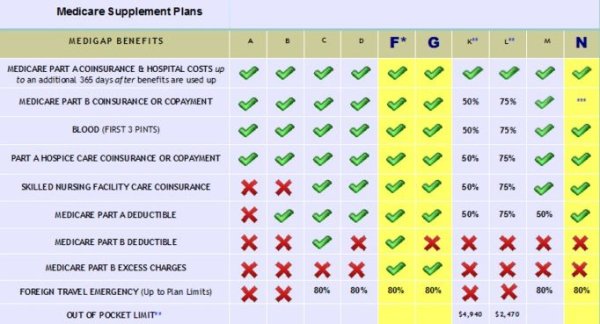
2017-Medicare-Supplement-Chart

NOTE: In the preceding chart, notice that the only difference between Plan F and Plan G is the $183 per calendar year Part B deductible.

SEP Situations

Here are some SEP situations that would guarantee you the right to switch back to Original Medicare and a Medicare Supplement plan:

  • The plan is leaving the Medicare program or stops service in your area.
  • You move out of the plan’s service area.
  • You leave the plan because the company has not followed certain rules or has misled you.
  • You decide to switch to Original Medicare within the first year of joining an MA plan when first eligible for Medicare Part A at age 65.

If you are in one of these situations, you cannot be turned down for Medicare Supplement insurance coverage, regardless of your health!

If You Are Not In a Special Enrollment Period

If you are not in a SEP, you will have to wait until the AEP (between October 15th and December 7th) to switch back to Original Medicare (Part A and Part B) on January 1st of the following year.

Although you can switch back to Original Medicare, there is no guarantee that you will be able to get a Medicare Supplement plan because you will be medically underwritten, and you must be in relatively good health to qualify for a Medicare Supplement plan.

If You Have Serious Health Conditions, You May Not Be Able to Get a Medicare Supplement Plan!

If you are not in a SEP and you are coming off of an MA plan during the AEP, you would normally have to meet minimum underwriting requirements to qualify for a Medicare Supplement plan, and you could be turned down for coverage.

If you live in California and you have serious health issues, more than likely, I can still get you a Medicare Supplement without having to answer any medical questions on the application! Call me for more details!

The Pros and Cons of MA Plans and Medicare Supplement Plans

Is there really an advantage to having a Medicare Advantage plan? Let’s take a look at the pros and cons of each, and you can decide for yourself.

Pros-and-Cons-of-Alternative-Lending

MA Plan Advantages

Here are some benefits of having an MA plan:

  1. MA premiums can be very low, and some plans have no monthly premiums at all.
  2. Some MA plans include Medicare prescription drug coverage (Part D).
  3. Maximum OOP costs are “limited.” Plans vary, but in 2017, the most you can pay in OOP costs is $6,700 per calendar year. (I wouldn’t really call this a “benefit” since $6,700 is a lot of money! With a Plan F Medicare Supplement, you won’t pay any OOP costs!)
  4. Some MA plans offer additional benefits such as vision, hearing, dental, and other health and wellness programs. (Note that some Medicare Supplement plans also offer additional benefits such as free gym memberships, vision, and hearing aid benefits.)

Medicare Supplement Plan Advantages

Here are some benefits of having a Medicare Supplement plan:

  1. You have much more FREEDOM of choice with a Medicare Supplement than you do with an MA plan because you can go to ANY doctor, hospital, specialist, or care facility in the United States as long as they accept Medicare. (You can’t do that with an MA plan.)
  2. You have much for financial stability with a Medicare Supplement than an MA plan because there are no unexpected spikes in costs and OOP expenses for co-payments, hospitalizations, surgeries, chemotherapy, etc.
  3. With a Plan F or Plan G Medicare Supplement, other than your premiums, your maximum OOP costs in a calendar year will be either $0 (Plan F) or $183 (Plan G) per calendar year in 2017. With an MA plan, your maximum OOP costs can be as high as $6,700 per calendar year!
  4. Chemotherapy is very expensive. With an MA plan, you have to pay the entire 20% Medicare Part B co-payment for chemotherapy, which can cost thousands of dollars. With a Plan F or Plan G Medicare Supplement, the most you will pay for Chemotherapy is either $0 (Plan F) or $183 (Plan G)!
  5. You are not limited to a specific geographic region or a restrictive network of doctors, hospitals, specialists, care facilities, etc. like you are with an MA plan. With most MA plans, you must use their providers or you may pay more or all of the costs if you go out of their network.
  6. With a Medicare Supplement, you can go directly to the specialist of your choice, ANYWHERE in the United States, as long as they accept Medicare. With most MA plans, you must go through your primary care doctor first (the “gatekeeper”) before you can see a specialist within your network.
  7. There are no HMO or PPO plans or networks with Medicare Supplements. If you have an MA plan and you go to a doctor, other health care provider, facility, or supplier that doesn’t belong to the plan’s network for non‑emergency or non-urgent care services, your services may not be covered, or your costs could be higher.
  8. If you want to go to a renowned treatment center such as the MD Anderson Cancer Treatment Center in Texas, you can do so with any Medicare Supplement, as long as they accept Medicare. You can’t do that with most MA plans.
  9. If you move to another part of the country, you can keep your Medicare Supplement, but you cannot keep your MA plan if you move out of your network.
  10. There are only 10 “standardized” Medicare Supplement plans to choose from, (Plan A through Plan N). Since Medicare Supplements are standardized, the coverage and benefits for every Plan F, Plan G, etc. is exactly the same with every insurance carrier, so it’s much easier to shop around and compare “apples with apples.” MA plans are not standardized, and the co-payments, deductibles, out of pocket costs, etc. vary significantly between MA plans, and they change every year making them unnecessarily complicated and confusing.
  11. Your Medicare Supplement plan cannot be cancelled as long as you pay your premiums. MA plans are annual contracts, and they can be cancelled or benefits changed at the end of each calendar year.
  12. There are no provider networks with Medicare Supplements. With MA plans, providers can join or leave a plan’s provider network anytime during the year meaning that you could have to start shopping around for a new doctor while simultaneously undergoing Chemotherapy or other specialized medical treatments.
  13. There is no AEP for Medicare Supplements, and you don’t have to shop around every year and make sure that your coverage, co-payments, co-insurance, deductibles, and benefits haven’t changed since the previous year. If there are any Medicare changes from one calendar year to the next, your Medicare Supplement will automatically pay the difference.
  14. You can travel around the US for as long as you want (or even move to a different geographic location), and your Medicare Supplement cannot be cancelled for leaving your “service area.” With most MA plans, if you travel outside of the MA plan’s service area for more than six months, you could be disenrolled from the plan.
  15. With most Medicare Supplements, there are no co-payments when you go to the doctor. With most MA plans, you have to pay co-payments when you go to the doctor.
  16. With Medicare Supplements, pre-certification is not required for surgeries, etc. as long as the procedure is “medically necessary.” With most MA plans, pre-certification is required for surgeries or before getting expensive treatments.
  17. You can switch Medicare Supplement plans or insurance carriers any time of the year as long as you meet minimum health and underwriting requirements. With an MA plan, you can only join or leave an MA plan during the AEP. Otherwise, you are locked into your plan for the entire calendar year, except for certain circumstances, such as moving out of your plan’s service area, etc.)

As you can see, you are much better off with a Medicare Supplement plan than you are with a Medicare Advantage plan!

Conclusion

If you currently have a Medicare Advantage (MA) plan, you have given up your Original Medicare rights that you have worked so hard for, and you are compromising your freedom to go to the best doctors, hospitals, specialists, neurosurgeons, care facilities, etc. in the United States.

I would strongly urge you to switch back to Original Medicare and get a Medicare Supplement plan during the upcoming AEP, between October 15th and December 7th)! Contact me TODAY for more information or a free quote!

As an independent insurance agent specializing in Medicare Supplements, I work with ALL of the major insurance carriers, not one particular company. I will shop around for you, every year, and save you money on your Medicare Supplement insurance!

If you live in California and you have a serious medical condition, more than likely, I can still get you a Medicare Supplement at a competitive price without answering any of the health questions on the application!

I hope that you have found this article to be helpful and informative. Please feel free to forward this article to anyone who may be interested.

Your comments and feedback are appreciated! If you have any questions, please contact me… I’m always happy to help!

Thank you!

Ron Lewis
www.MedigapExpress.com
Ron@RonLewisInsurance.com
866.718.1600 (Toll-free)

Should You Sign Up for a Medicare Prescription Drug Plan?

I just turned 65 yesterday, August 20th, and my Medicare Part A (Hospital) and Part B (Medical), Medicare Supplement, and Medicare Prescription Drug Plan (PDP), also known as Part D, all started a few weeks ago on August 1st, 2017.

NOTE: For most people, their Medicare benefits usually begin on the 1st of the month when they turn 65.

Fortunately, I’m in pretty good health, and I only take two relatively inexpensive medications. Since there is a late enrollment penalty added to your monthly PDP premiums if you don’t sign up for a PDP when you are first eligible (turning 65 or starting Medicare Part B), I decided that I was going to at least sign up for the cheapest PDP to avoid the penalty later on.

Pills

How Much is the Part D Penalty?

The cost of the late enrollment penalty depends on how long you went without Part D or creditable prescription drug coverage.

According to the Medicare.gov website “Medicare calculates the penalty by multiplying 1% of the “national base beneficiary premium” ($35.63 in 2017) times the number of full, uncovered months you didn’t have Part D or creditable coverage. The monthly premium is rounded to the nearest $.10 and added to your monthly Part D premium.”

NOTE: The national base beneficiary premium may increase each year, so your penalty amount may also increase each year.

The late enrollment penalty is approximately $0.34 per month for every month you could have had prescription drug coverage but didn’t. For example, if you went 10 months without PDP coverage before you started a new PDP, the total penalty would be approximately $3.40 per month ($0.34 x 10 months) on top of the regular prescription drug plan monthly premium. Again, the penalty amount can increase in the future.

Part D Penalty

My Prescription Drug Plan Coverage — Before and After Medicare

Before I started on Medicare, I had some limited prescription drug plan coverage through my Affordable Care Act (Obamacare) health insurance, which wasn’t so “affordable.”

I take two medications: Fluticasone nasal inhaler and Levothyroxine. Through my previous pharmacy, the regular price of the Fluticasone was $56.80 per month, but with my Obamacare insurance, I was paying $20.00 per month. In addition to that, I was paying $12.68 per month for the Levothyroxine.

Altogether, before I started on Medicare, I was paying $32.68 per month for both prescriptions.

In contrast, I recently signed up with the Medicare “Humana Walmart Rx Plan” because it is currently the cheapest and most cost-effective drug plan for my particular situation. During the next Annual Enrollment Period (AEP), which is from October 15th through December 7th each year, I may sign up for a different PDP plan if I find another plan that is better than the one that I currently have.

Regardless of what PDP you currently have, you should always shop around every year during the AEP between October 15th and December 7th.

open-enrollment-street-sign

NOTE: I am not certified to sell prescription drug plans, and I am not recommending, endorsing, or promoting Humana or any particular insurance carrier. My primary focus and area of expertise is with Medicare Supplement insurance plans.

With my Humana PDP, I pay a monthly premium of $17 per month, and I have a $400 per calendar year deductible. However, the two prescriptions that I take are classified as
Tier 1 prescriptions, and under my current plan, Tier 1 and Tier 2 prescriptions are not subject to the deductible, so I don’t have to pay any deductibles for the two prescriptions that I take!

With my Humana PDP, I chose to have my prescriptions mailed to me every three months, so I no longer have to drive to the pharmacy to pick up my prescriptions each month. That’s a nice benefit too!

NOTE: In my particular situation, the mail-order option ended up costing me less than picking my prescriptions up from a pharmacy, but that isn’t always the case.

For the Fluticasone, I am currently paying $8.00 TOTAL for a three-month supply! That comes out to $2.67 per month! For the Levothyroxine, I do not have to pay anything other than my monthly premium!

As mentioned before, I am currently paying $17.00 per month for my Humana PDP premium, and my total out-of-pocket cost for my medications is $2.67 per month for a total cost of $19.67 per month. In contrast, I was paying $32.68 per month prior to Medicare just for my prescriptions, not including my not-so-reasonably-priced health insurance premium.

I am very happy with my Medicare prescription drug plan. For me, it is significantly better than the prescription coverage that I had before I was on Medicare.

happy

Is a Medicare Prescription Drug Plan Good for Everyone?

Fortunately for me, the prescriptions that I take are relatively inexpensive, but I know that isn’t the case for everyone. Some of my clients take a lot of expensive prescriptions, and a PDP doesn’t always save them money or else some of the prescriptions may not be covered at all by the PDP, which is very frustrating.

Some people don’t take any prescriptions at all, and they may question whether it makes sense to sign up for a PDP if they currently don’t need one, even though their health could (and probably will) change at some point in the future.

Because of the late enrollment penalty, I would still recommend signing up for the cheapest PDP, at least for the time being, if it isn’t a financial hardship.

NOTE: This blog addresses my experience with Medicare prescription drug plans. To read about my experience with Medicare Supplement insurance plans, please click here.

Everyone is different, and what is good for one person isn’t necessarily good for another. Should you sign up for a prescription drug plan? That is a personal decision and a question that only you can answer.

*************************

Please click the “Subscribe” button to be notified when I write future blogs.

I am an independent insurance agent specializing in Medicare Supplement insurance plans. I work with all the major insurance carriers in California, Washington, and several other states. If you have any questions, or if you would like for me to shop around for you to save you money on your Medicare Supplement insurance, please don’t hesitate to let me know!

Thank you!

Ron Lewis
www.MedigapExpress.com
Ron@RonLewisInsurance.com
866.718.1600 (Toll-free)

Hello Medicare, and Goodbye Obamacare!

In several months from now, a good friend of mine will be turning 65 years old. While he is not anxious to get any older than he already is, he is happy about one thing… he will be getting off of Obamacare and onto Medicare!

65th-birthday-latex-balloons

My friend used to have a really good, low-deductible health insurance plan that was very affordable. But under Obamacare, all of that changed. The quality of his health insurance decreased significantly while his Affordable Care Act (ACA) premiums, co-payments, and deductibles increased dramatically. But fortunately, he now has maternity coverage, which is something that he never had before! Sorry about the sarcasm!

Pregnant man

When he goes onto Medicare, it will be just the opposite; the quality of his health insurance will increase significantly while the cost of his premiums, co-payments, co-insurance, and deductibles will all decrease!

Current Coverage

For example, he currently has a Bronze 60 ACA plan. The annual deductible is $4,800 per calendar year if he goes to “participating” providers and $9,000 per calendar year if he goes to “non-participating” providers! According to his health plan, “You must pay all the costs up to the deductible amount before this plan begins to pay for covered services you use. The integrated deductible applies to both medical and pharmacy services.” Therefore, the deductibles apply to prescription drug coverage as well.

Once the deductible is met, my friend must pay 40% of the remaining costs until he has reached the maximum out-of-pocket (OOP) cost, which is $6,550 per calendar year for “participating” providers and $9,650 per calendar year for “non-participating” providers.

NOTE: According to his current health insurance plan, OOP costs do not include “Premiums, balance-billed charges, some co-payments, charges in excess of specified benefit maximums, and health care this plan doesn’t cover.” So, total OOP costs are really much higher than $6,550 or $9,650 per calendar year when you factor in premiums and other miscellaneous costs.

The deductible and OOP costs start all over again every January. If he got really sick in the last six months of the year, there is a real possibility that he could reach his maximum OOP costs of $6,550 (or $9,650) again in the first six months of the following year. That means that he could potentially have total OOP costs in excess of $13,100 to $19,300 in a twelve-month period, not including his premiums!

My friend has a subsidized plan through Covered California. Although he pays $268.52 per month for his Bronze 60 PPO plan, the full premium that others are paying for the same identical (non-subsidized) plan is $784.79 per month, which isn’t exactly cheap for a high-deductible, catastrophic plan! I’m pretty sure you can buy or lease a luxury automobile for a lot less than that!

Mercedes

Medicare Coverage

In contrast, he won’t have to pay anything for his Medicare Part A (Hospital) insurance, and he will pay $134.00 per month for his Medicare Part B (Medical) insurance. In addition to his Original Medicare, he will need to take out a Medicare Supplement plan to pick up the difference in co-payments, deductibles, and co-insurance that Medicare does not pay.

Medicare Supplement Coverage

Of the 10 standardized Medicare Supplement plans (aka Medigap plans because they pick up the “gaps” in coverage that are not covered by Medicare), Plan F and Plan G are the two best plans:

  • Plan F pays for ALL of the co-payments, deductibles, and co-insurance that is not covered by Medicare. With Plan F, there are NO DEDUCTIBLES OR OUT-OF-POCKET COSTS!
  • Plan G is identical to Plan F except for the $183 per calendar year deductible for outpatient treatment such as physician services, inpatient and outpatient medical and surgical services and supplies, physical and speech therapy, diagnostic tests, and durable medical equipment.

NOTE: In 2017, the Part B deductible is $183 per calendar year. This amount can change from year to year, but historically, it has been very stable. With Plan G, once you have met the $183 per calendar year deductible, there are no other out of pocket costs, and Plan G is exactly the same as Plan F. The monthly premiums for Plan G are usually significantly less than the monthly premiums for Plan F, so Plan G usually ends up being more cost effective than Plan F.

For this reason, many people with Plan F have been switching to Plan G. Also, beginning on January 1st, 2020, Plan F will no longer be available for new people who are turning 65.

Although my friend’s ACA health plan is a PPO, he is still restricted to doctors, specialists, hospitals, care facilities, etc. that are within his health plan’s network. If he goes out of the network or goes to “non-participating” providers, he pays even more!

With Original Medicare and Medicare Supplements, there are no networks, HMO’s, or PPO’s, so my friend will have much more freedom of choice than he presently has with his ACA plan.

freedom

With a Medicare Supplement plan, you can go to ANY doctor, specialist, care facility, or hospital in the United States, as long as they accept Medicare! If you later move to another state, you can keep your Medicare Supplement plan and use it ANYWHERE in the US!

Medicare Supplement Premiums

In California, Medicare Supplement rates are based primarily on your age and zip code. If my friend decides to splurge and go with Plan F (the “Cadillac” plan) he will have a $0 deductible and no out-of-pocket costs! For age 65, his monthly premium will be as low as $132.00 per month!

Rates can vary significantly between insurance carriers for the same identical plan and coverage, so it’s important to shop around every year!

If my friend wants to save money on his Medicare Supplement premiums by signing up with Plan G, his maximum calendar year deductible AND out-of-pocket costs combined will be $183 per calendar year, and his monthly premium will be as low as $119.36 per month!

Plan F or Plan G

Scenario #1 – Total Costs if My Friend Signs up with Plan F

If he decides to sign up with Plan F, the most expensive Medicare Supplement plan, his total monthly premiums for his Medicare Part A ($0), Medicare Part B ($134.00), and his Plan F Medicare Supplement ($132.00) will be $266.00 per month!

NOTE: If he wants to, my friend can also pick up a good Prescription Drug Plan (PDP) for $17.00 per month.

Scenario #2 – Total Costs if My Friend Signs up with Plan G

If he decides to sign up with Plan G, the most popular Medicare Supplement plan, his total monthly premiums for his Medicare Part A ($0), Medicare Part B ($134.00) and his Plan G Medicare Supplement ($119.36) will be $253.36 per month!

Conclusion

My friend is currently paying $268.52 per month for a high-deductible, catastrophic ACA health insurance plan that is basically worthless.

If he decides to sign up for a Plan F Medicare Supplement with no deductibles or out-of-pocket costs, his total cost for coverage under Medicare and his Medicare Supplement will be $266.00 per month!

If he decides to sign up for a Plan G Medicare Supplement with a $183 per calendar year deductible and no out-of-pocket costs, his total cost for coverage under Medicare and his Medicare Supplement will be $253.36 per month!

And now you know why my friend is smiling about his upcoming 65th birthday…
“Hello Medicare, and good riddance Obamacare!”

*****************************************************

Let me do the shopping for you and save you money on your Medicare Supplement! Contact me today for a for a free insurance quote and price comparison!

Ron Lewis
www.MedigapExpress.com
Ron@RonLewisInsurance.com
866.718.1600 (Toll-free)

Upcoming Changes for Medicare Supplement Plan F and Plan C in 2020

Change Image

As of January 1st, 2020, “newly eligible” Medicare beneficiaries will no longer be able to purchase Plan F and Plan C Medicare Supplement plans, which are also known as “Medigap” plans because they pick up the “gaps” in coverage that Medicare doesn’t cover.

NOTE: The high-deductible Plan F Medigap plan is also going away.

Individuals that are signing up for Medicare on or after January 1st, 2020, will not be able to sign up for any Medigap plan that covers the Medicare Part B deductible, which is currently $183 per calendar year in 2017.

Of the 10 “standardized” Medigap plans, Plan F and Plan C are the only two plans that cover the Part A (Hospital) and Part B (Medical) deductibles and coinsurance in full. These two plans are the only Medigap plans that offer “first-dollar” coverage for every doctor or hospital visit.

Why Are Plan F and Plan C Going Away?

These changes are taking place because of Section 401 in the Medicare Access and CHIP Reauthorization Act (MACRA) of 2015, which is also known as the “doc fix” law. To view the text, please click here.

In a nutshell, Nutshell ImageCongress passed this legislation to ensure that doctors would be paid adequately for providing Medicare services and to provide an incentive for doctors to continue accepting Medicare patients. Previous legislation had budgeted for doctors to have rate decreases over the years and there was concern that many doctors would stop accepting Medicare patients.

Because of the ever-increasing cost of medical care and the fact that more than 10,000 baby-boomers are turning 65 every day, Medicare is experiencing increased financial strain. Since individuals with Plan F and Plan C have no co-payments or deductibles, lawmakers fear that this lack of cost-sharing results in Medicare abuse, which is driving up costs.

It has been argued that the “first dollar” coverage available from Plan F and Plan C cause Medicare recipients to see their doctors more frequently than they would if they didn’t have all of their deductibles covered and had to pay some out-of-pocket costs when they did go to the doctor. Some claim that these changes will save Medicare billions of dollars each year in medical claim exposure.

In an effort to control costs by reducing claims, Congress has decided that it makes more sense for Medicare recipients to be responsible for more of their out-of-pocket medical expenses. Consequently, Congress has decided to eliminate Plan F and Plan C because they want Medicare beneficiaries to have more “skin in the game.”

No one knows if these measures will really reduce Medicare’s overall annual costs. Some argue that Medicare beneficiaries may end up waiting to get medical care for serious issues, which would ultimately cost Medicare more money in the future.

free-money

What Happens If I Have Plan F or Plan C Before January 2020?

Since the MACRA only prohibits the sale of Medigap Plan F and Plan C to “newly eligible” Medicare beneficiaries on or after January 1st, 2020, if you already have one of these plans in 2020, you will be exempted and “grandfathered” in. You will not lose your coverage!

You will still be able to purchase Plan F and Plan C policies from other insurance carriers after 2020 as long as you can medically qualify or if you are in an Open Enrollment or Guaranteed Issue situation.

If you were eligible for Medicare prior to 2020, but you delayed getting it because you are still working and have employer insurance, you will still be able to enroll in Plan F or Plan C after you stop working and switch back to Medicare.

What Happens If I Won’t Be Eligible for Medicare Until After January 2020?

For those individuals who will not be eligible for Medicare until January 1st, 2020 or later, although you will not be able to get Plan F, you will still be able to get Plan G, which is an excellent Medigap plan that is identical to Plan F in every way except for the $183 per calendar year deductible.

Today, many people that have Plan F have been switching to Plan G because the premiums for Plan G are usually significantly less than the premiums for Plan F. In most cases, Plan G will cost you less and is usually more cost effective, even if you pay for the entire Part B deductible!

Shop Around Every Year!

Since Medicare Supplement rates vary significantly between insurance carriers for the same identical plans and coverage, and since the rates in most states are based on your “attained” age, and they usually go up in price each year, it’s important to shop around every year, preferably during the 30 days before your birthday.

grocery cart image

If you live in California, there is a law called the “California Birthday Rule.” This law guarantees you the right to switch “like for like” Medigap plans, such as Plan F for Plan F, or you can switch to any other Medigap plan with fewer benefits, such as from Plan F to Plan G, etc. You can do this every yearREGARDLESS OF YOUR HEALTH, during the 30 days following your birthday! Most insurance carriers in California let you do this during the 30 days before or after your birthday.

Whether you decide to keep your current Plan C or Plan F, or if you want to find out how much you can save by switching to Plan G, you should take advantage of the California Birthday Rule and compare rates every year to make sure that you aren’t paying too much!

If you have any questions or comments, or if you’d like a free quote or rate comparison, please visit www.MedigapExpress.com or call my cell at (760) 525-5769 or (866) 718-1600 (Toll-free).

Thank you!

Ron Lewis

Medicare Supplements – Why Pay Wholesale When You Can Pay Retail?

Yes, you read the title correctly. When it comes to Medicare Supplement plans, which are also known as Medigap plans because they pay for the “gaps” in coverage that are not paid for by Medicare, some of my clients prefer to pay retail instead of wholesale! That’s right, “Why pay less when you can pay more?”

retail

Most people that I meet are very happy to save a lot of money on their insurance premiums, but there are always some that really don’t seem to care. Or maybe they are skeptical because it just “seems too good to be true,” which I can totally understand.

A Tale of Two Cities, I Mean Two Clients…

I was working with two different clients yesterday, Client “A” and Client “B.”

two clients

Client “A”

Client “A” has Plan F with Blue Shield of CA, and his monthly premium is $279 per month. I shopped around for him and found several other insurance carriers that are offering Plan F at much lower rates. The lowest rate that I found for him is $179.33 per month. That is a savings of $99.67 per month or $1,196.04 per year for the same identical plan and coverage!

Many people who have Plan F have been switching to Plan G because both plans are identical except there is no deductible with Plan F, and there is a small $166 (Part B) deductible with Plan G. That is the only difference between the two plans!

However, Plan G is usually much more cost effective (cheaper) because the rates are lower. So even if you pay the $166 deductible, in most cases, you still end up spending much less money with Plan G than Plan F.

In addition to getting the current Plan F rates for Client “A,” I also provided him with the current Plan G rates for comparison. If he switched from Plan F to Plan G, he would have saved even more money! The best Plan G rate is $156.70 per month. That would be a gross savings of $122.30 per month or $1,467.60 per year! If he spent the $166 deductible, his net savings would still be $1,301.60 per year! In this particular case, Client “A” would have saved even more money by switching from Plan F to Plan G.

Inexplicably, Client “A” decided to keep his current plan for another year!

Client “B”

Client “B” also has Plan F with Blue Shield of CA, and her rate is $219 per month. I shopped around for her and, like Client “A,” I found several other insurance carriers that are also offering Plan F at much lower rates. The lowest rate that I found for Client “B” is $170.99 per month. That is a savings of $48.01 per month or $576.12 per year for the same identical Medicare Supplement plan and coverage!

Client “B” also had the option to switch from Plan F to Plan G, and again, she would have saved even more money on her premiums by doing so. Her current Plan F rate is $219 per month, and the best Plan G rate for her is $147.19 per month. That would be a gross savings of $71.23 per month or $854.76 per year! If she spent the entire $166 deductible, her net savings per year would still be $688.76 per year!

Just like Client “A,” Client “B” also decided to keep her current plan for another year!

Some Common Misconceptions

It’s very baffling to me when I can literally save someone hundreds and even thousands of dollars a year on their premiums for the same exact plan and coverage, and for whatever reason they are not interested in doing so.

If my auto and homeowner’s insurance agent told me he could save me $100 a month on my premiums, I would be thrilled to be able to save that much money. I guess that some people just aren’t as happy about saving money as I am!

Save-Money

Misconception #1 – By Switching Medigap Plans, I Won’t Be Able to Go to the Same Doctors

Some people are reluctant to change Medigap plans because they are afraid that they won’t be able to continue seeing the same doctors. This is a misconception because you can go to ANY doctor or hospital in the US with your Medicare Supplement as long as the doctor or hospital accepts Medicare. If your doctor accepts your current Medicare Supplement plan, then they have to accept ANY Medigap plan or insurance carrier that you have, PERIOD.

Misconception #2 – The Rates Are Too Good to Be True

If the new rates are significantly lower than the current plan, some people think it’s either too good to be true or a huge rate increase is soon to follow. This is also a misconception because most of the carriers that I work with lock in their rates for the first 12 months, so there wouldn’t be any unexpected rate increases.

Misconception #3 – My Coverage Will Not Be the Same

Another common misconception is that the coverage will not be the same, even if someone is switching from Plan F to Plan F or Plan G to Plan G, etc. There are 10 “standardized” plans to choose from, Plan A through Plan N. This means that the coverage for every standardized plan is exactly the same with every insurance carrier. So if someone has Plan F with Blue Shield and they want to switch to Plan F with Mutual of Omaha, etc., the coverage is exactly the same. Plan F is Plan F is Plan F…Period!

One of the other reasons people don’t want to switch their Medicare Supplement plan is because they fear change. “Everything has been going great so far. Even though the rates are cheaper and the coverage is the same, why take a chance by going with a different carrier?”

If you decide to switch carriers, the transition is seamless. Your coverage with the first insurance carrier will end at the end of the month, and the new coverage begins on the 1st of the following month. There are no forms or paperwork to fill out. When you go to the doctor after your new coverage begins, they will make a copy of your new Medicare Supplement card, and after that, everything will be the same as before.

The California Birthday Rule

In California, there is a law called the California Birthday Rule. If you have a Medicare Supplement, you are lucky to live in California for more reasons than just the beautiful weather and the great beaches!

happy-birthday

This law guarantees you the right to switch insurance carriers, EVERY YEAR, within 30 days of your birthday (before or after) REGARDLESS OF YOUR HEALTH and without answering any health questions on the application! This is known as your annual open enrollment period. If another insurance carrier is offering the same plan that you currently have, or if they are offering another plan that has fewer benefits, you are guaranteed the right to switch carriers every year if you want to, and you cannot be turned down due to health reasons.

For example, if you have Plan F and another carrier is offering Plan F for a lower rate, you are guaranteed the right to switch to the other carrier every year around your birthday, without answering any health questions on the application. Likewise, you are guaranteed the right to switch to a plan with fewer benefits as well. So if you have Plan F, which has the most comprehensive coverage, you could switch to Plan G if you want to because Plan G has fewer benefits than Plan F.

NOTE: Under the California Birthday Rule, if you have Plan F, you can switch to any other plan, but if you have any other plan, you cannot use the California Birthday Rule to switch to Plan F because it has more benefits than any other plan.

You can actually switch insurance carriers or plans any time of the year, but if you do so at any time other than during the 30 days before or after your birthday, you will have to answer the health questions on the application, you will be medically underwritten, and you could be turned down for coverage due to medical reasons. If you have any serious health conditions, you should apply during the 30 days before your birthday!

In most other states, there isn’t a birthday rule. That means that once you sign up, if you later develop any serious health issues, you would have to meet minimum health and underwriting requirements if you wanted to change your Medicare Supplement plan or your insurance carrier. If your insurance rates increased significantly, you could be stuck paying very high premiums for many years! In California, that would never happen because you can always change your insurance every year around your birthday, regardless of your health!

Rates Vary Significantly Between Insurance Carriers For the Same Identical Plans and Coverage

In California, rates are based on “attained age,” which means that your rates are based on your current age, and they usually go up in price every year as you get older. As mentioned before, there are 10 “standardized” Medicare Supplement plans to choose from, Plan A through Plan N. When I say “standardized,” that means that the coverage for Plan F, Plan G, etc. is exactly the same no matter which insurance carrier that you are with.

Although the coverage is exactly the same with every insurance carrier, the rates (prices) vary significantly between insurance carriers!

dollars

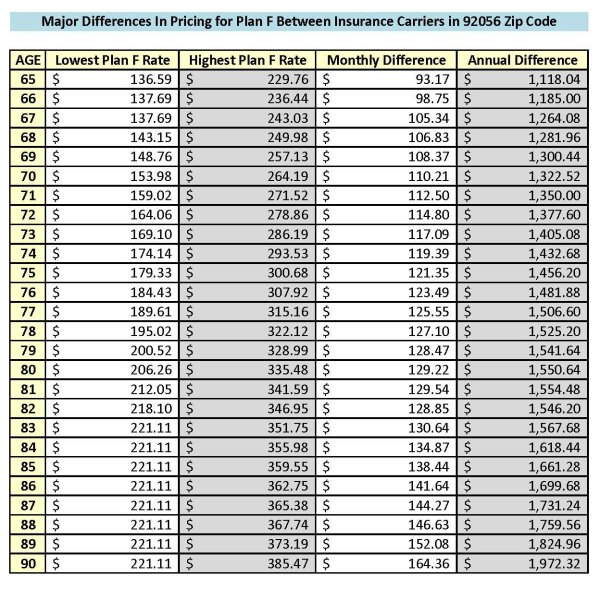
For example, in the 92056 zip code the Plan F rates for a 72 year old man range in price from $164.06 to $278.86 per month! That is a difference of $1,377.60 per year for the same exact plan and coverage! In other words, some 72 year old individuals in the 92056 zip code are paying $164.06 per month for their Plan F coverage while others are paying $278.86 per month for their Plan F coverage!

Examples of How I Recently Saved Clients Money By Switching From Plan F to Plan F

Here are some examples of how I took advantage of the California Birthday Rule and saved my clients a lot of money on their annual premiums by switching them from Plan F with one carrier to Plan F with a different carrier:

  • $142.08
  • $257.64
  • $334.08
  • $338.64
  • $349.68
  • $432.84
  • $498.24
  • $501.78
  • $501.78
  • $516.96
  • $536.76
  • $879.84
  • $1,003.56

Examples of How I Recently Saved Clients Money By Switching From Plan F to Plan G

Here are some other examples of how I took advantage of the California Birthday Rule and saved my clients a lot in their annual premiums by switching them from Plan F with one carrier to Plan G with a different carrier:

  • $203.12
  • $278.96
  • $349.16
  • $425.48
  • $462.68
  • $600.00

Although it’s not the norm, the most I have ever saved one of my clients, a married couple, was over $5,300 per year just by switching from Plan G with one insurance carrier to Plan G with a different insurance carrier! As you can see, it’s really important to shop around and compare rates!

Sometimes I Feel Like “I Get No Respect!”

Once in a while, however, I feel like Rodney Dangerfield because “I get no respect!” Most of my clients are 65 or over and many are retired and on fixed incomes. The majority are very receptive to saving money on their insurance premiums, but once in a while, I have to practically beg people to let me save them hundreds and even thousands of dollars a year on their premiums, and quite honestly, that drives me crazy!

Rodney_Dangerfield2

For whatever reasons, some people, like Client “A” and Client “B,” are apparently not so budget conscious. I was very excited and happy to tell them how much money I could save them, and their response was basically “Let me think about it!”

Think about it? Really? What is there to think about! It seems to me that it’s pretty much a no-brainer. I can hear them now. “Do I want to save $1,200 per year on my premiums for the same exact plan and coverage? Hmm, this is really a tough one. What am I going to do with an extra $100 a month? This might complicate my taxes! Eh, who needs this kind of stress and aggravation!”

stress

I don’t want any of my clients to feel stressed or aggravated! If you’re one of those individuals that prefer to pay wholesale instead of retail, instead of the other way around, please don’t hesitate to contact me if you have any questions or if I can help in any way. If you’d like me to, I’m happy to do the shopping for you, EVERY YEAR, to save you money on your Medicare Supplement insurance!

NOTE: Although this article focuses primarily on Medigap plans in California, I am licensed and work with Medicare Supplement insurance plans outside of California as well. If you need premium rates for other states, I am happy to provide you with that information as well.

If you or someone that you know would like a free quote, please let me know. If you know anyone that might enjoy reading this blog, please feel free to forward it on! And please feel free to send me any of your questions, comments, and feedback!

Thank you,

Ron Lewis

Major Medicare Supplement Rate Discrepancies Between Insurance Carriers!

Do you know that Medicare Supplement (MediGap) rates vary significantly between insurance carriers for the same identical plan and coverage? In the US, there are 10 “standardized” Medicare Supplement plans to choose from, plans A through N.

medigap

NOTE: The plans are labeled A, B, C, D, F, G, K, L, M and N to signify the plan differences. (Plans E, H, I and J are no longer available.)

The word “standardized” means that the coverage for Plan F, Plan G, etc. is exactly the same no matter what insurance carrier you have. For example, the coverage for Plan F is exactly the same with Mutual of Omaha, UnitedHealthcare, Blue Shield of CA, Aetna, Cigna, Anthem Blue Cross,  etc.

Although the coverage is exactly the same between insurance carriers for the standardized plans, the PREMIUMS ARE NOT THE SAME! In fact, most people are paying hundreds of dollars per year more for their insurance premiums than they should be!

For example, the Plan F premiums for a 70 year old living in the 92056 zip code in San Diego range in price from $153.98 per month to $264.19 per month. That’s a difference of $110.21 per month or $1,322.52 per year for the same identical plan and coverage! On the following rate sheet, you can see the different Plan F rates for 18 different insurance carriers in the 92056 zip code. Obviously, some carriers are more competitively priced than others!

Mary Jones Plan F Rates_Page_1

Mary Jones Plan F Rates_Page_2

As you can see, in the 92056 zip code, the Plan F rates for a 70 year old range in price from $153.98 per month to $264.19 per month! Again, that’s a difference of $110.21 per month or $1,322.52 per year for the same exact plan and coverage!

It’s Important to Shop Around Every Year!

The Medicare Supplement market is constantly changing, and so are the premiums. If you have a Medicare Supplement and you haven’t shopped around during the last year, there’s a good chance that you’re paying hundreds of dollars a year more for your insurance than you should be! Many people that I meet haven’t shopped around at all since they first signed up for Medicare! Many of these individuals haven’t heard from their insurance agent since then as well!

This past year, two of my clients (a husband and wife) had Plan G, and they were paying $809 per month for both of them, approximately $404.50 each! I shopped around for them and found them Plan G with a different carrier, Mutual of Omaha, and their total monthly premium is now $367.01 per month! That’s a savings of $441.99 per month or $5,303.88 per year! While this is not the norm, I can usually save most of my clients from $300 to $600 per year each on their Medicare Supplement insurance premiums and often more.

What is the Price Range for Plan F Medicare Supplement Rates?

In the following chart, I have taken the lowest and highest Plan F premiums for ages 65 through 90 in the 92056 zip code. As you can see, the monthly and annual differences are significant for every age group.

2 Lowest Plan F vs Highest Plan F

Is There An Open Enrollment Period for Medicare Supplement Plans?

No. Unlike Medicare Advantage (MA) plans, which have an annual open enrollment period from October 15th through December 7th every year, you can shop around and apply for Medicare Supplement plans all year long.

NOTE: There is a six month-open enrollment period for Medicare Supplements when you first sign up for Medicare Part B.

Do I Need to Be In Good Health to Get a New Medicare Supplement Plan?

Unless you are in a Special Enrollment Period (SEP), if you already have a Medicare Supplement, you need to be in relatively good health to apply for a new Medicare Supplement with a different carrier. However, if you have a Medicare Supplement and you apply during the 30 days before or after your birthday, you don’t have to answer any health questions on the application, and you cannot be turned down due to health reasons if you apply for the same plan or another plan with fewer benefits. For more details, please see the California Birthday Rule section below.

Heart

What Happens If I Am Not In Good Health? Can I Still Apply For a New Medicare Supplement Plan?

Yes, absolutely! Because of the California Birthday Rule, if you already have a Medicare Supplement and you have serious health issues, YOU CANNOT BE TURNED DOWN FOR COVERAGE if you apply during the 30 days before or after your birthday.

California Birthday Rule

In California, there is a law called the California Birthday Rule. This law guarantees you the right to apply for a new Medicare Supplement plan EVERY YEAR, as long as you apply during the 30 days following your birthday. This is also known as the annual 30-day open enrollment period.

NOTE: Although the California Birthday Rules specifies that you can apply, REGARDLESS OF YOUR HEALTH, during the 30 days following your birthday without being turned down for coverage, several insurance carriers will let you apply during the 30 days BEFORE or AFTER your birthday!

This is more advantageous for you because the premiums with these carriers are based on your current age when you apply, and your rates will be lower if you apply during the 30 days prior to your birthday. With these carriers, your new rates are also guaranteed and locked in for the first 12 months of your policy, so there won’t be any unexpected rate increases.

NOTE: Not all insurance carriers lock your rates for the first 12 months.

If you want to take advantage of the California Birthday Rule and apply during the 30 days before or after your birthday,  YOU CANNOT BE TURNED DOWN FOR COVERAGE as long as you apply for the same plan that you currently have OR if you apply for a different plan that has fewer benefits. For example, if you have Plan F (the most comprehensive plan) and you want to apply for Plan F with another carrier to save money on your premiums, or if you have Plan F and you want to apply with Plan G, etc.

NOTE: If you apply under the California Birthday Rule, there are no preexisting waiting periods for prior health conditions.

If you are in relatively good health, you can apply for a new Medicare Supplement plan any time of the year. If you have serious health issues, you should take advantage of the California Birthday Rule and apply for coverage during the 30 days before your birthday to save money on your premiums.

Consider Plan G to Save More Money On Your Premiums

Besides shopping around every year to make sure that you aren’t paying too much for your premiums, if you currently have Plan F, you should consider Plan G. Why? Because Plan G is identical to Plan F in EVERY way except you would pay a small $166 Part B (Medical) deductible one time per calendar year. That is the only difference between the two plans!

NOTE: I have an Obamacare Bronze plan, and my individual medical deductible is only $6,000 per year! I would gladly pay $166 per year for my medical deductible!

In other words, the most you would pay for any out-of-pocket expense with Plan G in any calendar year is $166. However, in most cases, you will save significantly more than $166 per year on your premiums, which usually makes Plan G a better value and more cost effective.

NOTE: The Part B (Medical) deductible is subject to change each year, but historically, it has remained stable.

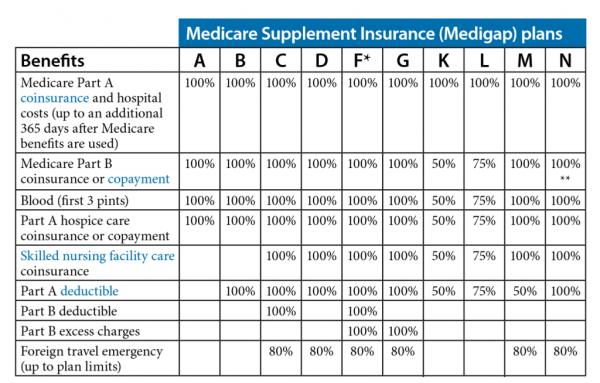
To see the difference in coverage between Plan F and Plan G, please see the following chart:

Medigap Chart Plans F and G

As you can see, when you compare Plan F and Plan G, everything is exactly the same except for the $166 Part B deductible. Plan F has no deductible, and Plan G is basically Plan F with a small, $166 deductible.

Price Differences Between Plan F and Plan G

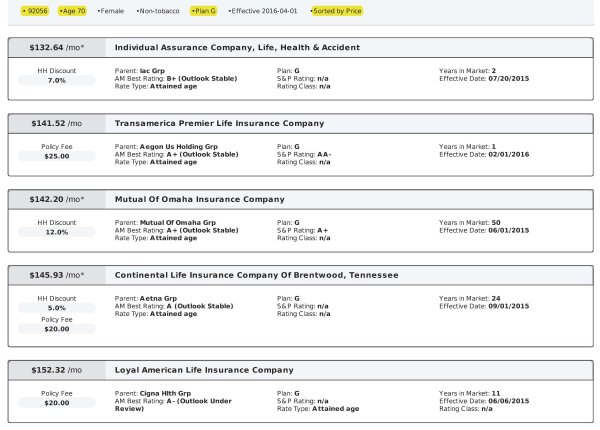
Although the two plans are almost identical in coverage, the rates for Plan G are usually significantly less than the Plan F rates. For a 70 year old in the 92056 zip code, the Plan F rates (above) range in price from $153.98 per month to $264.19 per month. The Plan G rates (below) range in price from $132.64 per month to $152.32 per month!

Plan F or Plan G

Plan G Rates Age 70

As you can see, the Plan G rates are significantly less than the Plan F rates for almost the same identical coverage.

Conclusion

The rates vary significantly from one insurance carrier to the next for the same identical plan and coverage. I recommend that you take advantage of the California Birthday Rule and shop around, every year, to make sure that you aren’t paying too much for your insurance. I would also suggest that you check out Plan G as another way to save a lot of money on your insurance premiums.

If you have any questions, or if you would like a free, no obligation quote, please don’t hesitate to let me know! I’m always happy to help!

Ron Lewis OHCC AD

Also, your feedback and comments are appreciated!

Thanks!

Ron Lewis
Ron@RonLewisInsurance.com
(760) 525-5769 – Cell
(866) 718-1600 – Toll-free