Hello Medicare, and Goodbye Obamacare!

In several months from now, a good friend of mine will be turning 65 years old. While he is not anxious to get any older than he already is, he is happy about one thing… he will be getting off of Obamacare and onto Medicare!

65th-birthday-latex-balloons

My friend used to have a really good, low-deductible health insurance plan that was very affordable. But under Obamacare, all of that changed. The quality of his health insurance decreased significantly while his Affordable Care Act (ACA) premiums, co-payments, and deductibles increased dramatically. But fortunately, he now has maternity coverage, which is something that he never had before! Sorry about the sarcasm!

Pregnant man

When he goes onto Medicare, it will be just the opposite; the quality of his health insurance will increase significantly while the cost of his premiums, co-payments, co-insurance, and deductibles will all decrease!

Current Coverage

For example, he currently has a Bronze 60 ACA plan. The annual deductible is $4,800 per calendar year if he goes to “participating” providers and $9,000 per calendar year if he goes to “non-participating” providers! According to his health plan, “You must pay all the costs up to the deductible amount before this plan begins to pay for covered services you use. The integrated deductible applies to both medical and pharmacy services.” Therefore, the deductibles apply to prescription drug coverage as well.

Once the deductible is met, my friend must pay 40% of the remaining costs until he has reached the maximum out-of-pocket (OOP) cost, which is $6,550 per calendar year for “participating” providers and $9,650 per calendar year for “non-participating” providers.

NOTE: According to his current health insurance plan, OOP costs do not include “Premiums, balance-billed charges, some co-payments, charges in excess of specified benefit maximums, and health care this plan doesn’t cover.” So, total OOP costs are really much higher than $6,550 or $9,650 per calendar year when you factor in premiums and other miscellaneous costs.

The deductible and OOP costs start all over again every January. If he got really sick in the last six months of the year, there is a real possibility that he could reach his maximum OOP costs of $6,550 (or $9,650) again in the first six months of the following year. That means that he could potentially have total OOP costs in excess of $13,100 to $19,300 in a twelve-month period, not including his premiums!

My friend has a subsidized plan through Covered California. Although he pays $268.52 per month for his Bronze 60 PPO plan, the full premium that others are paying for the same identical (non-subsidized) plan is $784.79 per month, which isn’t exactly cheap for a high-deductible, catastrophic plan! I’m pretty sure you can buy or lease a luxury automobile for a lot less than that!

Mercedes

Medicare Coverage

In contrast, he won’t have to pay anything for his Medicare Part A (Hospital) insurance, and he will pay $134.00 per month for his Medicare Part B (Medical) insurance. In addition to his Original Medicare, he will need to take out a Medicare Supplement plan to pick up the difference in co-payments, deductibles, and co-insurance that Medicare does not pay.

Medicare Supplement Coverage

Of the 10 standardized Medicare Supplement plans (aka Medigap plans because they pick up the “gaps” in coverage that are not covered by Medicare), Plan F and Plan G are the two best plans:

  • Plan F pays for ALL of the co-payments, deductibles, and co-insurance that is not covered by Medicare. With Plan F, there are NO DEDUCTIBLES OR OUT-OF-POCKET COSTS!
  • Plan G is identical to Plan F except for the $183 per calendar year deductible for outpatient treatment such as physician services, inpatient and outpatient medical and surgical services and supplies, physical and speech therapy, diagnostic tests, and durable medical equipment.

NOTE: In 2017, the Part B deductible is $183 per calendar year. This amount can change from year to year, but historically, it has been very stable. With Plan G, once you have met the $183 per calendar year deductible, there are no other out of pocket costs, and Plan G is exactly the same as Plan F. The monthly premiums for Plan G are usually significantly less than the monthly premiums for Plan F, so Plan G usually ends up being more cost effective than Plan F.

For this reason, many people with Plan F have been switching to Plan G. Also, beginning on January 1st, 2020, Plan F will no longer be available for new people who are turning 65.

Although my friend’s ACA health plan is a PPO, he is still restricted to doctors, specialists, hospitals, care facilities, etc. that are within his health plan’s network. If he goes out of the network or goes to “non-participating” providers, he pays even more!

With Original Medicare and Medicare Supplements, there are no networks, HMO’s, or PPO’s, so my friend will have much more freedom of choice than he presently has with his ACA plan.

freedom

With a Medicare Supplement plan, you can go to ANY doctor, specialist, care facility, or hospital in the United States, as long as they accept Medicare! If you later move to another state, you can keep your Medicare Supplement plan and use it ANYWHERE in the US!

Medicare Supplement Premiums

In California, Medicare Supplement rates are based primarily on your age and zip code. If my friend decides to splurge and go with Plan F (the “Cadillac” plan) he will have a $0 deductible and no out-of-pocket costs! For age 65, his monthly premium will be as low as $132.00 per month!

Rates can vary significantly between insurance carriers for the same identical plan and coverage, so it’s important to shop around every year!

If my friend wants to save money on his Medicare Supplement premiums by signing up with Plan G, his maximum calendar year deductible AND out-of-pocket costs combined will be $183 per calendar year, and his monthly premium will be as low as $119.36 per month!

Plan F or Plan G

Scenario #1 – Total Costs if My Friend Signs up with Plan F

If he decides to sign up with Plan F, the most expensive Medicare Supplement plan, his total monthly premiums for his Medicare Part A ($0), Medicare Part B ($134.00), and his Plan F Medicare Supplement ($132.00) will be $266.00 per month!

NOTE: If he wants to, my friend can also pick up a good Prescription Drug Plan (PDP) for $17.00 per month.

Scenario #2 – Total Costs if My Friend Signs up with Plan G

If he decides to sign up with Plan G, the most popular Medicare Supplement plan, his total monthly premiums for his Medicare Part A ($0), Medicare Part B ($134.00) and his Plan G Medicare Supplement ($119.36) will be $253.36 per month!

Conclusion

My friend is currently paying $268.52 per month for a high-deductible, catastrophic ACA health insurance plan that is basically worthless.

If he decides to sign up for a Plan F Medicare Supplement with no deductibles or out-of-pocket costs, his total cost for coverage under Medicare and his Medicare Supplement will be $266.00 per month!

If he decides to sign up for a Plan G Medicare Supplement with a $183 per calendar year deductible and no out-of-pocket costs, his total cost for coverage under Medicare and his Medicare Supplement will be $253.36 per month!

And now you know why my friend is smiling about his upcoming 65th birthday…
“Hello Medicare, and good riddance Obamacare!”

*****************************************************

Let me do the shopping for you and save you money on your Medicare Supplement! Contact me today for a for a free insurance quote and price comparison!

Ron Lewis
www.MedigapExpress.com
Ron@RonLewisInsurance.com
866.718.1600 (Toll-free)

Upcoming Changes for Medicare Supplement Plan F and Plan C in 2020

Change Image

As of January 1st, 2020, “newly eligible” Medicare beneficiaries will no longer be able to purchase Plan F and Plan C Medicare Supplement plans, which are also known as “Medigap” plans because they pick up the “gaps” in coverage that Medicare doesn’t cover.

NOTE: The high-deductible Plan F Medigap plan is also going away.

Individuals that are signing up for Medicare on or after January 1st, 2020, will not be able to sign up for any Medigap plan that covers the Medicare Part B deductible, which is currently $183 per calendar year in 2017.

Of the 10 “standardized” Medigap plans, Plan F and Plan C are the only two plans that cover the Part A (Hospital) and Part B (Medical) deductibles and coinsurance in full. These two plans are the only Medigap plans that offer “first-dollar” coverage for every doctor or hospital visit.

Why Are Plan F and Plan C Going Away?

These changes are taking place because of Section 401 in the Medicare Access and CHIP Reauthorization Act (MACRA) of 2015, which is also known as the “doc fix” law. To view the text, please click here.

In a nutshell, Nutshell ImageCongress passed this legislation to ensure that doctors would be paid adequately for providing Medicare services and to provide an incentive for doctors to continue accepting Medicare patients. Previous legislation had budgeted for doctors to have rate decreases over the years and there was concern that many doctors would stop accepting Medicare patients.



Because of the ever-increasing cost of medical care and the fact that more than 10,000 baby-boomers are turning 65 every day, Medicare is experiencing increased financial strain. Since individuals with Plan F and Plan C have no co-payments or deductibles, lawmakers fear that this lack of cost-sharing results in Medicare abuse, which is driving up costs.

It has been argued that the “first dollar” coverage available from Plan F and Plan C cause Medicare recipients to see their doctors more frequently than they would if they didn’t have all of their deductibles covered and had to pay some out-of-pocket costs when they did go to the doctor. Some claim that these changes will save Medicare billions of dollars each year in medical claim exposure.

In an effort to control costs by reducing claims, Congress has decided that it makes more sense for Medicare recipients to be responsible for more of their out-of-pocket medical expenses. Consequently, Congress has decided to eliminate Plan F and Plan C because they want Medicare beneficiaries to have more “skin in the game.”

No one knows if these measures will really reduce Medicare’s overall annual costs. Some argue that Medicare beneficiaries may end up waiting to get medical care for serious issues, which would ultimately cost Medicare more money in the future.

free-money

What Happens If I Have Plan F or Plan C Before January 2020?

Since the MACRA only prohibits the sale of Medigap Plan F and Plan C to “newly eligible” Medicare beneficiaries on or after January 1st, 2020, if you already have one of these plans in 2020, you will be exempted and “grandfathered” in. You will not lose your coverage!

You will still be able to purchase Plan F and Plan C policies from other insurance carriers after 2020 as long as you can medically qualify or if you are in an Open Enrollment or Guaranteed Issue situation.

If you were eligible for Medicare prior to 2020, but you delayed getting it because you are still working and have employer insurance, you will still be able to enroll in Plan F or Plan C after you stop working and switch back to Medicare.

What Happens If I Won’t Be Eligible for Medicare Until After January 2020?

For those individuals who will not be eligible for Medicare until January 1st, 2020 or later, although you will not be able to get Plan F, you will still be able to get Plan G, which is an excellent Medigap plan that is identical to Plan F in every way except for the $183 per calendar year deductible.

Today, many people that have Plan F have been switching to Plan G because the premiums for Plan G are usually significantly less than the premiums for Plan F. In most cases, Plan G will cost you less and is usually more cost effective, even if you pay for the entire Part B deductible!

Shop Around Every Year!

Since Medicare Supplement rates vary significantly between insurance carriers for the same identical plans and coverage, and since the rates in most states are based on your “attained” age, and they usually go up in price each year, it’s important to shop around every year, preferably during the 30 days before your birthday.

grocery cart image

If you live in California, there is a law called the “California Birthday Rule.” This law guarantees you the right to switch “like for like” Medigap plans, such as Plan F for Plan F, or you can switch to any other Medigap plan with fewer benefits, such as from Plan F to Plan G, etc. You can do this every yearREGARDLESS OF YOUR HEALTH, during the 30 days following your birthday! Most insurance carriers in California let you do this during the 30 days before or after your birthday.

Whether you decide to keep your current Plan C or Plan F, or if you want to find out how much you can save by switching to Plan G, you should take advantage of the California Birthday Rule and compare rates every year to make sure that you aren’t paying too much!

If you have any questions or comments, or if you’d like a free quote or rate comparison, please visit www.MedigapExpress.com or call my cell at (760) 525-5769 or (866) 718-1600 (Toll-free).

Thank you!

Ron Lewis

Major Medicare Supplement Rate Discrepancies Between Insurance Carriers!

Do you know that Medicare Supplement (MediGap) rates vary significantly between insurance carriers for the same identical plan and coverage? In the US, there are 10 “standardized” Medicare Supplement plans to choose from, plans A through N.

medigap

NOTE: The plans are labeled A, B, C, D, F, G, K, L, M and N to signify the plan differences. (Plans E, H, I and J are no longer available.)

The word “standardized” means that the coverage for Plan F, Plan G, etc. is exactly the same no matter what insurance carrier you have. For example, the coverage for Plan F is exactly the same with Mutual of Omaha, UnitedHealthcare, Blue Shield of CA, Aetna, Cigna, Anthem Blue Cross,  etc.

Although the coverage is exactly the same between insurance carriers for the standardized plans, the PREMIUMS ARE NOT THE SAME! In fact, most people are paying hundreds of dollars per year more for their insurance premiums than they should be!

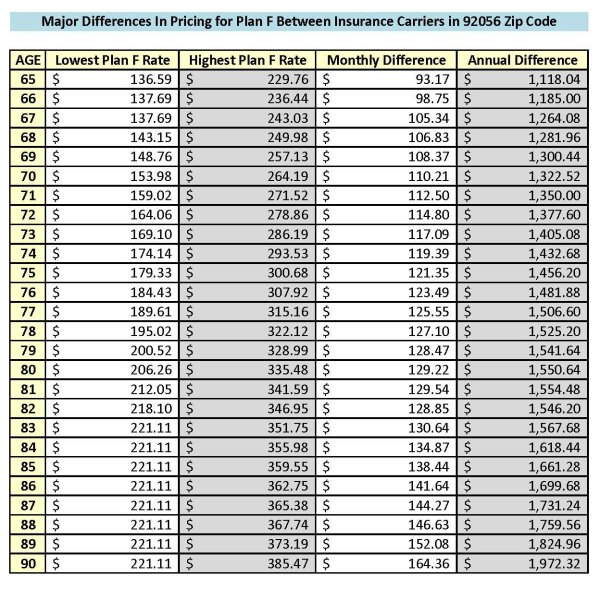
For example, the Plan F premiums for a 70 year old living in the 92056 zip code in San Diego range in price from $153.98 per month to $264.19 per month. That’s a difference of $110.21 per month or $1,322.52 per year for the same identical plan and coverage! On the following rate sheet, you can see the different Plan F rates for 18 different insurance carriers in the 92056 zip code. Obviously, some carriers are more competitively priced than others!

Mary Jones Plan F Rates_Page_1

Mary Jones Plan F Rates_Page_2

As you can see, in the 92056 zip code, the Plan F rates for a 70 year old range in price from $153.98 per month to $264.19 per month! Again, that’s a difference of $110.21 per month or $1,322.52 per year for the same exact plan and coverage!

It’s Important to Shop Around Every Year!

The Medicare Supplement market is constantly changing, and so are the premiums. If you have a Medicare Supplement and you haven’t shopped around during the last year, there’s a good chance that you’re paying hundreds of dollars a year more for your insurance than you should be! Many people that I meet haven’t shopped around at all since they first signed up for Medicare! Many of these individuals haven’t heard from their insurance agent since then as well!

This past year, two of my clients (a husband and wife) had Plan G, and they were paying $809 per month for both of them, approximately $404.50 each! I shopped around for them and found them Plan G with a different carrier, Mutual of Omaha, and their total monthly premium is now $367.01 per month! That’s a savings of $441.99 per month or $5,303.88 per year! While this is not the norm, I can usually save most of my clients from $300 to $600 per year each on their Medicare Supplement insurance premiums and often more.

What is the Price Range for Plan F Medicare Supplement Rates?

In the following chart, I have taken the lowest and highest Plan F premiums for ages 65 through 90 in the 92056 zip code. As you can see, the monthly and annual differences are significant for every age group.

2 Lowest Plan F vs Highest Plan F

Is There An Open Enrollment Period for Medicare Supplement Plans?

No. Unlike Medicare Advantage (MA) plans, which have an annual open enrollment period from October 15th through December 7th every year, you can shop around and apply for Medicare Supplement plans all year long.

NOTE: There is a six month-open enrollment period for Medicare Supplements when you first sign up for Medicare Part B.

Do I Need to Be In Good Health to Get a New Medicare Supplement Plan?

Unless you are in a Special Enrollment Period (SEP), if you already have a Medicare Supplement, you need to be in relatively good health to apply for a new Medicare Supplement with a different carrier. However, if you have a Medicare Supplement and you apply during the 30 days before or after your birthday, you don’t have to answer any health questions on the application, and you cannot be turned down due to health reasons if you apply for the same plan or another plan with fewer benefits. For more details, please see the California Birthday Rule section below.

Heart

What Happens If I Am Not In Good Health? Can I Still Apply For a New Medicare Supplement Plan?

Yes, absolutely! Because of the California Birthday Rule, if you already have a Medicare Supplement and you have serious health issues, YOU CANNOT BE TURNED DOWN FOR COVERAGE if you apply during the 30 days before or after your birthday.

California Birthday Rule

In California, there is a law called the California Birthday Rule. This law guarantees you the right to apply for a new Medicare Supplement plan EVERY YEAR, as long as you apply during the 30 days following your birthday. This is also known as the annual 30-day open enrollment period.

NOTE: Although the California Birthday Rules specifies that you can apply, REGARDLESS OF YOUR HEALTH, during the 30 days following your birthday without being turned down for coverage, several insurance carriers will let you apply during the 30 days BEFORE or AFTER your birthday!

This is more advantageous for you because the premiums with these carriers are based on your current age when you apply, and your rates will be lower if you apply during the 30 days prior to your birthday. With these carriers, your new rates are also guaranteed and locked in for the first 12 months of your policy, so there won’t be any unexpected rate increases.

NOTE: Not all insurance carriers lock your rates for the first 12 months.

If you want to take advantage of the California Birthday Rule and apply during the 30 days before or after your birthday,  YOU CANNOT BE TURNED DOWN FOR COVERAGE as long as you apply for the same plan that you currently have OR if you apply for a different plan that has fewer benefits. For example, if you have Plan F (the most comprehensive plan) and you want to apply for Plan F with another carrier to save money on your premiums, or if you have Plan F and you want to apply with Plan G, etc.

NOTE: If you apply under the California Birthday Rule, there are no preexisting waiting periods for prior health conditions.

If you are in relatively good health, you can apply for a new Medicare Supplement plan any time of the year. If you have serious health issues, you should take advantage of the California Birthday Rule and apply for coverage during the 30 days before your birthday to save money on your premiums.

Consider Plan G to Save More Money On Your Premiums

Besides shopping around every year to make sure that you aren’t paying too much for your premiums, if you currently have Plan F, you should consider Plan G. Why? Because Plan G is identical to Plan F in EVERY way except you would pay a small $166 Part B (Medical) deductible one time per calendar year. That is the only difference between the two plans!

NOTE: I have an Obamacare Bronze plan, and my individual medical deductible is only $6,000 per year! I would gladly pay $166 per year for my medical deductible!

In other words, the most you would pay for any out-of-pocket expense with Plan G in any calendar year is $166. However, in most cases, you will save significantly more than $166 per year on your premiums, which usually makes Plan G a better value and more cost effective.

NOTE: The Part B (Medical) deductible is subject to change each year, but historically, it has remained stable.

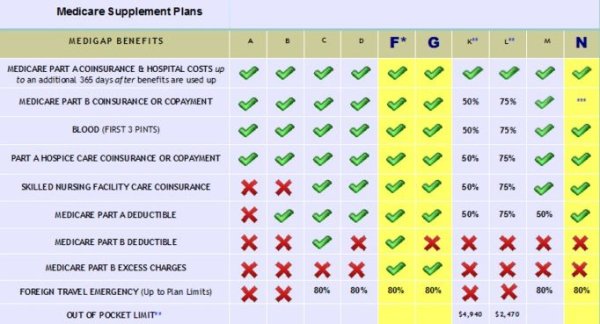
To see the difference in coverage between Plan F and Plan G, please see the following chart:

Medigap Chart Plans F and G

As you can see, when you compare Plan F and Plan G, everything is exactly the same except for the $166 Part B deductible. Plan F has no deductible, and Plan G is basically Plan F with a small, $166 deductible.

Price Differences Between Plan F and Plan G

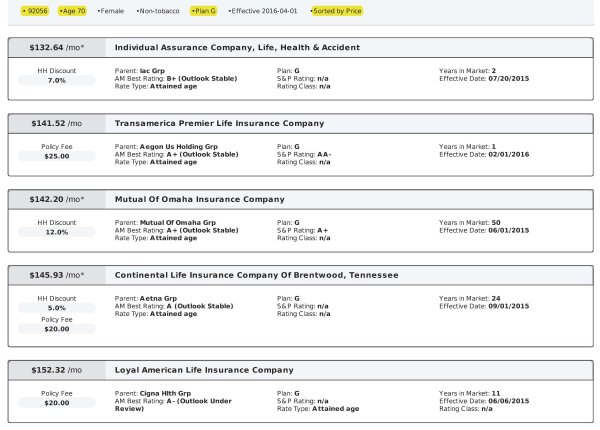
Although the two plans are almost identical in coverage, the rates for Plan G are usually significantly less than the Plan F rates. For a 70 year old in the 92056 zip code, the Plan F rates (above) range in price from $153.98 per month to $264.19 per month. The Plan G rates (below) range in price from $132.64 per month to $152.32 per month!

Plan F or Plan G

Plan G Rates Age 70

As you can see, the Plan G rates are significantly less than the Plan F rates for almost the same identical coverage.

Conclusion

The rates vary significantly from one insurance carrier to the next for the same identical plan and coverage. I recommend that you take advantage of the California Birthday Rule and shop around, every year, to make sure that you aren’t paying too much for your insurance. I would also suggest that you check out Plan G as another way to save a lot of money on your insurance premiums.

If you have any questions, or if you would like a free, no obligation quote, please don’t hesitate to let me know! I’m always happy to help!

Ron Lewis OHCC AD

Also, your feedback and comments are appreciated!

Thanks!

Ron Lewis
Ron@RonLewisInsurance.com
(760) 525-5769 – Cell
(866) 718-1600 – Toll-free

Want to Change Your Medicare Advantage Plan to a Medicare Supplement Plan During AEP?

MEDICARE_MazeThe Annual Enrollment Period (AEP) for Medicare Advantage (MA) plans (Part C) is almost here! If you have an Advantage plan and you’d like to change to a traditional Medicare Supplement plan, you can apply during the upcoming AEP, which is from October 15th through December 7th, for an effective date of January 1st, 2016.

If you have an Advantage plan or a Prescription Drug Plan (PDP), this is the one time of year to make changes to your health and/or prescription drug plans for the following year. To make these changes, the plan has to receive your enrollment request (application) no later than December 7th. If you stay with the same plan that you had, any changes to coverage, benefits, or costs for the new year will also begin on January 1st.

What is the Annual Notice of Change (ANOC)

Medicare_AdvantageIf you have an Advantage plan, your plan will send you an “Annual Notice of Change” (ANOC) each fall. The ANOC includes any changes in coverage, costs, provider networks, or service areas that will be effective in January. These are usually mailed out in September by your Advantage plan. After you receive your notice, review any changes to decide whether the plan will continue to meet your needs during the following year. If you don’t receive this important notice, contact your Advantage plan and request that they send it to you.

IMPORTANT: If you have health conditions that may prevent you from meeting the underwriting requirements for a Medicare Supplement, the ANOC may qualify you for one of the “guaranteed issue” situations listed below.

Minimum Health Requirements for a Medicare Supplement

To apply for a Medicare Supplement during the AEP, you must complete a Medicare Supplement application, which includes a section with health questions. If you have serious health issues, there is a good chance that your application will be turned down. However, there are certain “guaranteed issue” situations that you may qualify for. This means that you will not have to answer any of the health questions on the application, and you cannot be turned down!

In the “Eligibility for Guaranteed Issue In California” section below, there are nine situations that would guarantee you the right to change your Advantage plan to a Medicare Supplement plan, REGARDLESS OF YOUR HEALTH, without answering any health questions on the application!

Carefully check the ANOC. If your Medicare Advantage plan has increased your premium or co-payments by 15% or more, reduced your benefits, or terminated its relationship with your medical provider who was treating you, YOU PROBABLY QUALIFY FOR A GUARANTEED ISSUE MEDICARE SUPPLEMENT PLAN!

Guaranteed Issue Rights

Guaranteed issue rights are rights you have in certain situations when insurance companies MUST offer you certain Medicare Supplement policies (plans A, B, C, F, K, or L). In these situations, an insurance company:

  • Must sell you a Medicare Supplement policy
  • Must cover all your pre-existing health conditions
  • Can’t charge you more for a Medicare Supplement policy because of past or present health problems

In most cases, you have a guaranteed issue right when you have other health coverage that changes in some way, such as when you lose the other health care coverage. In other cases, you have a “trial right” to try an Advantage plan and still buy a Medicare Supplement policy if you change your mind.

Medicare_Supplement

Eligibility for Guaranteed Issue In California

In California, you would qualify for a guaranteed issue Medicare Supplement for any of the following situations:

  1. Has your employer-sponsored retiree plan that is supplementing Medicare involuntarily terminated?
  2. Has your employer-sponsored retiree plan stopped providing Medicare supplement benefits or the Medicare Part B 20% coinsurance for services?
  3. Have you lost eligibility for an employer-sponsored retiree plan due to divorce or death of a spouse or family member?
  4. Has your Medicare Advantage plan increased your premium or co-payments by 15% or more, reduced your benefits, or terminated its relationship with your medical provider who was treating you?
  5. Have you moved out of the area of your MA plan or Program for All-Inclusive Care for the Elderly (PACE) organization?
  6. Has your MA plan, Medicare SELECT Plan, PACE provider or any other health plan under contract with Medicare: (a) committed fraud; (b) ended or lost its contract with Medicare; (c) misrepresented the plan you bought, or (d) failed to meet its contractual obligations to Medicare beneficiaries, as determined by the federal government?
  7. Did you join a MA plan or PACE organization when you first became eligible for Medicare at age 65, and you want to switch to a Medicare Supplement policy during your first 12 months in the MA plan or PACE organization?
  8. Have you switched from a Medicare Supplement policy to a MA plan, PACE organization, Medicare SELECT plan, or any other health care organization contracting with Medicare, for the first time since becoming eligible for Medicare within the past 12 months?
  9. Has your MA plan left your area, and if so, did your MA plan benefits end within the past 123 days?

Purchasing a Medicare Supplement Insurance Policy if You’ve Lost Your Health Care Coverage

If you believe that you have a guaranteed issue right to purchase a Medicare Supplement policy, make sure you keep the following items:

  • A copy of any letters, notices, emails, and/or claim denials that have your name on them as proof of your coverage being terminated.
  • The postmarked envelope these papers come in as proof of when it was mailed.
  • You may need to send a copy of some or all of these papers with your Medicare Supplement application to prove you have a guaranteed issue right.
  • If you have a Medicare Advantage Plan but you’re planning to return to Original Medicare, you can apply for a Medicare Supplement policy before your coverage ends. The Medicare Supplement insurer can sell it to you as long as you’re leaving the plan. Ask that the new policy take effect no later than when your Medicare Advantage enrollment ends, so you’ll have continuous coverage.

Which is Better, a Medicare Supplement or an Advantage Plan?

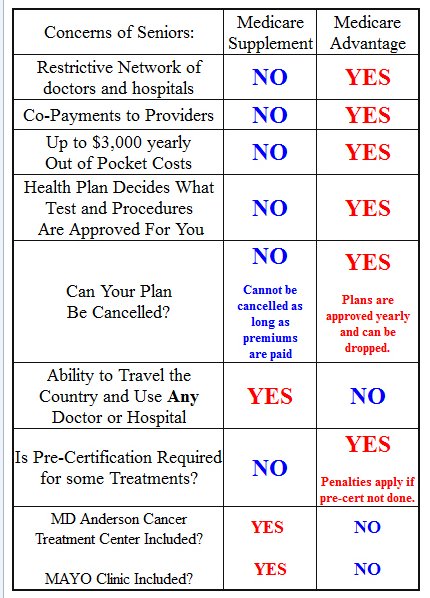
This topic is big enough to have its own blog! Personally, I strongly prefer Medicare Supplements over Advantage plans because you can go to ANY doctor or hospital in the US as long as they accept Medicare, and most of them do. With an Advantage plan, you are limited to their local networks of doctors and hospitals, and that is a major disadvantage. Also, a lot of people seem to think that Advantage plans cost less than Medicare Supplements, but if you are every hospitalized or develop a serious medical condition, you will be spending thousands of dollars on co-payments and deductibles with your Advantage plan.

Here are some pros and cons when comparing Medicare Supplements to Advantage plans.

Medigap Advantage Comparison ChartFor the reasons mentioned above, I would recommend Medicare Supplements over Advantage plans. If you are relatively healthy, an Advantage plan may be okay. But if you later develop serious health conditions, you’ll wish you had a Medicare Supplement because you should have the freedom to go to the best doctors, hospitals, specialists, and facilities ANYWHERE in the United States!

Peace of Mind Next Exit

If you (or someone you know) have an Advantage plan and you have any questions or would like to find out more about Medicare Supplement plans, please contact me at Ron@RonLewisInsurance.com. As an independent agent, I work with ALL the major insurance carriers in California, Washington, Nevada, and Arizona, and I’ll shop around for you to get you the best rates.

Everyone’s Least Favorite Insurance Topic…

Can you guess what it is? In the past, I used to specialize in long-term care insurance (LTCi), and I’d joke that it was probably the second to the last favorite type of insurance that people wanted to think about or talk about next to Final Expense (burial) insurance. After all, who can get excited about spending money for a piece of paper that you hope you’ll never use?

Final Expense2

Most people don’t get emotional when they talk about automobile insurance, health insurance, or homeowners (fire) insurance, but when it comes to long-term care insurance or final expense insurance, that’s different. For many people, these are sensitive and uncomfortable subjects, which is understandable. However, the risk of a long-term care stay is significantly higher than the risk of an auto accident, a home fire, being hospitalized, etc. And I wonder what the risk of dying is? I’d venture to say that it’s probably around 100%!  😉 As my good (and cynical) friend likes to say, “There’s no getting out of here alive!”

Personally, I don’t get emotional when I think about insurance. I look at it strictly as a financial planning tool and nothing else. It is there to protect my loved ones and my assets, and I don’t want to get my money’s worth out of it! Although I’m sure that many of you reading this article cannot wait for me to delve into the topic of long-term care insurance, you’ll have to be patient and wait because I am going to focus on everyone’s least favorite insurance topic for now, which is Final Expense insurance!

What is Final Expense (Burial) Insurance?
Final expense plans are small, permanent whole-life insurance policies that are specifically designed to handle the last expenses a person’s family must handle for them including funeral costs, outstanding medical bills, and any other unexpected expenses or debt that may be left behind. Because they are whole-life and not term-life insurance policies, the premiums are locked in. Once you select the amount of coverage you want, the premiums are guaranteed to never increase for as long as you hold the policy, and the policy will never expire as long as you pay the premiums.

final-expense-101

In addition, some policies include a small cash value component where tax-deferred savings can be built up over time. These funds may be withdrawn or borrowed against if you decide to do so. However, any unpaid loans or withdrawals will reduce the policy’s death benefit.

Today, funeral expenses can easily cost more than $10,000. Although the cost of a funeral may surprise you, if you plan ahead, a final expense plan can help reduce the burden of these costs on your family and help them focus on what is most important during a difficult time. Having a final expense plan in place can be a very loving and considerate thing to do, and it will give you the peace of mind that comes from knowing that you have planned ahead to ease the burden on loved ones.

Peace of Mind Next Exit

Two Types of Final Expense Benefit Levels

Final expense plans usually have two types of benefit levels:

  • Graded Benefit – The application process for these kind of final expense plans is the simplest and easiest. No medical exam is required and there are no health questions to answer. These plans are a guaranteed issue! You cannot be turned down, REGARDLESS OF YOUR HEALTH, as long as you meet the age requirements. There is usually a 24-month waiting period before the full face amount of the policy is in force. If death occurs within the first two policy years for any reason other than an accident, all premiums plus 10% interest are usually paid to the beneficiary. After the initial two year period, the full benefit is paid for death due to all causes.
  • Level Benefit – The full face amount of the policy will be in-force the day the application is approved. The premiums for these policies are more competitive because health questions will be asked at the time of application. If someone wants a final expense plan, they should first apply for a level benefit final expense plan if they are in relatively good health. If they have health issues that might prevent them from getting accepted, they can always get a graded benefit plan.

Premiums Never Increase

Once you select the amount of coverage that you want, your premiums are guaranteed to never increase for as long as you hold the policy. The rates are based on your age at the time you signed the application, and they will never increase in the future.

Sample Rates For a Graded Benefit Final Expense Plan

Gerber Life Insurance Company, which is a financially separate affiliate of the Gerber Products Company, offers a graded benefit final expense plan. With their plan, if you are a US citizen or permanent legal resident between the ages of 50 and 80, you can choose from $5,000 to $25,000 in guaranteed life insurance. Plus, under current federal law, the death benefit is not subject to federal income tax when paid to a named beneficiary.

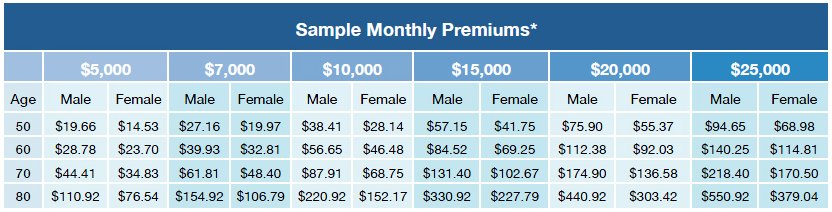
The following chart shows some sample monthly premiums for the Gerber Life graded benefit final expense plan:

Sample Monthly Final Expense Rates

As you can see, the monthly premium for a $10,000 final expense plan for a 60 year old male is $56.65. For a 60 year old female, the monthly premium is $46.48 per month. Again, these rates will never increase and the plan cannot be canceled for any reason as long as the premiums are paid.

Sample Rates For a Level Benefit Final Expense Plan

United of Omaha Life Insurance Company offers a level benefit final expense plan, and their application is a simple one that has 10 health questions. If you answer “No” to every question, you would be eligible for their level benefit product. With their plan, if you are between the ages of 45 and 85, you can choose from $2,000 to $40,000 in life insurance.

The monthly premium for a $10,000 level benefit final expense plan for a 60 year old male is $42.76. For a 60 year old female, the premium is $32.87 per month. Again, these rates will never increase and the plan cannot be canceled for any reason as long as the premiums are paid.

Which Final Expense Plan (Level Benefit or Graded Benefit) Has the Best Rates?

If you are in relatively good health and you don’t have any serious medical conditions, you should first apply for a level benefit final expense plan because the rates would be less than the rates for a graded benefit final expense plan. For example, the monthly premium for a United of Omaha Life Insurance Company $10,000 level benefit final expense plan for a 60 year old male and female is currently $42.76 and $32.87 per month, respectively, compared to $56.65 and $46.48 per month for the Gerber Life graded benefit final expense plan. As you can see, the level benefit rates are more competitively priced than the graded benefit rates.

Again, final expense is probably everyone’s least favorite insurance topic, but it is something that should be taken into consideration, without emotion, as a financial planning tool, and nothing more. Remember, it’s peace of mind.

For more information or to get a quote, please give me a call at (760) 525-5769.

Which is Better, Medicare Supplement Plan F or Plan G?

Today, there are 10 standardized Medicare Supplement plans (Plans A through N). The coverage for these plans is the same no matter which insurance company you have. For example, the coverage and benefits for Plan F is exactly the same at Aetna, Cigna, Blue Shield, Stonebridge, Blue Cross, etc., so it’s much easier to shop around and compare plans and prices today.

As you can see in the following chart, Plan F provides the most extensive Medicare Supplement coverage. (The plans with the empty boxes indicate coverage that is not included with that particular plan.)

Medicare Chart

Of the 10 standardized Medicare Supplement plans (aka “Medigap” plans), Plan F is considered to be the best plan because it provides the most comprehensive coverage. Plan F pays for all of the coinsurance, copayments, and deductibles not paid for by Medicare.

Plan F pays for the following benefits:

  • Medicare Part A Hospital Deductible (Currently $1,216 per benefit period) *
  • Medicare Part A Hospital Coinsurance
  • Medicare Part B Deductible (Currently $147 per year)
  • Medicare Part B Coinsurance
  • Medicare Part B Excess Charges
  • Hospice Care Coinsurance or Copayments
  • Skilled Nursing Facility Care Coinsurance
  • Charges for First Three Pints of Blood
  • Foreign Travel Emergencies

* A benefit period begins on the first day you receive service as an inpatient in a hospital and ends after you have been out of the hospital and have not received skilled care in any other facility for 60 days in a row. Therefore, there can be multiple Part A hospital deductibles in one calendar year.

Which is Better, Plan F or Plan G?

Which is Better, Plan F or Plan G?

Plan F and Plan G include the following benefits:

  • Freedom to choose any doctor or hospital that accepts Medicare patients.
  • Benefits start immediately with no waiting period for pre-existing conditions.
  • There are no networks and no referral needed.
  • No cancellation for age, health or the number of claims you file.
  • Covers 100% of all Medicare allowable excess charges.
  • Coverage that expands automatically with any future changes in Medicare.
  • Virtually eliminates all claims paperwork for you.
  • 30-day, no-risk free look guarantees your satisfaction or you get your money back.

Medicare Plan G Is Identical To Plan F Except For the Part B Deductible

Medicare Plan G provides the same identical coverage as Plan F except it does not cover the $147 Part B calendar year deductible (in bold above). That is the only difference between the two plans. They are exactly the same in every other way! Plan F and Plan G are the only two Medicare Supplement plans that pay 100% of any excess charges, so there would rarely be any unexpected out-of-pocket expenses. (Excess charges are additional expenses incurred outside of the Medicare-approved charge. For example, if you go to a doctor that charges more than the Medicare-approved amount.)

Why Would I Choose Medicare Plan G Over Plan F?

The decision to go with Plan G depends on whether the annual savings will exceed the $147 Part B deductible. For example, if your Plan G premiums are $30 per month less than the Plan F premiums, then you will save $360 per year in premiums ($30 x 12 = $360). If you are healthy, and you didn’t go to a doctor that year, you would have saved $360 on your premiums. If you had to pay the $147 Part B deductible, then you still would have saved $213 for the year in premiums ($360 – $147 = $213). On the other hand, if your annual premium savings would be just slightly more than, equal to, or less than $147 per year, then you are unquestionably better off with Plan F.

The Likelihood of Future Rate Increases is Less With Plan G Than With Plan F

Under federal law, Plan F falls under certain Guaranteed Issue (GI) requirements while Plan G doesn’t. For example, if someone has their health insurance with an employer plan or if they are on a Medicare Advantage plan and they loose their coverage, in most cases, they are guaranteed the right to switch to Plan F, regardless of their health and without medical underwriting.

Plan G is not a guaranteed issue plan. Consequently, the overall pool of people with Plan G are healthier than those on Plan F, and the quantity of submitted medical claims is lower with Plan G. Rate increases are often a result of too much GI business, so “F” plans have historically had greater and more frequent rate increases than “G” plans. That’s not a guarantee that “G” plans won’t have future rate increases, but if they do, the increases will more than likely be smaller.

Make the Switch!

Make the Switch!

The Only Potential Risk That I See With Plan G…

The only potential risk that I see for the future is that nobody knows for sure what the Part B deductible for Medicare will be in the future. Between 2011 and 2012, the Part B deductible actually went down from $162 per year to $140 per year. For the last few years, from 2013 through 2015, the Part B deductible has been stable and remained the same at $147 per year.

Here is the history of Medicare Part B deductibles:

  • 2017 — $183
  • 2016 — $166
  • 2015 — $147
  • 2014 — $147
  • 2013 — $147
  • 2012 — $140
  • 2011 — $162
  • 2010 — $155
  • 2009 — $135
  • 2008 — $135
  • 2007 — $131
  • 2006 — $124
  • 2005 — $110
  • 1991 through 2004 the Part B deductible was $100
  • 1982 through 1990 the Part B deductible was $75
  • 1973 through 1981 the Part B deductible was $60
  • 1966 through 1972 the Part B deductible was $50

As you can see, the historical Part B deductible rates have been relatively stable over the years. For me, it wouldn’t be an issue if I could otherwise save $200 to $300 per year by having a Plan G Medicare Supplement. On the other hand, many of my clients can afford to pay for the best and most comprehensive plan, Plan F, and they don’t want the uncertainty of not knowing for sure what the future will bring. Saving $200 to $300 per year isn’t always a big enough motivator for many to warrant switching from Plan F to Plan G. Then again, many retirees are on tight budgets and fixed incomes, and if that is the case, I would unquestionably recommend that they switch from Plan F to Plan G if they can save money on their premiums.

The California Birthday Rule

With the California Birthday Rule, you are guaranteed the right to switch plans every year within 30 days after your birthday, regardless of your health and without underwriting, if another company is offering the same plan or a lesser plan for less money. In other words, if you have Plan F, you can switch to Plan F with a different company if their rates are lower, or you could switch from Plan F to Plan G with a different company since Plan G is considered to have less benefits (the $147 Part B deductible) than Plan F. Rates vary significantly from one company to the next for the same identical plan and coverage, so it’s important to shop around every year.

Please let me know if you have any questions or comments!

If you or someone that you know would like a Medicare Supplement quote, please let me know, or click here to visit my website. Or, you can compare Medicare Supplement prices on your own by clicking the “Get A Quote” button below.

Get a Quote

Did You Know About These Free Medicare Preventive Services and Screenings?

I’m in the process of taking some Medicare certification courses, and I came across some important information that you (or a friend or family member) may not be aware of. Did you know that under your Medicare Part B benefits, you are entitled to certain preventive services and screenings, and there is no cost-sharing for most of these services?  Please take a few minutes and check these out. You may find some benefits that you didn’t realize you were entitled to!

Medicare icon
Preventive Services Include the Following:

  • One-time “Welcome to Medicare” physical exam
  • Annual wellness visit after 12 mos. enrolled in Part B
  • Immunizations – pneumococcal, hepatitis B, annual flu shot
  • Abdominal aortic aneurysm screening – one time, with referral
  • Alcohol misuse screening – every 12 months for certain individuals
  • Bone mass measurement – every 24 months for certain conditions
  • Cardiovascular screening blood tests – every five years for all persons
  • Colorectal cancer screening – four different tests, vary in frequency
  • Depression Screening – every 12 months
  • Diabetes screenings – up to two per year for those with risk factors
  • Diabetes self-management training – for persons with diabetes
  • Glaucoma testing – once per year for those at high risk
  • HIV Screening
  • Intensive Behavioral Therapy for Cardiovascular Disease – one face-to-face visit annually in a primary care setting
  • Mammogram (Breast Cancer Screening) – annual screening for most women
  • Medical nutrition therapy – for those with diabetes/kidney disease or kidney transplant
  • Obesity Screening and counseling – for certain individuals
  • Pap test and pelvic examination – every 24 mos. for all women; every 12 mos. for those at high risk
  • Prostate cancer screening – every 12 mos. for men over age 50
  • Screening for Sexually Transmitted Infections (STIs) and High Intensity Behavioral
  • Counseling to Prevent STIs – for certain individuals
  • Smoking cessation counseling – for any illness related to tobacco use

Other Part B Items and Services:

  • Ambulance services
  • Ambulatory surgical center fees
  • Blood
  • Cardiac rehabilitation–for certain situations
  • Chiropractic services–for limited situations
  • Clinical research studies – some costs of certain care in approved studies
  • Defibrillator (implantable automatic)
  • Diabetic supplies
  • Durable medical equipment – restricted to certain suppliers in some areas
  • Emergency room services
  • Eyeglasses after cataract surgery – limits apply
  • Foot exams and treatment for certain diabetics
  • Hearing and balance exams (no hearing aids)
  • Home health services in certain situations
  • Kidney dialysis and disease education – certain situations
  • Mental health care (outpatient) – limits apply
  • Occupational and physical therapy – limits apply
  • Pulmonary rehabilitation for COPD
  • Prosthetic/Orthotic items
  • Second surgical opinions
  • Speech-language pathology services
  • Telehealth services in some rural areas
  • Tests like X-rays, MRIs, CT scans
  • Transplant physician services and drugs

The Following Items Are Not Covered by Medicare Part A & B:

  • Acupuncture
  • Dental care/dentures
  • Cosmetic surgery
  • Custodial care
  • Health care while traveling outside the US – exceptions apply
  • Hearing aids
  • Orthopedic shoes
  • Outpatient prescription drugs (covered under Part D)
  • Routine foot care
  • Routine eye care and eyeglasses
  • Some screening tests and labs
  • Vaccines, except as previously listed (those not covered under Part B are covered under Part D)
  • Syringes and insulin unless used with an insulin pump (covered under Part D)

IMPORTANT WARNING REGARDING YOUR MEDICARE COVERAGE!

If you are on Medicare and you need to be admitted to a hospital, DO NOT let the hospital admit you with the words “UNDER OBSERVATION.” Insist on being admitted as “IN-PATIENT.” Otherwise, there is a good chance that you will be responsible for most or all of the hospital expenses, and you will be prevented from accessing nursing home care, rehabilitative care, etc. Click here to watch a recent NBC news television broadcast regarding this problem.

I Specialize in Medicare Supplement Insurance!

For an INSTANT Medicare Supplement insurance quote in California or Washington state, or for more information about long-term care (LTC) insurance, linked-benefit plans, critical care, etc., please call or visit my website.

The Simplest Explanation of Obamacare…

I can’t really take credit for writing the bullet points below (they were sent to me in an email), but I thought this was the best and simplest explanation I’ve seen so far to describe Obamacare…

  • In order to insure the uninsured, we first have to un-insure the insured.
  • Next we require the newly un-insured to be re-insured.
  • To re-insure the newly un-insured, they are required to pay extra charges to be re- insured.
  • The extra charges are required so that the original insured, who became un-insured, and then re-insured, can pay enough extra so that the original un-insured can be insured for free.
  • There… Now you understand what is going on.

ObamacareThis is exactly what happened to my family. We were happily insured and then we received our cancellation letter from Blue Shield, which I affectionately refer to as “BS.” 😉 Before the Affordable Care Act (ACA) was implemented, our health insurance coverage for EIGHT family members was $975.60 per month, which I thought was a little pricey. BS told us that a “comparable” ACA plan was the “Bronze” plan, which was the cheapest ACA plan available. Our “new and improved” ACA health insurance rates more than doubled to $1,995.48 per month! Wait a minute, I thought President Obama promised to save the average American family $2,500 per year? (Please click here to see for yourself.)

Besides that, our co-payments and deductibles increased significantly from what they were before, but I am thankful to now have maternity coverage, even though I’m a 61 year old male! I’m also relieved to know that more than 16,000 new IRS agents have been hired to enforce Obamacare!

Although I’m laughing and joking about this on the outside, it’s really no laughing matter because the simple explanation mentioned above is true! Real people are being harmed by this reckless law, and millions more are being adversely affected by the ACA than those who are benefiting from it. For more details about our personal experience, please refer to my earlier blog, “Is the Affordable Care Act Really Affordable?”

Sticker Shock and Skyrocketing Health Insurance Premiums Forecast in 2015 for ACA Plans

A story published by “The Hill” last week is forecasting skyrocketing health insurance premiums for the Affordable Care Act’s (ACA) new health insurance exchanges. The story cites insurance industry insiders who said they expect the price of monthly premiums to increase significantly. The outlook runs contrary to the comments of Health and Human Services Secretary Kathleen Sebelius who downplayed the likelihood of sticker shock next year while addressing members of Congress two weeks ago. The unnamed insiders mentioned in “The Hill” story said a combination of new ACA taxes and fees, rule changes, and delays in the enforcement of certain requirements will likely contribute to higher than expected rates for next year. According to the story, not everyone will experience sticker shock. Rates are likely to vary depending on the region of the country and the availability of doctors in the area. The rates for 2015 won’t be announced until fall. Please click here to view the article.

SkyRocketObamaCare

Hey Seniors… If You Like Your Medicare Advantage Plans, You Can Keep Them, Period…Maybe Not!

obama-if-i-like-your-plan-you-can-keep-itSound familiar? Part of the Affordable Care Act (ACA), also known as Obamacare, aims to reduce federal payments to the Medicare Advantage (MA) plans over time, and these savings would help pay for some parts of the ACA. In other words, Obamacare is slashing Medicare and MA benefits, which will adversely affect seniors in order to pay for other new programs created under the law that aren’t even for seniors!

According to Robert E. Moffit, Ph.D., “The money is cut from hospital services, Medicare Advantage, skilled nursing services, hospice services, and other Medicare services. To be clear, the cuts do not target individual institutions or medical organizations suspected of waste, fraud, or abuse.” Moffit goes on to say that “The $716 billion in “savings” from Medicare are taken out of the program to pay for new spending in Obamacare. The cuts do not strengthen the Medicare program, nor do they extend the life of the Part A trust fund.” Consequently, the $716 billion that is being cut from Medicare will not enhance Medicare Advantage benefits, and there is speculation that these drastic cuts will also adversely affect traditional Medicare and Medicare Supplements as well!

One way it’s expected to do this is by requiring Medicare Advantage plans to have a “medical loss ratio” of at least 85 percent. This means the companies offering the plans would have to spend at least 85 percent of the money they get on actual medical care. In other words, insurance companies can use no more than 15 percent for administrative costs and profits. As soon as these changes were announced with the ACA’s passage in 2010, there were fears and rumors that this was the beginning of the end for Medicare Advantage plans.

Medicare Advantage PlanThe Centers for Medicare and Medicaid Services (CMS) recently proposed a 1.9% cut in Medicare Advantage payments next year. If these cuts are implemented, many fear that millions of seniors who currently rely on the Medicare Advantage program will lose the plans, benefits, doctors, and financial protection they currently have. Seniors and people with disabilities who are enrolled in Medicare Advantage plans would face premium increases and benefit reductions of $35-$75 per month, or $420-$900 per year. According to Oliver Wyman of America’s Health Insurance Plans (AHIP), these types of cuts could result in a “high degree of disruption in the MA market,” including the “potential for plan exits, reductions in service areas, reduced benefits, provider network changes, and MA plan disenrollment.”

In all fairness to the supporters of the Medicare Advantage plan cuts, Medicare Advantage plans were paid on average more per beneficiary than what Medicare paid for beneficiaries enrolled in traditional Medicare plans. One of the goals of the ACA is to equalize the federal spending over time, so the government pays the same amount whether a beneficiary enrolls in Medicare Advantage or traditional Medicare. Cuts to Medicare Advantage plans are part of the $716 billion in Medicare spending reductions the health law calls for over the next decade.

As an independent insurance agent, I work primarily with Medicare Supplement (Medigap) insurance plans, which is health insurance for people who are 65 and over. The alternative to Medicare Supplements is Medicare Advantage (MA) plans. Personally, I’m not a big fan or advocate of MA plans because they are much more restrictive than “original” Medicare Supplements. By that I mean you are restricted to the doctors and hospitals in the plan’s network. With Medigap plans, you can go to any doctor or hospital in the country that accepts Medicare, and if you develop a serious illness, you have much greater freedom and options, and you are not limited or confined to a specific network of doctors or a geographic area.

Health Care Reform2Medicare Supplements do not include prescription drug coverage. For that, you would have to purchase a separate prescription drug plan (PDP) called “Part D.” (“Part A” is hospital insurance, “Part B” is medical insurance, and Medicare Advantage plans are referred to as “Part C.”) MA plans usually cost less than Medicare Supplements and many MA plans include prescription drug coverage. Some of the MA plans also provide additional benefits such as dental, vision, and wellness, which are not covered by Medicare. For these reasons, enrollment in Medicare Advantage plans rose in 2014 by 8.9 percent to 15.9 million enrollees, which is up from 14.6 million in 2013. Obviously, these plans are still very popular.

As mentioned before, I am not too excited about MA plans because of the network and geographic restriction. If money isn’t an issue, I would recommend a Medicare Supplement plan over an MA plan. However, for many retirees, MONEY IS AN ISSUE as many seniors live on fixed incomes, and every dollar counts.

Because of the cuts, reduction of benefits, and increased costs to seniors, there is no question that millions of seniors who rely on the Medicare Advantage program will lose the plans, benefits, doctors and financial protection they currently have. And just like the ACA, this could cause another major disruption in the health insurance market and a lot of confusion for seniors and their family, which they really don’t need at this stage of their life.

Unless the proposed cuts to Medicare and MA plans are significantly reduced or eliminated, I think there is a good chance that many seniors will not be able to keep their MA plan, even if they like it, PERIOD!

What do you think?


Is the Affordable Care Act (ACA) Really Affordable?

Dear Mr. Lewis,

“A few weeks ago we notified you about upcoming changes due to the Affordable Care Act (ACA) and explained that your current Blue Shield medical plan will end December 31, 2013…”

These were the words I was dreading to hear! When I received our cancellation letter, I was very upset to learn that it was being cancelled at the end of 2013 because it was not “compliant” with the “Affordable Care Act” (ACA). Blue Shield of CA offered us another plan in its place that was “comparable” in coverage, but it really was not. The deductibles, co-payments, and out of pocket expenses on the “new” plan are significantly higher than the “old” plan, and the overall quality is inferior.

Besides our family, over six million Americans received cancellation letters from their insurance companies because of the ACA, and they have had their health insurance plans cancelled despite our president’s repeated promises, over and over again, that…

President Obama Contemplating Obamacare.

The First Time Our President Contemplated Obamacare.

“If you like your doctor, you will be able to keep your doctor, period.” “If you like your health care plan, you’ll be able to keep your health care plan, period. No one will take it away, no matter what.” and “I will sign a universal health care bill into law by the end of my first term as president that will cover every American and cut the cost of a typical family’s premium by up to $2,500 a year.” Blah, blah, blah…

Well, we had a health insurance plan with Blue Shield of California for many years. It was called the “Shield Savings 3500/7000 PPO” plan, and we were very happy with it, despite the fact that President Obama felt it was a “sub-standard” plan. Since we were repeatedly told that our premiums would be going down approximately $2,500 a year, I was trying to keep an open mind. However, that was not the case.

We were paying $975.60 per month for a family of 8, and that included dental and prescription drug coverage for all of us as well as relatively low co-payments and deductibles. I thought that our premium on the Shield Savings plan was a little steep, but when I found out what our new ACA premium was going to be, I almost fell over!

Despite the fact that “Dirty Harry” Reid accused me (and thousands of other Americans) of being a liar this past week because the information in this blog is allegedly “untrue,” our ACA premiums more than doubled! Because of the “Affordable Care Act,” the health insurance premiums for our family went from $975.60 per month to $1,995.48 per month!

"Dirty Harry" Reid

“Dirty Harry” Reid

And unlike our Shield Savings plan, the ACA health plan only included dental for three of our six kids and no one else! Our premium would be even higher if the other five people in our family selected dental insurance. On an annual basis, we were paying $11,707.20 per year for our Shield Savings plan ($975.60 x 12 = $11,707.20), but the annual premium for our new ACA health insurance plan is $23,945.76 per year ($1,995.48 x 12 = $23,945.76)! Is that supposed to be “affordable?” I think not!

By the way, our new $23,945.76 per year ACA plan that I’m referring to is a basic PPO “Bronze” level plan, which is the “cheapest” of the four ACA metallic plans. This is the “ACA-compliant plan” that Blue Shield recommended because they told us it was the most “comparable” to our Shield Savings plan. Here is the description of the basic PPO “Bronze” level plan that we received from Blue Shield of CA:

“With low premiums, a high deductible, and more out-of-pocket costs, our Basic plan is designed for people who want affordable coverage and protection in the event of a serious medical emergency. You’ll have the basics such as three doctor’s visits prior to meeting the deductible and preventive care services.”

Now I’m not sure about you, but I don’t consider $23,945.76 per year to be either a “low premium” or more “affordable!” And regarding the “three doctor’s visits” and the “preventative care,” it would be much more cost effective (cheaper) for me to keep the old plan and pay for these expenses myself.

Furthermore, our deductibles and out of pocket costs increased significantly under the ACA plan. On our Shield Savings plan, our calendar year medical deductible was $3,500 per insured or $7,000 per family. On the ACA plan, it is $4,500 per insured or $9,000 per family. Our calendar year out of pocket (OOP) maximum on the Shield Savings plan was $5,000 per insured and $10,000 per family. On the ACA plan, it is $6,350 per insured or $12,700 per family!

With office visits (primary care doctors and specialists) and urgent care visits, lab and X-rays on the Shield Savings plan, we paid NOTHING after meeting our deductible. On the ACA plan, we still have to pay 40% of these costs AFTER meeting our deductible! And the same is true with Outpatient surgery and Inpatient hospitalization!

With generic drugs and preferred brand drugs, we paid $10 per prescription for generic and $35 per prescription for brand name after meeting our deductible. On the ACA plan, we still have to pay 40% of these costs after the deductible! I won’t go on and on with these boring details, but I hope that you get the point that the new ACA Bronze plan is significantly more expensive than the Shield Savings plan that we had, and it’s even more expensive when you take the additional costs of co-payments and deductibles into consideration.

If a family should end up in a situation where they have to pay a $9,000 family medical deductible as well as $12,700 in out-of-pocket costs (in addition to their obscene (non-subsidized) ACA health insurance premiums), there is a good chance that they are still going to end up bankrupt! So what’s the point of having insurance??? “The only thing worse than going broke is going broke with insurance!”

I hope and pray that people will wake up and repeal Obamacare or defund it because it is bad legislation that is destroying the quality of our health care system as well as hurting our economy and killing jobs. Then again, if enough young and healthy people don’t sign up for it, I think there’s a good chance that it will implode on itself and self-destruct.

As Nancy Pelosi famously said “We have to pass the bill to find out what’s in it.” President Obama and his administration purposely and repeatedly misrepresented the truth about the ACA, and it was sold to the American people as a pack of lies. Now that we know “what’s in it,” the majority of Americans don’t want it!

Nancy Pelosi

Nancy Pelosi, a little mixed up, as usual.

I would be curious to hear of your ACA experiences, both good and bad.

Thanks!