

You may have asked yourself this question: “I barely used my Medicare Supplement plan this year, so why did my premium go up?”
It is a common question and an understandable one. Unlike some types of insurance where your individual claims history can directly affect what you pay, Medicare Supplement insurance premiums are not simply based on how much you personally used your coverage. Your premium can change even if you rarely visit the doctor, have never been hospitalized, or have not filed a single claim.
For Medicare beneficiaries in California, several factors can influence the premium you pay, including your age, ZIP code, insurance company, and whether you qualify for certain household discounts. Medicare.gov also notes that Medigap premiums typically increase over time and can vary among insurance companies.
Your Premium Is Not Based on How Much You Personally Use Your Insurance
One of the biggest misconceptions about Medicare Supplement insurance is that your premium should stay the same if you do not use your policy. That is not how Medicare Supplement pricing works.
A Medicare Supplement policy is designed to help cover certain costs associated with Original Medicare (Part A and Part B). The insurance company collects premiums from policyholders and uses those premiums to help pay covered claims across its pool of insured individuals. That means your premium is not calculated simply by adding up the medical services you personally used during the year. So if you had a healthy year and barely used your Medicare Supplement policy, you could still receive a premium increase. And that is normal.
Why Can Medicare Supplement Premiums Increase?
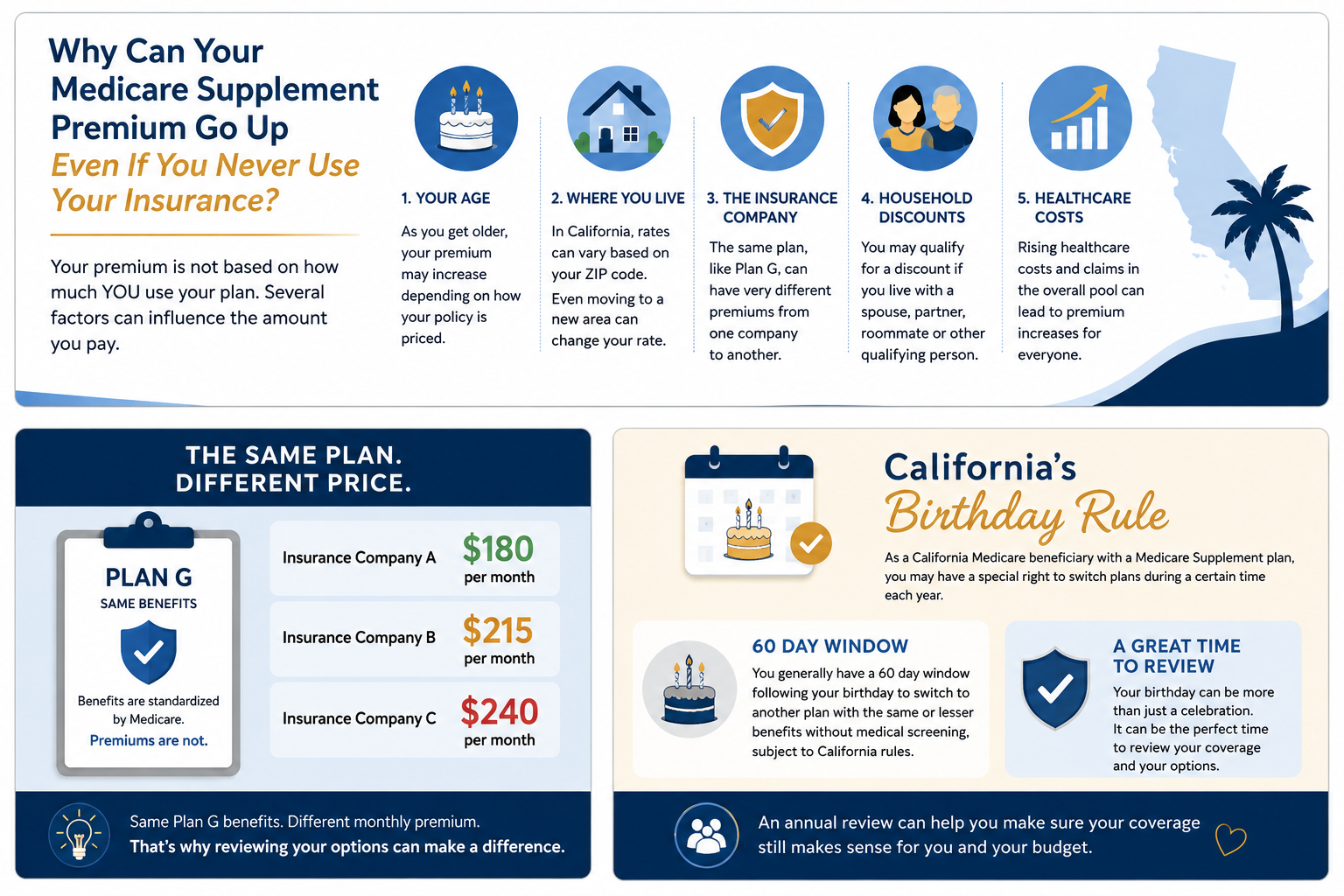
There is not necessarily one single reason for a rate increase. Various factors can cause this.
1. Your Age
Age can be an important factor in determining Medicare Supplement premiums. As you get older, your premium may increase depending on how your policy is priced. Premiums can also increase for reasons unrelated to your individual healthcare usage. This is one reason it is important to understand not only what you are paying today, but also how your premium may change over time.
2. Where You Live
Your location can also affect the price of Medicare Supplement insurance. In California, Medicare Supplement rates can vary based on factors such as age and ZIP code. This means that two people with the same Medicare Supplement plan may not necessarily pay the same premium if they live in different areas. If you move to a different ZIP code, your available rates may change as well.
3. The Insurance Company
Here is something many Medicare beneficiaries do not realize. Two insurance companies can offer the same Medicare Supplement plan and charge different premiums.
Medicare Supplement plans are standardized. For example, the basic benefits of Plan G are the same regardless of which insurance company sells the Plan G policy. However, the premium can be very different from one insurance company to another. So if your Plan G premium increased, that does not necessarily mean that Plan G itself changed. It may simply mean that another insurance company is currently offering the same standardized benefits at a lower premium.
The benefits are standardized. The premiums are not. This is one reason why reviewing your Medicare Supplement premium periodically can be worthwhile.
4. Household Discounts
Some insurance companies offer household discounts to qualifying individuals. Depending on the insurance company, a discount may be available when you live with a spouse, domestic partner, roommate, or another qualifying household member. These discounts can make a meaningful difference in the amount you pay each month. However, not every insurance company offers the same discount, and eligibility requirements can vary. This is another factor that can affect the premium you pay.
5. Overall Healthcare and Insurance Costs
Even if you personally have not used your Medicare Supplement policy very much, the insurance company is still paying claims for the larger group of people it insures. Changes in healthcare costs, medical services, utilization, and other factors can affect an insurance company’s overall expenses. As those costs change, premiums can change as well.
The Same Plan Does Not Always Mean the Same Price
This is one of the most important things to understand about Medicare Supplement insurance. Let assume that you have a Plan G policy. Your Plan G benefits are standardized. However, several insurance companies may offer Plan G in your area, and their premiums will be very different. For example, one insurance company might offer a Plan G for $180 per month while another might charge $215 or $240 for the same standardized plan.
That does not automatically mean the more expensive company provides better Plan G benefits. The benefits are standardized, but the premiums are not. This is why comparing Medicare Supplement rates can be valuable.
Should You Change Your Medicare Supplement Plan Because Your Premium Increased?
Not necessarily. A premium increase does not automatically mean you should switch insurance companies. There are several things to consider before making a change, including your current premium, the rates available from other companies, your eligibility for a new policy, and whether switching makes sense for your individual situation.
It is also important to understand that switching Medicare Supplement policies is not always as simple as switching other types of insurance. Outside certain protected situations, an insurance company may be able to use medical underwriting when you apply for a new Medicare Supplement policy. That is why you should never cancel your existing Medicare Supplement policy simply because you found a lower advertised rate. Always make sure your new coverage is approved and in place before cancelling your existing policy.
Why an Annual Medicare Supplement Review Can Make Sense
Your Medicare Supplement premium can and usually will change from year to year. This is why I believe it makes sense for Medicare Supplement policyholders to periodically review their coverage and current premium.
For my California clients, I review their Medicare Supplement options around their birthday each year. I look at factors such as their current premium, age, ZIP code, available plans, household discount eligibility, and rates from other insurance companies.
Many times I find an opportunity for my clients to save money, and sometimes the best decision is to stay exactly where they are. The goal is not to change your plan every year. The goal is to make sure you understand your options and are not paying more than necessary for comparable coverage.
California’s Birthday Rule Can Be Especially Important

California Medicare beneficiaries have an additional opportunity that can make an annual review particularly valuable.
Under the California Medicare Supplement Birthday Rule, eligible individuals who already have Medicare Supplement coverage have a 60 day window following their birthday each year to switch to another Medicare Supplement policy with the same or fewer benefits without medical underwriting.
For example, if someone has a Plan G Medicare Supplement, they can switch to Plan G with any other insurance carrier, regardless of their health. Or, they could switch to Plan N, etc. because Plan N has fewer benefits than Plan G. Under the birthday rule, you cannot switch from Plan N to Plan G because Plan G has greater benefits than Plan N, etc.
This can make your birthday more than just a day to celebrate. It’s a good time to review your Medicare Supplement coverage. For California policyholders, this annual review can be especially important because rates usually increase from year to year.
The Bottom Line
If your Medicare Supplement premium increased even though you barely used your insurance, you didn’t do anything wrong. Premiums can change for a variety of reasons, including age, location, insurance company pricing, household discounts, and broader healthcare costs.
It’s normal for rates to increase every year as we get older, and that’s why it’s important to review your coverage every year around your birthday and to take advantage of the California Birthday Rule. You do not have to change plans just because your premium went up. But you should know what your options are.
A Medicare Supplement review is not about changing your plan every year. It is about making sure the coverage you have continues to make sense for you and that you are aware of your available options.
Final Thoughts
Medicare is an excellent health insurance program, but it was never designed to cover every healthcare expense. Understanding these coverage gaps can help you avoid unexpected costs and build a more complete healthcare strategy.
If you have questions about Medicare Supplement plans or would like to review your coverage options, feel free to contact me. I am always happy to help you understand your choices and find competitively priced coverage that meets your needs.
About the Author

I’m an independent Medicare Supplement insurance specialist working with most of the major insurance carriers throughout California, Nevada, Arizona, and several other states.
I help people turning 65 coordinate their Medicare enrollment so their Medicare Supplement and prescription drug coverage begin at the same time as Medicare.
I also work with many people who already have Medicare Supplement plans and would like to review their options. In California, there is a law called the California Birthday Rule, which allows Medicare Supplement policyholders to change their plans each year during the 60 days following their birthday without answering health questions or going through medical underwriting. During this annual 60-day enrollment period, you cannot be turned down for coverage when changing to a Medicare Supplement plan with the same or fewer benefits.
I regularly help clients lower their Medicare Supplement premiums while keeping the same benefits and coverage.
Over the years, I have helped many clients save hundreds and sometimes even thousands of dollars on their annual premiums.
There is never a fee for my services because I am compensated by the insurance companies, not my clients. My goal is to help you find competitive premiums while providing dependable, personal service year after year.
If you’re turning 65 or already have a Medicare Supplement plan and would like to review your options, I’m happy to help.
Read what my clients have to say about working with me.
Contact Information
Ron Lewis
Independent Medicare Supplement Insurance Specialist
Cell: (760) 525-5769
Toll-Free: (866) 718-1600
Email: Ron@RonlewisInsurance.com
Website: www.MedigapShopper.com
Insurance Licenses
- California: #0B33674
- Nevada: #3822123
- Arizona: #681166
This website is operated by a licensed insurance agent and is intended for educational purposes only. I am not affiliated with or endorsed by Medicare or any government agency.