If You’re Losing Your Scripps Medicare Advantage Coverage… Don’t Panic!

Scripps Will No Longer Accept Medicare Advantage HMO Plans In 2024

Scripps recently began notifying about 32,000 Medicare beneficiaries that beginning on January 1st, 2024, the Scripps Clinic and Scripps Coastal medical groups will no longer accept Medicare Advantage (MA) HMO plans from carriers such as Anthem Blue Cross, Blue Shield of California, Health Net, UnitedHealthcare (UHc), etc. However, doctors from Scripps Clinic and Scripps Coastal will continue to accept Original Medicare Part A (Hospital insurance) and Part B (Medical insurance) as well as Medicare Supplement insurance, aka Medigap.

NOTE: Although Scripps will no longer accept MA HMO plans, I called and asked if they will accept MA PPO plans. I was told that individuals with MA PPO plans can still go to Scripps and see their doctors with those plans, BUT they will be billed as “out of network” instead of “in network” meaning that those individuals could have very high out-of-pocket costs if they continue going to Scripps with MA PPO plans.

If you have to pay out-of-network costs for your MA PPO plan, they are very expensive. In the 92024 zip code, there are 66 MA plans offered in 2024. Of those plans, 56 are HMO’s, and 10 are PPO’s, which are shown below. As you can see, the in-network and out-of-network costs are very expensive for all of the MA PPO plans.

In and Out of Network Costs for 2024 MA PPO Plans Offered In the 92024 (Encinitas) Zip Code:

AARP Medicare Advantage from UHC CA-0035 (PPO)
$9,550 In and Out-of-network
$4,500 In-network

Aetna Medicare Choice Plan (PPO)
$8,950 In and Out-of-network
$5,500 In-network

Aetna Medicare Core Plan (PPO)
$8,900 In and Out-of-network
$3,900 In-network

Aetna Medicare Eagle Plus Plan (PPO)
$9,500 In and Out-of-network
$6,700 In-network

Alignment Health AVA (PPO)
$8,950 In and Out-of-network
$3,900 In-network

Blue Shield Select (PPO)
$8,950 In and Out-of-network
$4,200 In-network

Humana USAA Honor (PPO)
$9,550 In and Out-of-network
$5,900 In-network

Humana USAA Honor with Rx (PPO)
$9,050 In and Out-of-network
$6,100 In-network

HumanaChoice H5525-076 (PPO)
$7,000 In and Out-of-network
$3,900 In-network

HumanaChoice H5525-077 (PPO)
$8,900 In and Out-of-network
$5,900 In-network

If you get seriously sick with one of these MA PPO plans, you can still end up with very high out-of-pocket costs, even if you stay in-network!

The Problem

More than half of the nation’s seniors have MA plans, but many hospitals and care facilities throughout the country are dropping MA plans altogether. Some of the most common reasons are because of excessive prior authorization denial rates and slow payments from insurers. Also, some MA insurers have faced allegations of billing fraud from the federal government, and they are being investigated by lawmakers over their high denial rates. Please click here to read “Kaiser Permanente Sued By Federal Government Over Alleged Medicare Fraud.”

According to Chris Van Gorder, president and CEO of Scripps Health, “It’s become a game of delay, deny and not pay. The health system is facing a loss of $75 million this year on the MA contracts, which will end Dec. 31 for patients covered by UnitedHealthcare, Anthem Blue Cross, Blue Shield of California, Centene’s Health Net and a few more smaller carriers. If other organizations are experiencing what we are, it’s going to be a short period of time before they start floundering or they get out of Medicare Advantage. I think we will see this trend continue and accelerate unless something changes.” For more information, please click here to read “Hospitals are dropping Medicare Advantage left and right” by Jakob Emerson.

Scripps Health released a statement explaining the reason for their decision. “Scripps has long served seniors and others in our community who are enrolled in Medicare and Medicare Advantage plans. Scripps and health systems across the country are facing unprecedented financial pressures. We are looking at all we do and, when necessary, making difficult decisions to ensure that we can continue to meet the needs of the community we serve. The revenue from Medicare Advantage plans is not sufficient to cover the cost of the patient care we provide.”

Understandably, many Scripps’ patients with MA plans are upset and panicking. If they keep their MA plans, they will no longer be able to keep the the same doctors and specialists they have been going to at Scripps, and they will have to go somewhere else and find new doctors. For those who are undergoing serious procedures such as cancer treatment, etc., this is not a viable option.

Scripps’ Patients Have Three Choices

If you are a Scripps patient with an MA plan, you have three choices for 2024:

  • You can keep your MA HMO plan (or switch to a different MA HMO plan), but if you do, you will not be able to go to Scripps Clinic or Scripps Coastal in 2024, and you must find new doctors.
  • You can keep your MA PPO plan (or switch from a MA HMO to a MA PPO plan, and continue going to Scripps and seeing your regular doctors, but you will incur very high out-of-pocket in-network and out-of-network costs.
  • The third and best option, in my opinion, is to switch back to Original Medicare (Part A and Part B) and get a Medicare Supplement plan.

With the third option, you can continue going to Scripps in 2024 and you can still go to the same doctors, specialists, etc. that you have been going to in the past. For those who are undergoing any serious medical procedures, such as cancer treatment, etc., you will continue in January 2024 with no changes or interruption in service or treatment.

When To Make These Changes

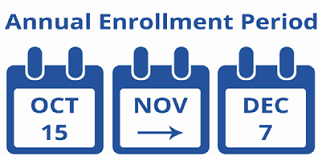
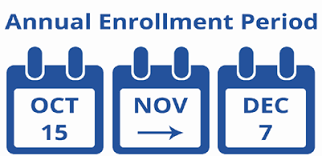
The time to make any of these changes is during the upcoming Annual Enrollment Period (AEP), which begins on October 15th and ends on December 7th every year.

If you want to keep your current MA plan, you don’t have to do anything (as long as it is still being offered in 2024). If you have an MA plan and want to switch to a different MA plan, you must do so during the AEP. You can also apply for or change your Prescription Drug Plan (PDP) or switch back to Original Medicare (Part A and Part B) during the AEP.

NOTE: If you have a Medicare Supplement, the AEP does NOT apply to you unless you want to enroll in or change your PDP. You can change your Medicare Supplement any time of the year.
The Solution

If you would like to continue seeing your doctors at Scripps in 2024, your only option is to drop your MA plan, switch back to Original Medicare, and get a Medicare Supplement. Normally, when you switch from an MA plan to a Medicare Supplement, you must answer health questions and go through medical underwriting. If you have a serious health condition such as cancer, etc., you will not be approved for coverage.

And Now For The Good News!

For all Scripps’ patients that have any kind of a Medicare Advantage plan (HMO or PPO), you can get a Medicare Supplement beginning on 1/1/24 to replace your MA plan REGARDLESS OF YOUR HEALTH! Because of this current situation with Scripps, you will be in a “Guaranteed Issue” situation meaning that you can get the best Medicare Supplement plan available, Plan G, without answering any health questions or being medically underwritten! As a Guaranteed Issue, YOU CANNOT BE TURNED DOWN FOR COVERAGE!

NOTE: With a Plan G Medicare Supplement, your only out-of-pocket cost for the entire calendar year is the Medicare Part B deductible, which will be $240 for all of 2024!

For example, with a Plan G Medicare Supplement, if you have multiple doctor visits, a couple of surgeries, and a hospital confinement in 2024, all you would pay is the $240 Part B deductible and that’s all! That’s a lot better and cheaper than the in-network and out-of-network maximums with MA plans!

Plus, with a Medicare Supplement, you can go to any doctor, specialist, care facility, hospital, etc. ANYWHERE in the US as long as they accept Medicare, and most do, about 93%. If you want to see a specialist, you can go directly to any specialist you want, anywhere in the country. With an MA plan, you must go to your primary care doctor first and get permission to see a specialist that’s in your local network, etc. You have much more freedom of choice with a Medicare Supplement than you do with an MA plan.

Other Guaranteed Issue Situations

There are other Guaranteed Issue situations that will qualify anyone with an MA plan to be able to bypass underwriting and get a Medicare Supplement as a guaranteed issue, REGARDLESS OF THEIR HEALTH. Regardless of your situation with Scripps, everyone with an MA plan should have received their Annual Notice of Change (ANOC) by now. The ANOC is a notice you receive from your Medicare Advantage or Prescription Drug Plan (PDP) every year in late September. The ANOC provides a summary of any changes in the plan’s costs and coverage that will take effect on January 1st of the following year.

If your MA plan did any of the following, you are in a guaranteed issue situation, which will allow you to get a Medicare Supplement, regardless of your health:

  • If your MA plan increased your premium or co-payments by 15% or more from this year to next year.
  • If your MA plan reduced any of your benefits next year from what they are this year.
  • If your MA plan terminated its relationship with your medical provider or the certification of the organization or plan has been terminated, such as Scripps.

Are Medicare Supplement Plans Expensive?

Many people are under the incorrect impression that Medicare Supplement plans are very expensive. I guess that’s kind of a relative question. In California, rates are based primarily on age and zip code, and rates normally go up as we get older.

Nationwide, there are 10 standardized Medicare Supplement plans to choose from, Plan A through Plan N. The term “standardized” means that coverage and benefits for every Plan G, Plan N, etc. are exactly the same, regardless of what insurance carrier you are with. In other words, Plan G is Plan G, Plan N is Plan N, etc. Although these plans and coverage are standardized (exactly the same), the rates are not standardized and prices vary significantly from one insurance carrier to another. For example, in the 92024 zip code (Encinitas), the Plan G rate for a 70 year old ranges from $158.29 per month with Cigna up to $262.04 per month with Humana!

As mentioned before, Plan G is the best Medicare Supplement plan offered today because your only out-of-pocket cost for the entire year is the Medicare Part B deductible, which will be $240 in 2024. As an independent agent, I work with all the major insurance carriers, and I shop around for my clients, every year, to find them the best rates as well as the best insurance carriers.

Do You Want to Change Your MA Plan to a Medicare Supplement Plan?

If you would like to switch from your MA plan to a Medicare Supplement in 2024, I can help you! Please call, text, or email me. My contact information is below. Please send me your birth date, zip code, and whether you live alone or if you have lived with someone else for longer than a year, and I can let you know what the best Medicare Supplement rates are for your age and zip code.

NOTE: Some carriers will give you a household discount (HHD), up to 12%, just for living with someone, even if they don’t have a plan. If this applies to you, please let me know their exact age.

If you’d like to apply for a Medicare Supplement, I can handle everything for you, and there is no charge for my service. If you have any questions or would like a no-obligation quote, please don’t hesitate to let me know.

Thank you!

Ron Lewis
CA agent #0B33674
NV agent #3822123

Ron@RonLewisInsurance.com
866.718.1600 (Toll-free)
760.525.5769 (Cell)
www.MedigapShopper.com

Medicare Prescription Drug Plans

When Is the Best Time To Sign Up For a Medicare Prescription Drug Plan?

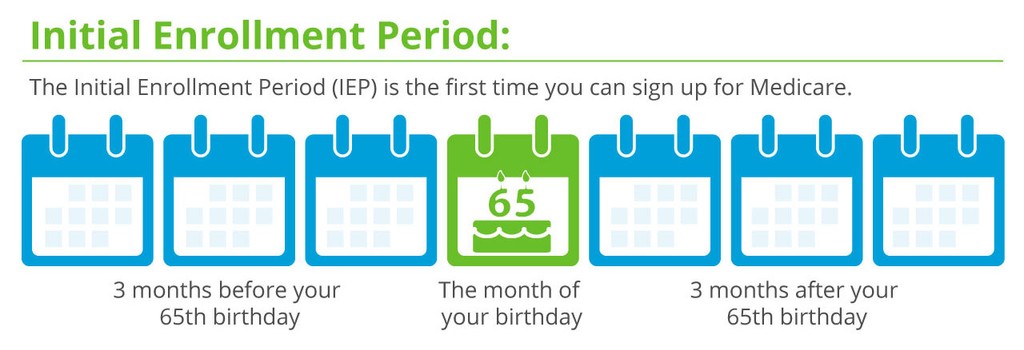
If you are eligible for Medicare, you can generally sign up for Medicare Part D, also known as a Medicare Prescription Drug Plan (PDP) during the Initial Enrollment Period (IEP), which is the 7-month period that starts 3 months before the month you turn 65, includes the month you turn 65, and ends 3 months after the month you turn 65.

In addition, you can also sign up for a Medicare PDP during the Annual Enrollment Period (AEP), which runs from October 15th through December 7th each year. During this period, you can join, switch, or drop your Medicare PDP.

NOTE: The AEP is the annual open enrollment period to change prescription drug plans and Medicare Advantage plans, not Medicare Supplement plans. If you have a Medicare Supplement, you can change it any time of the year. If you change your Medicare PDP or your Medicare Advantage plan during the AEP, the new coverage will begin on January 1st of the following year.

If you don’t enroll in a Medicare PDP during your IEP or when you first become eligible for Medicare, you may be subject to a late enrollment penalty if you later decide to enroll in a plan.

What Happens If I Don’t Sign Up For a Prescription Drug Plan During the Initial Enrollment Period?

If you miss your IEP to sign up for a Medicare PDP, you generally have to wait until the AEP to sign up for a plan unless you qualify for a Special Enrollment Period (SEP). A SEP is a time outside of the IEP or AEP when you can make changes to your Medicare coverage.

Here are some examples of events that may qualify as a SEP:

  • Moving to a new address: If an individual moves outside of their Medicare Advantage plan’s service area, they may be eligible for a SEP to enroll in a new plan.
  • Losing other health coverage: If an individual loses coverage from an employer, union, or other health plan, they may be eligible for a SEP to enroll in a Medicare Advantage plan or a Medicare Part D prescription drug plan.
  • Gaining new health coverage: If an individual gains coverage from an employer, union, or other health plan, they may be eligible for a SEP to disenroll from their Medicare Advantage plan or their Medicare Part D prescription drug plan.
  • Becoming eligible for Medicaid: If an individual becomes eligible for Medicaid, they may be eligible for a SEP to enroll in a Medicare Advantage plan or a Medicare Part D prescription drug plan.
  • Moving into or out of a nursing home or long-term care facility: If an individual moves into or out of a nursing home or long-term care facility, they may be eligible for a SEP to enroll in or change their Medicare coverage.

Not all events will qualify an individual for a Medicare SEP, and the rules and timelines for each SEP can vary. It’s always a good idea to check with Medicare or a licensed insurance agent to confirm eligibility and understand the options available. If you do qualify for a SEP, you have a limited time period to enroll in a Medicare PDP. The length of the SEP varies depending on the reason for the SEP. If you don’t qualify for a SEP, you will have to wait until the next AEP to sign up for a Medicare PDP.

When Do I Need to Sign Up For a Prescription Drug Plan When Coming Off An Employer Health Plan?

If you are coming off an employer health plan that included “creditable” prescription drug coverage and you enroll in a Medicare PDP within 63 days of losing your employer coverage, you generally will not be subject to a late enrollment penalty. Creditable coverage is prescription drug coverage that is expected to pay, on average, at least as much as Medicare’s standard prescription drug coverage. Your employer should notify you each year if your prescription drug coverage is creditable.

If you do not enroll in a Medicare PDP within 63 days of losing your employer coverage, you will be subject to a late enrollment penalty if you later decide to enroll in a plan. The penalty would be calculated based on the number of full months you were eligible for a Medicare PDP but did not have creditable prescription drug coverage.

Important: If you enroll in a Medicare Prescription Drug Plan after the 63-day period, you may also have a gap in coverage, which could result in higher out-of-pocket costs for your prescription medications.

What Is the Medicare Prescription Drug Plan Late Enrollment Penalty?

The Medicare PDP late enrollment penalty is a fee that may be imposed on individuals who enroll in a Medicare PDP after their IEP has ended, and who do not have creditable prescription drug coverage from another source (such as an employer).

The penalty is calculated based on the number of months that an individual went without creditable coverage, and is added to the monthly premium for the Medicare PDP. The penalty amount may increase each year, and the penalty is paid for as long as the individual is enrolled in a Medicare PDP. There are some exceptions to the penalty, such as if an individual had a valid reason for delaying enrollment, such as being covered under a spouse’s health insurance plan, etc.

How To Calculate the Medicare Prescription Drug Plan Late Enrollment Penalty

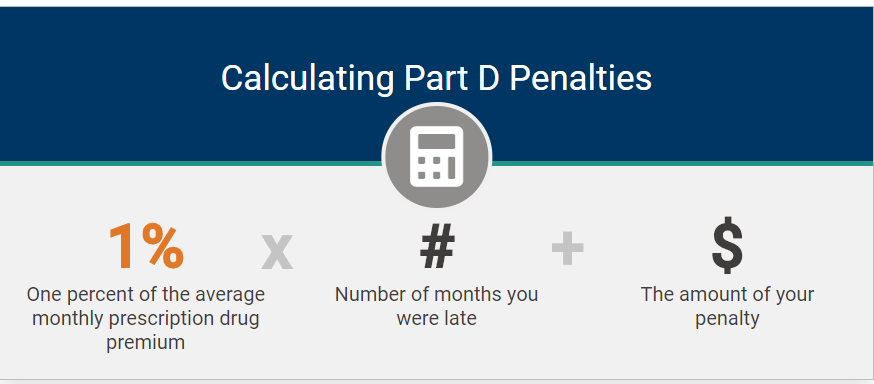
The Medicare PDP late enrollment penalty is calculated by multiplying 1% of the “national base beneficiary premium” ($32.74 in 2023) by the number of full, uncovered months that an individual did not have creditable prescription drug coverage.

The national base beneficiary premium is the average monthly premium for a Medicare prescription drug plan in the United States, as determined by the Centers for Medicare & Medicaid Services (CMS). The amount of the penalty may increase each year, as the national base beneficiary premium changes.

Here’s an example of how to calculate the penalty:

In 2023, the national base beneficiary premium is $32.74. If an individual goes without creditable prescription drug coverage for 12 months (a full year) after their IEP has ended, the penalty would be 1% of $32.74, or approximately $0.33 per month. Therefore, the penalty amount would be $3.96 ($0.33 x 12 months = $3.96), and this amount would be added to the individual’s monthly premium for their Medicare PDP.

If an individual goes without creditable prescription drug coverage for a shorter period of time, the penalty amount would be lower, based on the number of full, uncovered months, etc. The late enrollment penalty is added to your monthly premium for as long as you have Medicare PDP coverage.

NOTE: The penalty is permanent and may increase each year based on changes to the national base beneficiary premium.

To avoid the late enrollment penalty, it’s important to enroll in a Medicare PDP during your IEP, or when you first become eligible for Medicare, or within 63 days of coming off of an employer health plan, even if you don’t currently take any prescription medications. In California, you can get a Medicare PDP for as low as $4.50 per month!

How Do I Know If I Have to Pay a Penalty?

After you join a Medicare PDP, the plan will tell you if you have to pay a penalty and what your premium will be. In general, you’ll have to pay this penalty for as long as you have a Medicare drug plan.

What If I Don’t Agree With the Late Enrollment Penalty?

You may be able to ask for a “reconsideration.” Your drug plan will send information about how to request a reconsideration. Complete the form, and return it to the address or fax the number listed on the form. You must do this within 60 days from the date on the letter telling you that you have to pay a late enrollment penalty. Also send any proof that supports your case, like a copy of your notice of creditable prescription drug coverage from an employer or union plan.

Do I Have to Pay the Penalty Even If I Don’t Agree With It?

By law, the late enrollment penalty is part of the premium, so you must pay the penalty with the premium. You must also pay the penalty even if you’ve asked for a reconsideration. Medicare PDP’s can dis-enroll members who don’t pay their premiums, including the late enrollment penalty portion of the premium.

How Soon Will I Get a Reconsideration Decision?

In general, Medicare makes reconsideration decisions within 90 days. They will try to make a decision as quickly as possible. However, you may request an extension. Medicare may sometimes take an additional 14 days to resolve your case.

If Medicare decides that all or part of your late enrollment penalty is wrong, Medicare will send you and your drug plan a letter explaining its decision. Your Medicare PDP will remove or reduce your late enrollment penalty. The plan will send you a letter that shows the correct premium amount and explains whether you’ll get a refund. If Medicare decides that your late enrollment penalty is correct, Medicare will send you a letter explaining the decision, and you must pay the penalty.

To Make a Long Story Short…

To avoid the Medicare late enrollment penalty…

  • When you are turning 65, the best time to sign up for a Medicare PDP is during the 7-month IEP.
  • If you or your spouse is coming off of a creditable employer health plan, the best time to sign up for a Medicare PDP is during the 63 days after your employer coverage ends.

About Me

I hope that you have found this information to be interesting and informative. I’m an independent insurance agent with over 15 years of experience specializing in Medicare Supplement insurance, primarily in California. As an independent agent, I work with most of the major insurance carriers including Mutual of Omaha, Cigna, Blue Shield of CA, Anthem Blue Cross, Health Net, Aetna, etc. I have hundreds of clients, and I shop around for them every year around their birthday. Please click here to see some of my client testimonials.

If you have any questions, or if you know anyone that is turning 65 or starting Medicare, or if you would like for me to shop around for you, I’m happy to help, and there is no charge for my service!!! Please feel free to contact me! Also, please feel free to forward this blog on to anyone you know who may be interested.

Thank you!

Ron Lewis
CA agent #0B33674
NV agent #3822123

Ron@RonLewisInsurance.com
866.718.1600 (Toll-free)
760.525.5769 (Cell)
www.MedigapShopper.com
How to Sign Up for Original Medicare (Part A and Part B)

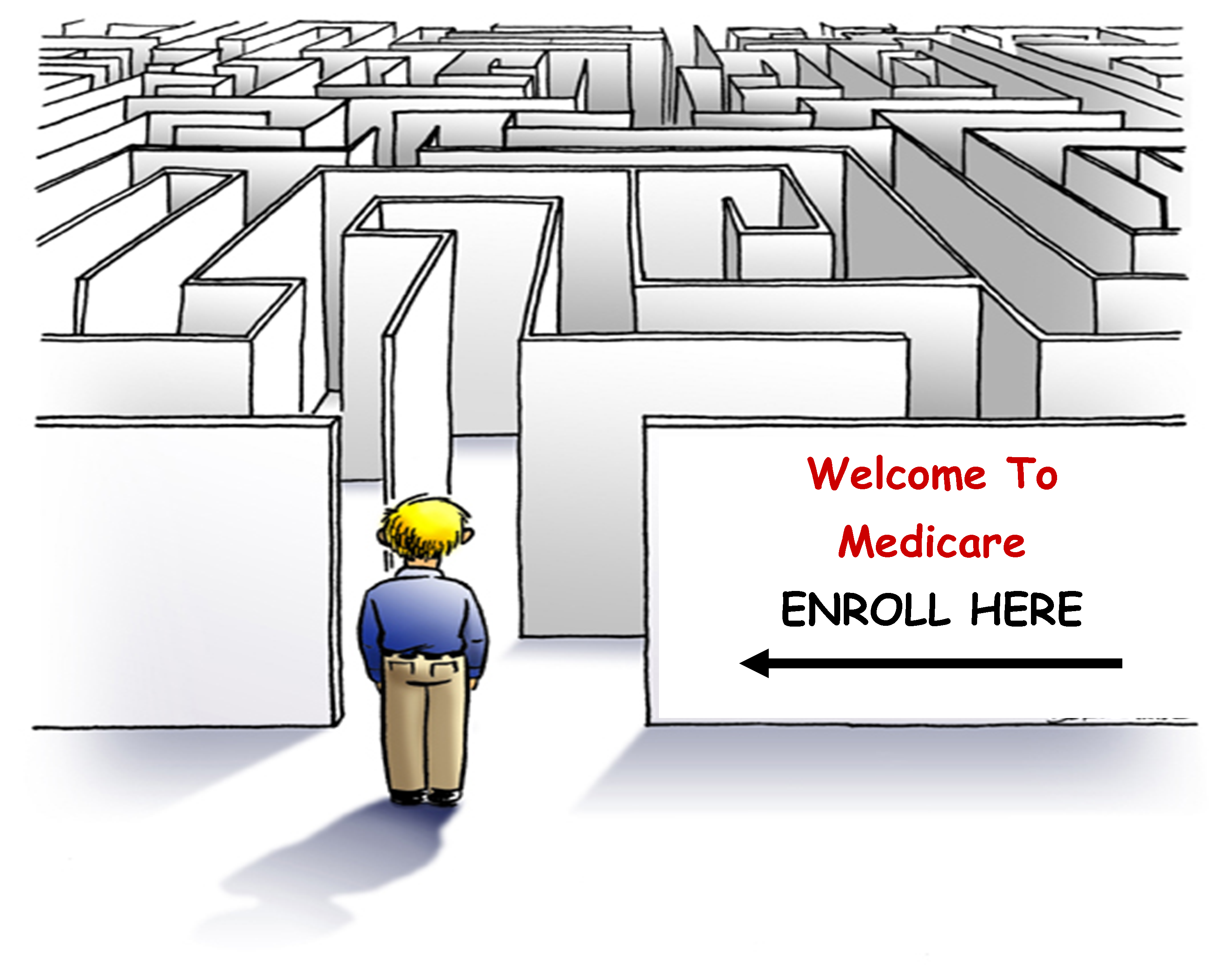
Signing up for Medicare can seem like a confusing and daunting task, but it’s really not that bad. This article will hopefully answer any questions you have and make the Medicare maze easy to navigate.

What is Medicare?

Medicare is the federal health insurance program for:

  • People who are 65 or older
  • Certain younger people with disabilities
  • People with End-Stage Renal Disease (permanent kidney failure requiring dialysis or a transplant, sometimes called ESRD)

Who is Eligible For Medicare?

You are generally eligible for Medicare if you are 65 or older, a U.S. citizen or permanent legal resident, and have lived in the U.S. for at least five year

What Are the Four Parts of Medicare?

Medicare is composed of four parts:

  • Part A (Hospital insurance)
  • Part B (Medical insurance)
  • Part C (Medicare Advantage plans)
  • Part D (Prescription drug plans)

NOTE: Medicare Parts A and B are also referred to as “Original Medicare.”

What Does Medicare Part A Cover?

Part A covers things like inpatient hospital stays, home health care and some skilled nursing facility care.

What Does Medicare Part B Cover?

Part B covers things like doctor visits, outpatient services, X-rays and lab tests, and preventive screenings.

What Does Medicare Part C Cover?

Part C is also known as Medicare Advantage (MA). An MA plan is a Medicare-approved plan from a private company that offers an alternative (replacement) to Original Medicare (see note below) for your health and drug coverage. These “bundled” plans include Part A, Part B, and often Part D. In most cases, you must only use doctors who are in the plan’s network. Most MA plans are HMO’s and are restrictive and limit your options to what doctors, specialist, hospitals, and care facilities you can go to.

IMPORTANT: A much better option to Part C, in my opinion, is a Medicare Supplement plan, also known as “Medigap” because it picks up the gap in coverage not covered by Medicare. With a Medigap plan, there are NO networks, and you have much greater freedom of choice as to which doctors, specialists, care facilities, etc. that you go to. You can go to any doctor, specialist, care facility, etc. ANYWHERE in the US as long as they accept Medicare, and most do, about 93%.

What Does Medicare Part D Cover?

Part D covers the cost of prescription drugs (including many recommended shots or vaccines).

The Medicare Initial Enrollment Period (IEP)

If you are turning 65 and are eligible for Medicare, you can sign up for Original Medicare, aka Medicare Part A (Hospital insurance) and Part B (Medical insurance) during your Initial Enrollment Period (IEP), which typically starts three months before the month of your 65th birthday and ends three months after your birth month. For example, if your birthday is June 23rd, your IEP would begin on March 1st and end on September 30th of that year.

NOTE: Medicare normally begins on the 1st of the month of your 65th birthday. If you want your coverage to start then, you need to sign up for Medicare during the 3 months before the month of your birthday. Otherwise, your Medicare won’t start until sometime after your birthday month.

For most people, their Medicare normally begins on the 1st of the month of their 65th birthday. However, if your birthday is on the 1st of the month, your Medicare would begin on the 1st of the previous month. For example, if your birthday is June 1st, your Medicare would normally begin on May 1st.

NOTE: If your birthday is on the 1st of the month, your IEP begins and ends one month earlier as well. For example, if you turn 65 on June 1st, your IEP would begin on February 1st and end on August 31st.

Some People Are Automatically Enrolled in Medicare When They Turn 65 and Some Are Not

If you are currently receiving Social Security or Railroad Retirement Board benefits before you turn 65, you will normally be automatically enrolled in Medicare, and you’ll receive your Medicare card in the mail before your 65th birthday. You’ll still have an IEP, and during this seven-month window, you can still make Medicare coverage decisions such as signing up for a Medicare Supplement and a Prescription Drug Plan (PDP).

IMPORTANT: If you are not currently receiving Social Security or Railroad Retirement Board benefits before you turn 65, you’ll have to sign up for Medicare on your own. If that’s the case, be sure to write down your IEP dates on your calendar before you turn 65.

Three Ways to Sign Up for Medicare

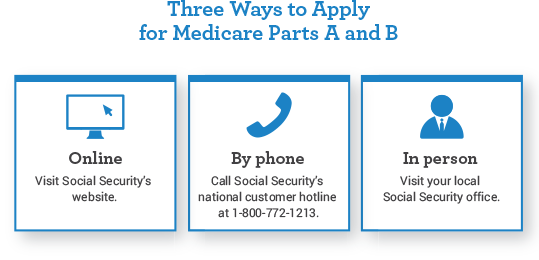
There are the three different ways to sign up for Medicare:

  • You can apply for Medicare online at the Social Security Administration’s website (https://secure.ssa.gov/iClaim/rib).
  • You can call Social Security toll-free number at 1-800-772-1213 and sign up on the phone.
  • You can visit your local Social Security office.

I know that it doesn’t seem intuitive that you would contact Social Security to sign up for Medicare, but you do! When you apply for Medicare, you will need to provide personal and financial information including your name, Social Security number, birth date, income, etc.

After you apply for Medicare, you will receive a confirmation notice in the mail indicating whether your application has been approved, etc. If you have any questions or concerns about the Medicare enrollment process, you can contact Medicare directly at 1-800-MEDICARE (1-800-633-4227).

Do I Need to Enroll in Medicare If I’m Working After Age 65

For most people, Medicare Part A (Hospital insurance) is free because you or your spouse paid Medicare taxes long enough while working, generally at least 10 years. However, Part B (Medical insurance) is not free. There is a monthly premium for Part B, which is currently $164.90 each month for most people (or higher depending on your income).

You’ll pay a higher monthly premium for Part B if your modified adjusted gross income (MAGI), as reported on your IRS tax return from 2 years ago, is more than $97,000 in 2023 if you file an individual tax return or are married and file separately, or $194,000 if you are married and file a joint tax return. Please click here for more detailed information about the Part B premiums. Social Security will tell you if you have to pay a higher premium because of your income.

NOTE: If you are planning to continue working past age 65, you may be able to delay enrolling in Medicare Part B and avoid paying the Medicare Part B monthly premium. Since Medicare Part A is usually free, most people sign up for it even if they are working.

If you have “creditable” health coverage from your employer or are covered under a spouse’s employer plan, you may qualify for a Special Enrollment Period (SEP), and be able to delay enrolling in Part B without a penalty.

Medicare defines “creditable coverage” as coverage that is at least as good as what Medicare provides.

Here are some situations that will affect when you should begin your Medicare coverage:

  • If an employer has 20 or more employees, you can generally choose to delay Medicare enrollment, drop your employer coverage for Medicare, or have both Medicare and employer coverage.
  • If an employer has fewer than 20 employees, you will generally need to enroll in Medicare during your IEP.
  • If you have health coverage through a spouse’s employer, what you can do will depend on the employer’s rules. You may be able to delay signing up for Medicare or you may need to enroll at age 65.

IMPORTANT: When you are turning 65, if you aren’t sure if your employer plan provides creditable coverage, you should call Social Security to verify. Otherwise, you could end up paying a penalty.

What If I’m Coming Off An Employer Group Plan?

If you qualified to delay Medicare because you had creditable coverage from an employer, there is an 8-month Special Enrollment Period (SEP) for enrolling in Medicare Parts A and B.

IMPORTANT: Be careful because this SEP can be tricky. Although you have the entire 8 months to get Medicare Parts A & B, you only get the first 2 months to enroll in Part C or Part D without penalty. If you enroll after the two-month period, you’ll face late enrollment penalties for Part D (regardless of whether you end up with a stand-alone Part D plan or a Medicare Advantage plan that includes drug coverage).

What If I Don’t Enroll in Medicare On Time?

If you don’t sign up for Medicare Part A, Part B, or Part D on time, you will pay late enrollment penalties for life so make sure to sign up for Medicare coverage during your IEP unless you have other creditable coverage that’s comparable in value to Medicare, such as from an employer. Please click here for more detailed information.

It’s a good idea to start researching your Medicare options a few months before your 65th birthday to make sure you have enough time to enroll and choose the plan that’s right for you.

Original Medicare Will Not Cover All of Your Costs!

Original Medicare (Part A and Part B) does not cover 100% of your medical costs. Like most health insurance, Medicare generally comes with out-of-pocket (OOP) costs including co-payments, coinsurance, and deductibles. Medicare usually pays approximately 80% of allowable charges for covered services.

The Part A Deductible and Co-payments

If you’re a hospital inpatient, Medicare Part A generally covers your care for a limited time. A deductible or copay generally applies.

NOTE: The Part A deductible isn’t an annual deductible, it’s a “benefit period” deductible meaning there can be multiple Part A benefit periods and deductibles per calendar year. In 2023, the Part A deductible per benefit period is $1,600.

The Part A benefit period begins the day you go into a hospital or skilled nursing facility and ends when you have been out for 60 consecutive days in a row. It’s possible to have multiple benefit periods in a calendar year, and without a Medicare Supplement, you would have to pay the full deductible amount for each benefit period!

Most Medicare Supplements pay for all the Part A deductibles, co-payments, etc. With a Plan G Medicare Supplement, your only out-of-pocket cost for the entire year is the Part B deductible, which is currently $226 in 2023.

In 2023, after you pay the $1,600 Part A deductible for each benefit period, there are no hospital co-payments for the first 60 days, but there are co-payments if you are in a hospital for longer than 61 days. Most Medicare Supplements will cover all of these costs.

The Medicare Part B Deductible

In 2023, the Medicare Part B calendar year deductible is $226. Unlike Part A, the Part B deductible is payable only one time per calendar year.

What is the Maximum Out-of-Pocket Expense Limit Under Original Medicare?

Original Medicare (Part A and Part B) have no out-of-pocket maximum amount.

NOTE: A Plan G Medicare Supplement will pick up ALL Medicare-approved costs over and above the $226 Part B deductible!

10 Standardized Medicare Supplement Plans to Choose From

Nationwide, there are 10 “standardized” Medicare Supplement plans to choose from, Plan A through Plan N. These plans are standardized meaning that Plan G is Plan G, Plan N is Plan N, etc. The coverage and benefits are exactly the same with every Plan G, Plan N, etc. making it easier to compare “apples with apples,” etc.

Although these plans are standardized, the rates are not standardized, so it is important to shop around and compare because the rates vary significantly between insurance carriers for the same identical plan and coverage.

Since there are co-payments, coinsurance, and deductibles and no out-of-pocket maximum with Original Medicare (Part A and Part B), most people get a Medicare Supplement plan in addition to Original Medicare to pay for most of these costs.

The Plan G Medicare Supplement is the Most Popular and Cost-Effective Plan

Of the 10 standardized Medicare Supplement plans, the three most popular plans are Plan F, Plan G, and Plan N. Of the three plans, Plan G is the best plan and most cost-effective because your only OOP cost for the entire year is the Medicare Part B deductible, which is $226 for all of 2023.

NOTE: The Part B deductible can change from year to year, but historically, it has never increased significantly. Once you meet this small annual deductible, you normally won’t have any other costs for the remainder of the year.

How Much Do Medicare Supplement Plans Cost?

In California, rates are based primarily on age and zip code, so Plan G will cost less for someone who is age 65 rather than age 85. For example, in the San Diego area (zip code 92024), the rates for age 65 range from $100 per month to $203 per month! For age 85 in the same zip code, the rates range from $221 per month to $395 per month!

The California Birthday Rule

In California, you can change your Medicare Supplement plan any time of the year, but you would normally have to be in relatively good health to do so because you will have to answer health questions and be medically underwritten. However, California is one of only a few states with a birthday rule called the California Birthday Rule.

Under this law, if you currently have a Medicare Supplement, you can apply for a new Medicare Supplement with “equal or fewer” benefits during the 60 days following your birthday each year, and you cannot be turned down for coverage. For example, if you have Plan G, you can switch to Plan G with any other insurance carrier, REGARDLESS OF YOUR HEALTH and without answering any health questions on the application.

NOTE: Only six states currently have a Medicare Supplement birthday rule including California, Idaho, Illinois, Louisiana, Nevada, and Oregon. Before 2022, only two states had a birthday rule.

It’s Important to Shop Around and Compare Medicare Supplement Rates Every Year!

Since there is such a large discrepancy in pricing and because Medicare Supplement rates are constantly changing as we get older, it’s important to take advantage of the California Birthday Rule and compare prices and shop around every year or two.

About Me

I hope that you have found this information to be interesting and informative. I’m an independent insurance agent with over 15 years of experience specializing in Medicare Supplement insurance, primarily in California. As an independent agent, I work with most of the major insurance carriers including Mutual of Omaha, Cigna, Blue Shield of CA, Anthem Blue Cross, Health Net, Aetna, etc. I have hundreds of clients, and I shop around for them every year around their birthday. Please click here to see some of my client testimonials.

If you have any questions, or if you know anyone that is turning 65 or starting Medicare, or if you would like for me to shop around for you, I’m happy to help, and there is no charge for my service!!! Please feel free to contact me! Also, please feel free to forward this blog on to anyone you know who may be interested.

Thank you!

Ron Lewis
CA agent #0B33674
NV agent #3822123

Ron@RonLewisInsurance.com
866.718.1600 (Toll-free)
760.525.5769 (Cell)
www.MedigapShopper.com
2019 Medicare Deductibles, Coinsurance, and Out-Of-Pocket Limits

The new 2019 Medicare deductibles, coinsurance, and out-of-pocket limits were recently released, and they go into effect on January 1st, 2019.

January 2019

Medicare Part A (Hospital Insurance)

  • Part A Deductible: This deductible is increasing $24 to $1,364 per benefit period.
  • Part A Coinsurance: Inpatient Hospital Care (Days 61-90). Increasing $6 to $341 per day.
  • Lifetime Reserve Coinsurance: Inpatient Hospital Care (Days 91-150). Increasing $12 to $682 per day.
  • Skilled Nursing Facility (SNF) Coinsurance: (Days 21 through 100) Increasing $3 to $170.50 per day.

NOTE: A benefit period begins on the first day you receive service as an inpatient in a hospital and ends after you have been out of the hospital and not received skilled care in any other facility for 60 days in a row. This is not an annual deductible; there can be multiple benefit periods (up to six) in a calendar year!

Medicare Part B (Medical Insurance)

  • Part B Annual Deductible: Increasing $2 to $185 per year.

NOTE: For those of you with a Plan G Medicare Supplement (also known as Medigap because it picks up the gap in coverage not covered by Medicare), Plan G is identical to Plan F with the exception of the Part B deductible. Once this deductible has been met, Plan F and Plan G are exactly the same. If you are saving more than $185 per year on your premiums by switching from Plan F to Plan G, then Plan G ends up costing less than Plan F.

Medicare Supplement Plan-Specific Deductibles and Out-of-Pocket  Limits

  • High Deductible Plan F Annual Deductible: Increasing $60 to $2,300 per calendar year.
  • Plan K Annual Out-of-Pocket Limit: Increasing $320 to $5,560 per calendar year.
  • Plan L Annual Out-of-Pocket Limit: Increasing $160 to $2,780 per calendar year.

Part D Prescription Drug Plans

The new 2019 Part D deductible is $415 once a year.

How Do These Changes Affect My Medicare Supplement?

If you have a Medicare Supplement, your benefits are automatically adjusted every year to cover the new deductibles, co-payments, and coinsurance amounts in 2019.

Do You Have a Medicare Supplement Plan?

If you have a Medicare Supplement plan, contact me for a free quote! As an independent insurance agent, I work with all the major insurance carriers, and more than likely, I can save you hundreds of dollars on your Medicare Supplement premiums for the same exact plan and coverage!

If you have any questions or comments, please let me know!

Thanks!

Ron Lewis

Ron@RonLewisInsurance.com
www.MedigapExpress.com

Major Medicare Supplement Rate Discrepancies Between Insurance Carriers!

Do you know that Medicare Supplement (MediGap) rates vary significantly between insurance carriers for the same identical plan and coverage? In the US, there are 10 “standardized” Medicare Supplement plans to choose from, plans A through N.

medigap

NOTE: The plans are labeled A, B, C, D, F, G, K, L, M and N to signify the plan differences. (Plans E, H, I and J are no longer available.)

The word “standardized” means that the coverage for Plan F, Plan G, etc. is exactly the same no matter what insurance carrier you have. For example, the coverage for Plan F is exactly the same with Mutual of Omaha, UnitedHealthcare, Blue Shield of CA, Aetna, Cigna, Anthem Blue Cross,  etc.

Although the coverage is exactly the same between insurance carriers for the standardized plans, the PREMIUMS ARE NOT THE SAME! In fact, most people are paying hundreds of dollars per year more for their insurance premiums than they should be!

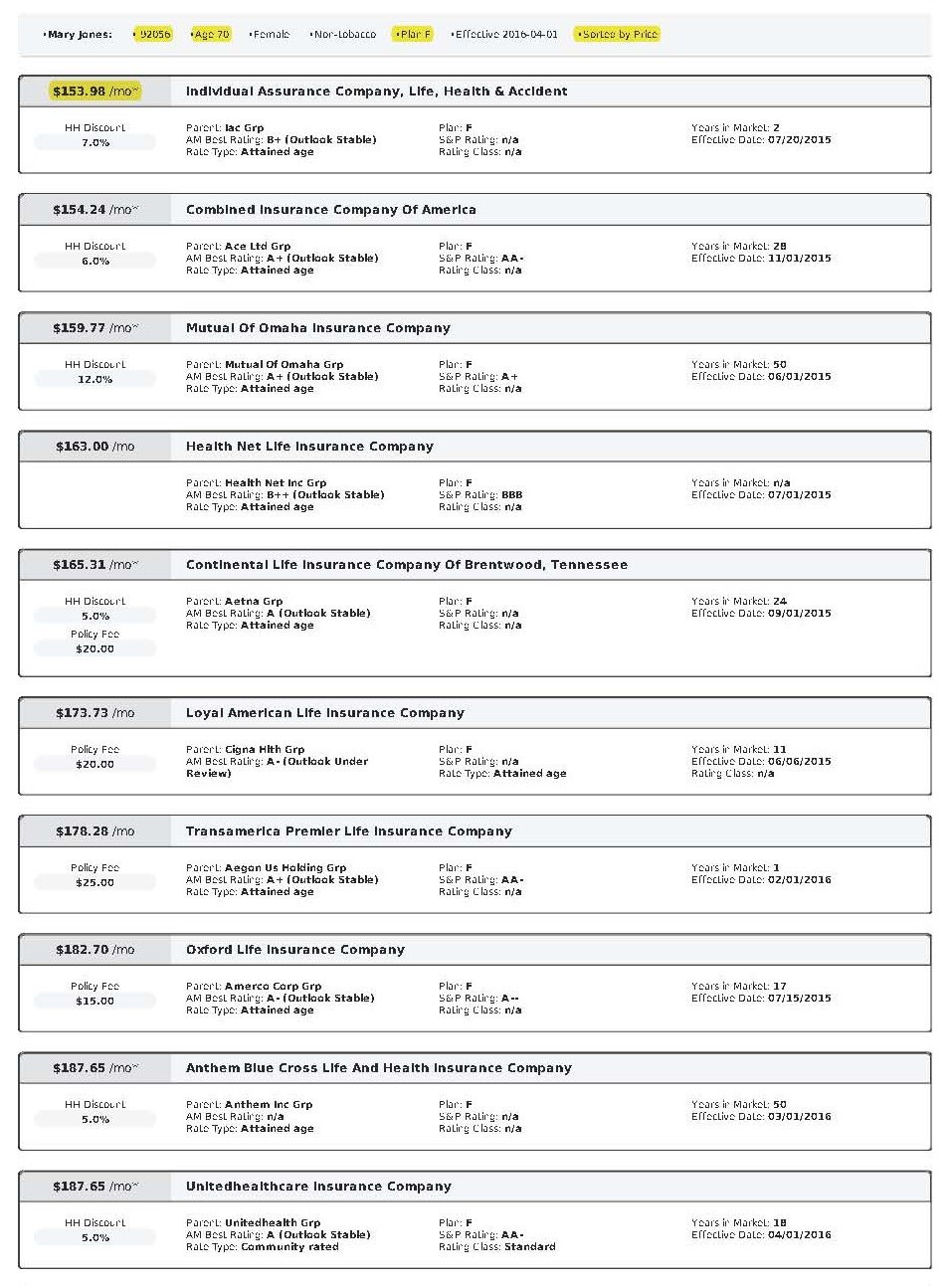
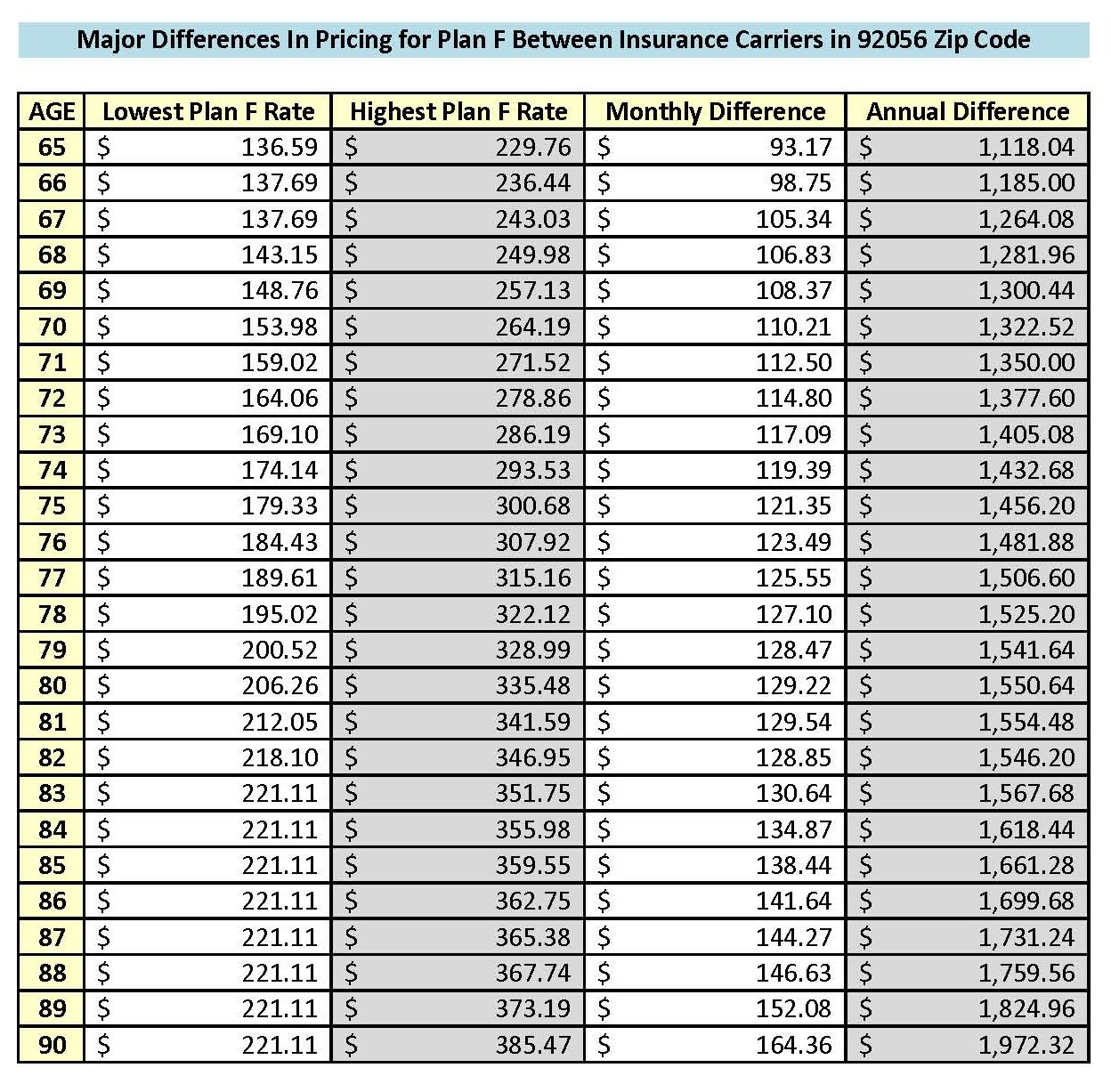
For example, the Plan F premiums for a 70 year old living in the 92056 zip code in San Diego range in price from $153.98 per month to $264.19 per month. That’s a difference of $110.21 per month or $1,322.52 per year for the same identical plan and coverage! On the following rate sheet, you can see the different Plan F rates for 18 different insurance carriers in the 92056 zip code. Obviously, some carriers are more competitively priced than others!

Mary Jones Plan F Rates_Page_1

Mary Jones Plan F Rates_Page_2

As you can see, in the 92056 zip code, the Plan F rates for a 70 year old range in price from $153.98 per month to $264.19 per month! Again, that’s a difference of $110.21 per month or $1,322.52 per year for the same exact plan and coverage!

It’s Important to Shop Around Every Year!

The Medicare Supplement market is constantly changing, and so are the premiums. If you have a Medicare Supplement and you haven’t shopped around during the last year, there’s a good chance that you’re paying hundreds of dollars a year more for your insurance than you should be! Many people that I meet haven’t shopped around at all since they first signed up for Medicare! Many of these individuals haven’t heard from their insurance agent since then as well!

This past year, two of my clients (a husband and wife) had Plan G, and they were paying $809 per month for both of them, approximately $404.50 each! I shopped around for them and found them Plan G with a different carrier, Mutual of Omaha, and their total monthly premium is now $367.01 per month! That’s a savings of $441.99 per month or $5,303.88 per year! While this is not the norm, I can usually save most of my clients from $300 to $600 per year each on their Medicare Supplement insurance premiums and often more.

What is the Price Range for Plan F Medicare Supplement Rates?

In the following chart, I have taken the lowest and highest Plan F premiums for ages 65 through 90 in the 92056 zip code. As you can see, the monthly and annual differences are significant for every age group.

2 Lowest Plan F vs Highest Plan F

Is There An Open Enrollment Period for Medicare Supplement Plans?

No. Unlike Medicare Advantage (MA) plans, which have an annual open enrollment period from October 15th through December 7th every year, you can shop around and apply for Medicare Supplement plans all year long.

NOTE: There is a six month-open enrollment period for Medicare Supplements when you first sign up for Medicare Part B.

Do I Need to Be In Good Health to Get a New Medicare Supplement Plan?

Unless you are in a Special Enrollment Period (SEP), if you already have a Medicare Supplement, you need to be in relatively good health to apply for a new Medicare Supplement with a different carrier. However, if you have a Medicare Supplement and you apply during the 30 days before or after your birthday, you don’t have to answer any health questions on the application, and you cannot be turned down due to health reasons if you apply for the same plan or another plan with fewer benefits. For more details, please see the California Birthday Rule section below.

Heart

What Happens If I Am Not In Good Health? Can I Still Apply For a New Medicare Supplement Plan?

Yes, absolutely! Because of the California Birthday Rule, if you already have a Medicare Supplement and you have serious health issues, YOU CANNOT BE TURNED DOWN FOR COVERAGE if you apply during the 30 days before or after your birthday.

California Birthday Rule

In California, there is a law called the California Birthday Rule. This law guarantees you the right to apply for a new Medicare Supplement plan EVERY YEAR, as long as you apply during the 30 days following your birthday. This is also known as the annual 30-day open enrollment period.

NOTE: Although the California Birthday Rules specifies that you can apply, REGARDLESS OF YOUR HEALTH, during the 30 days following your birthday without being turned down for coverage, several insurance carriers will let you apply during the 30 days BEFORE or AFTER your birthday!

This is more advantageous for you because the premiums with these carriers are based on your current age when you apply, and your rates will be lower if you apply during the 30 days prior to your birthday. With these carriers, your new rates are also guaranteed and locked in for the first 12 months of your policy, so there won’t be any unexpected rate increases.

NOTE: Not all insurance carriers lock your rates for the first 12 months.

If you want to take advantage of the California Birthday Rule and apply during the 30 days before or after your birthday,  YOU CANNOT BE TURNED DOWN FOR COVERAGE as long as you apply for the same plan that you currently have OR if you apply for a different plan that has fewer benefits. For example, if you have Plan F (the most comprehensive plan) and you want to apply for Plan F with another carrier to save money on your premiums, or if you have Plan F and you want to apply with Plan G, etc.

NOTE: If you apply under the California Birthday Rule, there are no preexisting waiting periods for prior health conditions.

If you are in relatively good health, you can apply for a new Medicare Supplement plan any time of the year. If you have serious health issues, you should take advantage of the California Birthday Rule and apply for coverage during the 30 days before your birthday to save money on your premiums.

Consider Plan G to Save More Money On Your Premiums

Besides shopping around every year to make sure that you aren’t paying too much for your premiums, if you currently have Plan F, you should consider Plan G. Why? Because Plan G is identical to Plan F in EVERY way except you would pay a small $166 Part B (Medical) deductible one time per calendar year. That is the only difference between the two plans!

NOTE: I have an Obamacare Bronze plan, and my individual medical deductible is only $6,000 per year! I would gladly pay $166 per year for my medical deductible!

In other words, the most you would pay for any out-of-pocket expense with Plan G in any calendar year is $166. However, in most cases, you will save significantly more than $166 per year on your premiums, which usually makes Plan G a better value and more cost effective.

NOTE: The Part B (Medical) deductible is subject to change each year, but historically, it has remained stable.

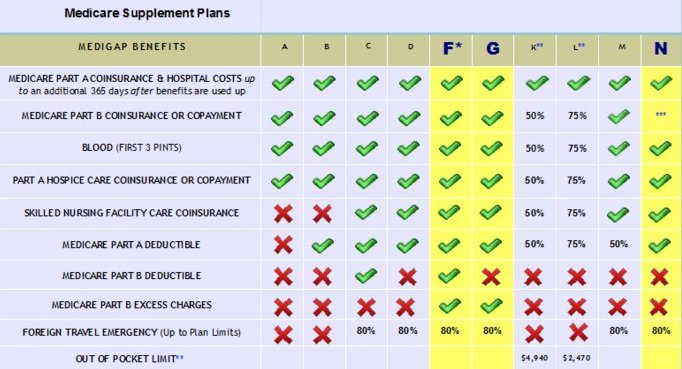
To see the difference in coverage between Plan F and Plan G, please see the following chart:

Medigap Chart Plans F and G

As you can see, when you compare Plan F and Plan G, everything is exactly the same except for the $166 Part B deductible. Plan F has no deductible, and Plan G is basically Plan F with a small, $166 deductible.

Price Differences Between Plan F and Plan G

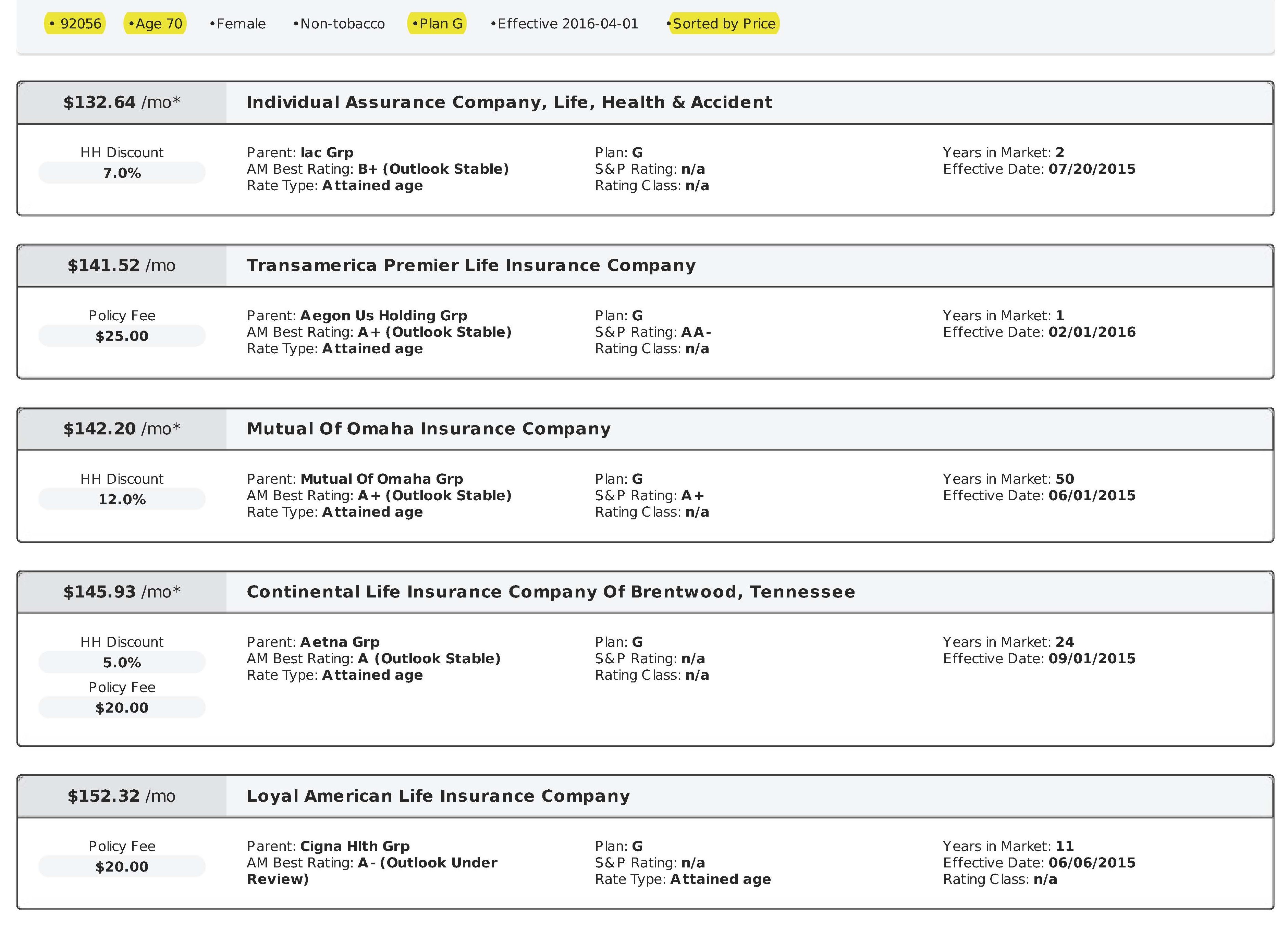
Although the two plans are almost identical in coverage, the rates for Plan G are usually significantly less than the Plan F rates. For a 70 year old in the 92056 zip code, the Plan F rates (above) range in price from $153.98 per month to $264.19 per month. The Plan G rates (below) range in price from $132.64 per month to $152.32 per month!

Plan F or Plan G

Plan G Rates Age 70

As you can see, the Plan G rates are significantly less than the Plan F rates for almost the same identical coverage.

Conclusion

The rates vary significantly from one insurance carrier to the next for the same identical plan and coverage. I recommend that you take advantage of the California Birthday Rule and shop around, every year, to make sure that you aren’t paying too much for your insurance. I would also suggest that you check out Plan G as another way to save a lot of money on your insurance premiums.

If you have any questions, or if you would like a free, no obligation quote, please don’t hesitate to let me know! I’m always happy to help!

Ron Lewis OHCC AD

Also, your feedback and comments are appreciated!

Thanks!

Ron Lewis
Ron@RonLewisInsurance.com
(760) 525-5769 – Cell
(866) 718-1600 – Toll-free

Want to Change Your Medicare Advantage Plan to a Medicare Supplement Plan During AEP?

MEDICARE_MazeThe Annual Enrollment Period (AEP) for Medicare Advantage (MA) plans (Part C) is almost here! If you have an Advantage plan and you’d like to change to a traditional Medicare Supplement plan, you can apply during the upcoming AEP, which is from October 15th through December 7th, for an effective date of January 1st, 2016.

If you have an Advantage plan or a Prescription Drug Plan (PDP), this is the one time of year to make changes to your health and/or prescription drug plans for the following year. To make these changes, the plan has to receive your enrollment request (application) no later than December 7th. If you stay with the same plan that you had, any changes to coverage, benefits, or costs for the new year will also begin on January 1st.

What is the Annual Notice of Change (ANOC)

Medicare_AdvantageIf you have an Advantage plan, your plan will send you an “Annual Notice of Change” (ANOC) each fall. The ANOC includes any changes in coverage, costs, provider networks, or service areas that will be effective in January. These are usually mailed out in September by your Advantage plan. After you receive your notice, review any changes to decide whether the plan will continue to meet your needs during the following year. If you don’t receive this important notice, contact your Advantage plan and request that they send it to you.

IMPORTANT: If you have health conditions that may prevent you from meeting the underwriting requirements for a Medicare Supplement, the ANOC may qualify you for one of the “guaranteed issue” situations listed below.

Minimum Health Requirements for a Medicare Supplement

To apply for a Medicare Supplement during the AEP, you must complete a Medicare Supplement application, which includes a section with health questions. If you have serious health issues, there is a good chance that your application will be turned down. However, there are certain “guaranteed issue” situations that you may qualify for. This means that you will not have to answer any of the health questions on the application, and you cannot be turned down!

In the “Eligibility for Guaranteed Issue In California” section below, there are nine situations that would guarantee you the right to change your Advantage plan to a Medicare Supplement plan, REGARDLESS OF YOUR HEALTH, without answering any health questions on the application!

Carefully check the ANOC. If your Medicare Advantage plan has increased your premium or co-payments by 15% or more, reduced your benefits, or terminated its relationship with your medical provider who was treating you, YOU PROBABLY QUALIFY FOR A GUARANTEED ISSUE MEDICARE SUPPLEMENT PLAN!

Guaranteed Issue Rights

Guaranteed issue rights are rights you have in certain situations when insurance companies MUST offer you certain Medicare Supplement policies (plans A, B, C, F, K, or L). In these situations, an insurance company:

  • Must sell you a Medicare Supplement policy
  • Must cover all your pre-existing health conditions
  • Can’t charge you more for a Medicare Supplement policy because of past or present health problems

In most cases, you have a guaranteed issue right when you have other health coverage that changes in some way, such as when you lose the other health care coverage. In other cases, you have a “trial right” to try an Advantage plan and still buy a Medicare Supplement policy if you change your mind.

Medicare_Supplement

Eligibility for Guaranteed Issue In California

In California, you would qualify for a guaranteed issue Medicare Supplement for any of the following situations:

  1. Has your employer-sponsored retiree plan that is supplementing Medicare involuntarily terminated?
  2. Has your employer-sponsored retiree plan stopped providing Medicare supplement benefits or the Medicare Part B 20% coinsurance for services?
  3. Have you lost eligibility for an employer-sponsored retiree plan due to divorce or death of a spouse or family member?
  4. Has your Medicare Advantage plan increased your premium or co-payments by 15% or more, reduced your benefits, or terminated its relationship with your medical provider who was treating you?
  5. Have you moved out of the area of your MA plan or Program for All-Inclusive Care for the Elderly (PACE) organization?
  6. Has your MA plan, Medicare SELECT Plan, PACE provider or any other health plan under contract with Medicare: (a) committed fraud; (b) ended or lost its contract with Medicare; (c) misrepresented the plan you bought, or (d) failed to meet its contractual obligations to Medicare beneficiaries, as determined by the federal government?
  7. Did you join a MA plan or PACE organization when you first became eligible for Medicare at age 65, and you want to switch to a Medicare Supplement policy during your first 12 months in the MA plan or PACE organization?
  8. Have you switched from a Medicare Supplement policy to a MA plan, PACE organization, Medicare SELECT plan, or any other health care organization contracting with Medicare, for the first time since becoming eligible for Medicare within the past 12 months?
  9. Has your MA plan left your area, and if so, did your MA plan benefits end within the past 123 days?

Purchasing a Medicare Supplement Insurance Policy if You’ve Lost Your Health Care Coverage

If you believe that you have a guaranteed issue right to purchase a Medicare Supplement policy, make sure you keep the following items:

  • A copy of any letters, notices, emails, and/or claim denials that have your name on them as proof of your coverage being terminated.
  • The postmarked envelope these papers come in as proof of when it was mailed.
  • You may need to send a copy of some or all of these papers with your Medicare Supplement application to prove you have a guaranteed issue right.
  • If you have a Medicare Advantage Plan but you’re planning to return to Original Medicare, you can apply for a Medicare Supplement policy before your coverage ends. The Medicare Supplement insurer can sell it to you as long as you’re leaving the plan. Ask that the new policy take effect no later than when your Medicare Advantage enrollment ends, so you’ll have continuous coverage.

Which is Better, a Medicare Supplement or an Advantage Plan?

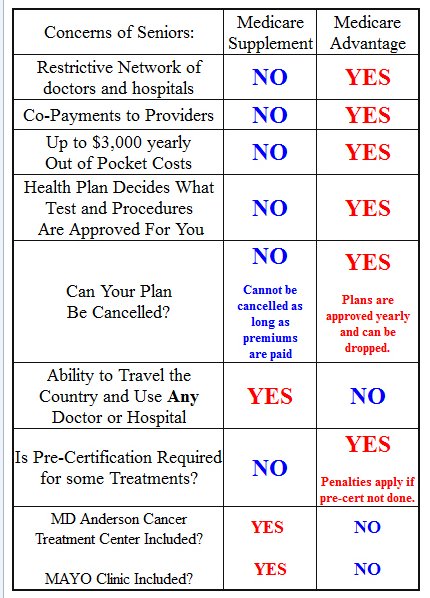
This topic is big enough to have its own blog! Personally, I strongly prefer Medicare Supplements over Advantage plans because you can go to ANY doctor or hospital in the US as long as they accept Medicare, and most of them do. With an Advantage plan, you are limited to their local networks of doctors and hospitals, and that is a major disadvantage. Also, a lot of people seem to think that Advantage plans cost less than Medicare Supplements, but if you are every hospitalized or develop a serious medical condition, you will be spending thousands of dollars on co-payments and deductibles with your Advantage plan.

Here are some pros and cons when comparing Medicare Supplements to Advantage plans.

Medigap Advantage Comparison ChartFor the reasons mentioned above, I would recommend Medicare Supplements over Advantage plans. If you are relatively healthy, an Advantage plan may be okay. But if you later develop serious health conditions, you’ll wish you had a Medicare Supplement because you should have the freedom to go to the best doctors, hospitals, specialists, and facilities ANYWHERE in the United States!

Peace of Mind Next Exit

If you (or someone you know) have an Advantage plan and you have any questions or would like to find out more about Medicare Supplement plans, please contact me at Ron@RonLewisInsurance.com. As an independent agent, I work with ALL the major insurance carriers in California, Washington, Nevada, and Arizona, and I’ll shop around for you to get you the best rates.

Which is Better, Medicare Supplement Plan F or Plan G?

Today, there are 10 standardized Medicare Supplement plans (Plans A through N). The coverage for these plans is the same no matter which insurance company you have. For example, the coverage and benefits for Plan F is exactly the same at Aetna, Cigna, Blue Shield, Stonebridge, Blue Cross, etc., so it’s much easier to shop around and compare plans and prices today.

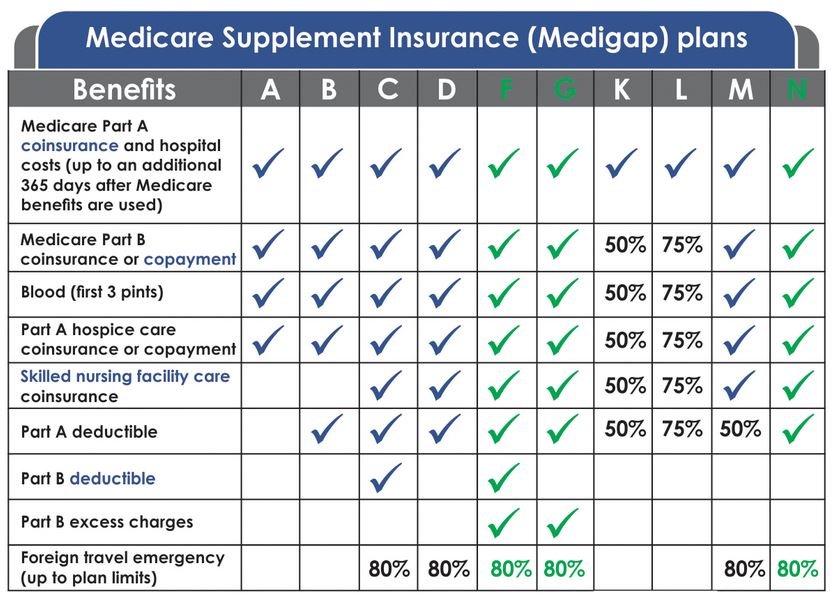
As you can see in the following chart, Plan F provides the most extensive Medicare Supplement coverage. (The plans with the empty boxes indicate coverage that is not included with that particular plan.)

Medicare Chart

Of the 10 standardized Medicare Supplement plans (aka “Medigap” plans), Plan F is considered to be the best plan because it provides the most comprehensive coverage. Plan F pays for all of the coinsurance, copayments, and deductibles not paid for by Medicare.

Plan F pays for the following benefits:

  • Medicare Part A Hospital Deductible (Currently $1,216 per benefit period) *
  • Medicare Part A Hospital Coinsurance
  • Medicare Part B Deductible (Currently $147 per year)
  • Medicare Part B Coinsurance
  • Medicare Part B Excess Charges
  • Hospice Care Coinsurance or Copayments
  • Skilled Nursing Facility Care Coinsurance
  • Charges for First Three Pints of Blood
  • Foreign Travel Emergencies

* A benefit period begins on the first day you receive service as an inpatient in a hospital and ends after you have been out of the hospital and have not received skilled care in any other facility for 60 days in a row. Therefore, there can be multiple Part A hospital deductibles in one calendar year.

Which is Better, Plan F or Plan G?

Which is Better, Plan F or Plan G?

Plan F and Plan G include the following benefits:

  • Freedom to choose any doctor or hospital that accepts Medicare patients.
  • Benefits start immediately with no waiting period for pre-existing conditions.
  • There are no networks and no referral needed.
  • No cancellation for age, health or the number of claims you file.
  • Covers 100% of all Medicare allowable excess charges.
  • Coverage that expands automatically with any future changes in Medicare.
  • Virtually eliminates all claims paperwork for you.
  • 30-day, no-risk free look guarantees your satisfaction or you get your money back.

Medicare Plan G Is Identical To Plan F Except For the Part B Deductible

Medicare Plan G provides the same identical coverage as Plan F except it does not cover the $147 Part B calendar year deductible (in bold above). That is the only difference between the two plans. They are exactly the same in every other way! Plan F and Plan G are the only two Medicare Supplement plans that pay 100% of any excess charges, so there would rarely be any unexpected out-of-pocket expenses. (Excess charges are additional expenses incurred outside of the Medicare-approved charge. For example, if you go to a doctor that charges more than the Medicare-approved amount.)

Why Would I Choose Medicare Plan G Over Plan F?

The decision to go with Plan G depends on whether the annual savings will exceed the $147 Part B deductible. For example, if your Plan G premiums are $30 per month less than the Plan F premiums, then you will save $360 per year in premiums ($30 x 12 = $360). If you are healthy, and you didn’t go to a doctor that year, you would have saved $360 on your premiums. If you had to pay the $147 Part B deductible, then you still would have saved $213 for the year in premiums ($360 – $147 = $213). On the other hand, if your annual premium savings would be just slightly more than, equal to, or less than $147 per year, then you are unquestionably better off with Plan F.

The Likelihood of Future Rate Increases is Less With Plan G Than With Plan F

Under federal law, Plan F falls under certain Guaranteed Issue (GI) requirements while Plan G doesn’t. For example, if someone has their health insurance with an employer plan or if they are on a Medicare Advantage plan and they loose their coverage, in most cases, they are guaranteed the right to switch to Plan F, regardless of their health and without medical underwriting.

Plan G is not a guaranteed issue plan. Consequently, the overall pool of people with Plan G are healthier than those on Plan F, and the quantity of submitted medical claims is lower with Plan G. Rate increases are often a result of too much GI business, so “F” plans have historically had greater and more frequent rate increases than “G” plans. That’s not a guarantee that “G” plans won’t have future rate increases, but if they do, the increases will more than likely be smaller.

Make the Switch!

Make the Switch!

The Only Potential Risk That I See With Plan G…

The only potential risk that I see for the future is that nobody knows for sure what the Part B deductible for Medicare will be in the future. Between 2011 and 2012, the Part B deductible actually went down from $162 per year to $140 per year. For the last few years, from 2013 through 2015, the Part B deductible has been stable and remained the same at $147 per year.

Here is the history of Medicare Part B deductibles:

  • 2017 — $183
  • 2016 — $166
  • 2015 — $147
  • 2014 — $147
  • 2013 — $147
  • 2012 — $140
  • 2011 — $162
  • 2010 — $155
  • 2009 — $135
  • 2008 — $135
  • 2007 — $131
  • 2006 — $124
  • 2005 — $110
  • 1991 through 2004 the Part B deductible was $100
  • 1982 through 1990 the Part B deductible was $75
  • 1973 through 1981 the Part B deductible was $60
  • 1966 through 1972 the Part B deductible was $50

As you can see, the historical Part B deductible rates have been relatively stable over the years. For me, it wouldn’t be an issue if I could otherwise save $200 to $300 per year by having a Plan G Medicare Supplement. On the other hand, many of my clients can afford to pay for the best and most comprehensive plan, Plan F, and they don’t want the uncertainty of not knowing for sure what the future will bring. Saving $200 to $300 per year isn’t always a big enough motivator for many to warrant switching from Plan F to Plan G. Then again, many retirees are on tight budgets and fixed incomes, and if that is the case, I would unquestionably recommend that they switch from Plan F to Plan G if they can save money on their premiums.

The California Birthday Rule

With the California Birthday Rule, you are guaranteed the right to switch plans every year within 30 days after your birthday, regardless of your health and without underwriting, if another company is offering the same plan or a lesser plan for less money. In other words, if you have Plan F, you can switch to Plan F with a different company if their rates are lower, or you could switch from Plan F to Plan G with a different company since Plan G is considered to have less benefits (the $147 Part B deductible) than Plan F. Rates vary significantly from one company to the next for the same identical plan and coverage, so it’s important to shop around every year.

Please let me know if you have any questions or comments!

If you or someone that you know would like a Medicare Supplement quote, please let me know, or click here to visit my website. Or, you can compare Medicare Supplement prices on your own by clicking the “Get A Quote” button below.

Get a Quote

Did You Know About These Free Medicare Preventive Services and Screenings?

I’m in the process of taking some Medicare certification courses, and I came across some important information that you (or a friend or family member) may not be aware of. Did you know that under your Medicare Part B benefits, you are entitled to certain preventive services and screenings, and there is no cost-sharing for most of these services?  Please take a few minutes and check these out. You may find some benefits that you didn’t realize you were entitled to!

Medicare icon
Preventive Services Include the Following:

  • One-time “Welcome to Medicare” physical exam
  • Annual wellness visit after 12 mos. enrolled in Part B
  • Immunizations – pneumococcal, hepatitis B, annual flu shot
  • Abdominal aortic aneurysm screening – one time, with referral
  • Alcohol misuse screening – every 12 months for certain individuals
  • Bone mass measurement – every 24 months for certain conditions
  • Cardiovascular screening blood tests – every five years for all persons
  • Colorectal cancer screening – four different tests, vary in frequency
  • Depression Screening – every 12 months
  • Diabetes screenings – up to two per year for those with risk factors
  • Diabetes self-management training – for persons with diabetes
  • Glaucoma testing – once per year for those at high risk
  • HIV Screening
  • Intensive Behavioral Therapy for Cardiovascular Disease – one face-to-face visit annually in a primary care setting
  • Mammogram (Breast Cancer Screening) – annual screening for most women
  • Medical nutrition therapy – for those with diabetes/kidney disease or kidney transplant
  • Obesity Screening and counseling – for certain individuals
  • Pap test and pelvic examination – every 24 mos. for all women; every 12 mos. for those at high risk
  • Prostate cancer screening – every 12 mos. for men over age 50
  • Screening for Sexually Transmitted Infections (STIs) and High Intensity Behavioral
  • Counseling to Prevent STIs – for certain individuals
  • Smoking cessation counseling – for any illness related to tobacco use

Other Part B Items and Services:

  • Ambulance services
  • Ambulatory surgical center fees
  • Blood
  • Cardiac rehabilitation–for certain situations
  • Chiropractic services–for limited situations
  • Clinical research studies – some costs of certain care in approved studies
  • Defibrillator (implantable automatic)
  • Diabetic supplies
  • Durable medical equipment – restricted to certain suppliers in some areas
  • Emergency room services
  • Eyeglasses after cataract surgery – limits apply
  • Foot exams and treatment for certain diabetics
  • Hearing and balance exams (no hearing aids)
  • Home health services in certain situations
  • Kidney dialysis and disease education – certain situations
  • Mental health care (outpatient) – limits apply
  • Occupational and physical therapy – limits apply
  • Pulmonary rehabilitation for COPD
  • Prosthetic/Orthotic items
  • Second surgical opinions
  • Speech-language pathology services
  • Telehealth services in some rural areas
  • Tests like X-rays, MRIs, CT scans
  • Transplant physician services and drugs

The Following Items Are Not Covered by Medicare Part A & B:

  • Acupuncture
  • Dental care/dentures
  • Cosmetic surgery
  • Custodial care
  • Health care while traveling outside the US – exceptions apply
  • Hearing aids
  • Orthopedic shoes
  • Outpatient prescription drugs (covered under Part D)
  • Routine foot care
  • Routine eye care and eyeglasses
  • Some screening tests and labs
  • Vaccines, except as previously listed (those not covered under Part B are covered under Part D)
  • Syringes and insulin unless used with an insulin pump (covered under Part D)

IMPORTANT WARNING REGARDING YOUR MEDICARE COVERAGE!

If you are on Medicare and you need to be admitted to a hospital, DO NOT let the hospital admit you with the words “UNDER OBSERVATION.” Insist on being admitted as “IN-PATIENT.” Otherwise, there is a good chance that you will be responsible for most or all of the hospital expenses, and you will be prevented from accessing nursing home care, rehabilitative care, etc. Click here to watch a recent NBC news television broadcast regarding this problem.

I Specialize in Medicare Supplement Insurance!

For an INSTANT Medicare Supplement insurance quote in California or Washington state, or for more information about long-term care (LTC) insurance, linked-benefit plans, critical care, etc., please call or visit my website.