Why You May Be Better Off Choosing Your Own Medicare Prescription Drug Plan (Part D)

If you’ve ever tried to compare Medicare Prescription Drug Plans (PDPs), also known as Medicare Part D, you know how confusing it can be. There are dozens of options, and each plan has its own list of covered drugs (called a formulary), preferred pharmacies, and cost structure. What looks like a small difference in co-pays or premiums can easily add up to hundreds of dollars over the course of a year.

Why Most Agents No Longer Sell Prescription Drug Plans

You might assume that a licensed insurance agent can help you find the best plan, and in the past, many could. However, today’s system makes that much more difficult. Because of how Medicare’s certification and contracting rules work, most independent agents are not certified with every drug plan available in your area. They can only recommend or enroll you in a limited number of specific plans they are contracted with and certified to sell.

If another company offers a plan with lower co-pays or better coverage for your medications, your agent may not even be allowed to discuss it with you. Why? Because they don’t get paid for selling plans they’re not certified or contracted to represent. Even if they know a different plan would save you money, compliance rules and commission structures prevent them from showing it to you.

The Hidden Time and Cost Burden on Agents

Before an agent can help anyone with a PDP or a Medicare Advantage (MA) plan, they must complete extensive training and certification every year. This starts with the AHIP certification exam, which takes many agents 10–20 hours of study time to complete. The AHIP exam covers topics such as Medicare compliance, plan rules, CMS marketing guidelines, etc.

But that’s only the beginning. Agents must also spend time studying and taking individual certification exams for EVERY insurance company whose plans they want to sell. Each carrier’s certification process is different. Some require several hours of training, testing, and annual renewal. Altogether, a well-rounded agent could easily spend 50+ hours each year just keeping up with certifications before they can even begin helping clients.

Then there are the CMS compliance rules, which now require all sales calls related to PDPs and MA plans to be recorded and stored securely for 10 years! The added administrative burden and potential liability make it even less practical for agents to offer these plans, especially since commissions for prescription plans are typically under $100 per year per client. Many agents have simply decided that it’s not worth the time and effort.

How You Can Shop and Enroll in a Drug Plan On Your Own

Fortunately, Medicare makes it easy for you to shop around on your own and sign up for a prescription drug plan at www.Medicare.gov by using the exact same tool that agents use.

This past year, I put together a short video that explains how to shop for and sign up for a Medicare prescription drug plan using the Medicare Plan Finder tool. It’s actually very easy, and there aren’t any significant changes since last year. Please click here to watch the video.

The Medicare Plan Finder is available 24/7 and it is updated every fall with the latest plan information. It allows you to make an informed decision without pressure or bias, and without worrying whether your agent is certified to sell a particular plan.

Review Your Coverage Each Fall

Even if you’re happy with your current PDP, it’s important to review your coverage each year during the Annual Election Period (AEP), which goes from October 15th through December 7th each year. PDPs are annual contracts, and drug prices, plan premiums, and pharmacy networks can change every year. What’s good this year may not be so good next year.

It only takes about 15 to 20 minutes to shop around and review your PDP options, and it could save you literally hundreds of dollars and ensure you have the right coverage for your specific prescriptions.

The Bottom Line

Most Medicare agents are honest, hardworking professionals who want to help their clients, but the system is stacked against them when it comes to prescription drug plans. Between certification costs, compliance rules, and low commissions, many agents have chosen to focus on Medicare Supplements, Medicare Advantage plans, or other types of insurance products instead.

By learning how to shop for your own prescription drug coverage at Medicare.gov, you can take control of your health care costs, stay informed, and make sure you’re always getting the best prescription drug plan every year.

About the Author

As an independent Medicare Supplement insurance specialist, I work with all the major carriers throughout California, Nevada, and several other states. I shop around for my clients every year during their 60-day annual open enrollment period under the California Birthday Rule to help them save money on their Medicare Supplement premiums. Many of my clients have saved hundreds, even thousands of dollars on the same exact plan and coverage! Please click here to see what my clients have to say about my services.

There is no charge for my services as I’m compensated by the insurance carriers, not my clients. My goal is to help you find the lowest premiums and provide the best personal service possible—year after year. Unlike many agents, I won’t disappear after you sign up!

If you enjoyed this blog and found it helpful, please leave your comments, questions, or feedback below and feel free to share this article with your friends!

Thank you!

Ron Lewis
Ron@RonLewisInsurance.com
www.MedigapShopper.com
(760) 525-5769 – Cell
(866) 718-1600 – Toll-free


Medicare Advantage Plans – Do the Advantages Outweigh the Disadvantages?

The Annual Election Period (AEP) is from October 15th through December 7th each year. During this annual open enrollment period, you can sign up for or change your Medicare Advantage (MA) plan or your Prescription Drug Plan (PDP). Medicare Advantage and prescription drug plans are annual contracts, and they can change from year to year. Therefore, you should shop around and compare plans every year.

NOTE: If you have a Medicare Supplement, the AEP does not apply to you unless you want to enroll in or change your PDP.

If you have an MA plan and you want to change to a different MA plan, or if you want to leave your MA plan and switch back to Original Medicare, Part A (Hospital insurance) and Part B (Medical insurance), you would normally do so during the AEP. The new coverage will begin on January 1st of the following year. In most cases, you must stay enrolled in your MA plan for the calendar year beginning in January or on the date your coverage begins. However, in certain situations, you may be able to join, switch, or drop an MA plan during a Special Enrollment Period (SEP), such as if you move out of your plan’s service area, etc.

open-enrollment

Pros and Cons – Medicare Supplements Versus Medicare Advantage Plans

When it comes to Medicare Advantage (MA) plans, I’m going to be totally honest and admit to you that I am biased because I don’t like them! Unless you can’t afford to pay the monthly premium for a Medicare Supplement (aka Medigap), I would NEVER recommend or advise someone to give up their Original Medicare rights (Part A and Part B) and sign up for an MA plan!

If you currently have an MA plan, or if you are thinking about signing up for one, I would strongly recommend that you read this article first so that you can make an “informed decision” about whether an MA plan is right for you and in your best interest.

There are pros and cons to each, but the benefits of having a Medicare Supplement plan far outweigh the benefits of having an MA plan. Please click here for a detailed comparison between Original Medicare and Medicare Advantage plans.

medicare-advantage-vs-medigap-boxes

MA Plan Advantages

Here are some of the benefits of having an MA plan:

  • MA premiums can be very low, and some plans have no monthly premiums at all.
  • Some MA plans include Medicare prescription drug coverage (Part D).
  • Maximum out-of-pocket (OOP) costs are limited. Plans vary, but in 2025, the most you can pay for in-network OOP costs is $9,350 per calendar year. If you go out of network, you would normally pay all costs! (I wouldn’t really call this a benefit since $9,350 is a lot of money, and the most you would pay in OOP costs with a Plan G Medicare Supplement is the Medicare Part B deductible, which is currently $240 per calendar year in 2024! The Medicare Part B deductible for 2025 is projected to be $257. However, the Centers for Medicare & Medicaid Services (CMS) will not finalize the deductible until fall 2024.)
  • Some MA plans offer additional benefits such as vision, hearing, dental, and other health and wellness programs. (Some Medicare Supplement plans also offer additional benefits such as free gym memberships, vision, and hearing aid benefits.)

Medicare Supplement Plan Advantages

Here are some of the benefits of having a Medicare Supplement plan:

  • You have much more FREEDOM of choice with a Medicare Supplement than you do with an MA plan because you can go to ANY doctor, hospital, specialist, care facility, etc. in the United States as long as they accept Medicare, and most do, about 93%. (You can’t do that with an MA plan.)
  • You have much for financial stability with a Medicare Supplement than an MA plan because there are no unexpected expenses for deductibles, co-payments, hospitalizations, surgeries, chemotherapy, etc.
  • With a Plan G Medicare Supplement, other than your premiums, your maximum OOP cost in the 2025 calendar year will be no more than the Part B deductible, which is currently projected to be around $257. With an MA plan, your in-network maximum OOP “in-network” costs can be as high as $9,350! If you go out of network, your costs can be significantly higher.

NOTE: The Medicare Part B deductible is payable only one time per calendar year. If you’ve already met that deductible, you won’t have any other costs for Medicare-approved charges for the rest of the year.

  • You are not limited to a specific geographic region or a restrictive network of doctors, hospitals, specialists, care facilities, etc. like you are with an MA plan. Most MA plans are HMO’s and you will normally pay all costs if you go out of network.
  • With a Medicare Supplement, you can go directly to the specialist of your choice, ANYWHERE in the United States, as long as they accept Medicare. Most MA plans require you to go through a primary care doctor first and get permission to see a specialist within the local, geographic network.
  • Unlike MA plans, there are no HMO or PPO plans or networks with Medicare Supplements. You can go to any doctor or specialist in the US as long as they accept Medicare.
  • If you want to go to a renowned treatment center such as the MD Anderson Cancer Treatment Center in Texas, you can do so with any Medicare Supplement, as long as they accept Medicare. You can’t do that with most MA plans.
  • If you move to another part of the country, you can keep your Medicare Supplement, but you cannot keep your MA plan if you move out of your network.
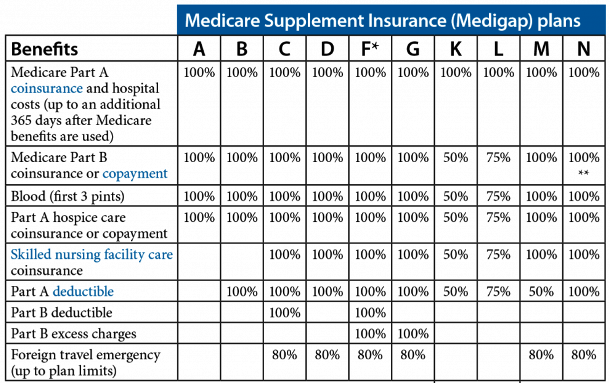
  • There are only 10 “standardized” Medicare Supplement plans to choose from,  (Plan A through Plan N). Since Medicare Supplements are standardized, the coverage and benefits for every Plan G, etc. is exactly the same with every insurance carrier, so it’s much easier to shop around and compare “apples with apples.” MA plans are not standardized, and the co-payments, deductibles, out of pocket costs, etc. vary between MA plans, and they change every year making them unnecessarily complicated and confusing.
  • A Medicare Supplement plan cannot be cancelled as long as you pay your premiums. MA plans are annual contracts, and they can be cancelled or benefits changed at the end of each calendar year.
  • There is no Annual Election Period (AEP) for Medicare Supplements, and you don’t have to shop around every year and make sure that your coverage, co-payments, co-insurance, deductibles, and benefits haven’t changed since the previous year. If there are any Medicare changes from one calendar year to the next, your Medicare Supplement will automatically pay the difference.
  • Medicare Supplements are “portable” meaning that you can keep them and take them with you if you travel to another state or if you move to another state, and your Medicare Supplement cannot be cancelled for leaving your “service area.” With most MA plans, if you travel outside of the MA plan’s service area for more than six months, you could be dis-enrolled from the plan.
  • With a Plan G Medicare Supplement, there are no co-payments when you go to the doctor. With most MA plans, you have to pay co-payments every time you see a doctor.
  • You can switch Medicare Supplement plans or Medicare insurance carriers any time of the year as long as you meet minimum health and underwriting requirements. With an MA plan, you can only join or leave an MA plan during the AEP or a SEP. Otherwise, you are locked into your MA plan for the entire calendar year.

NOTE: In California, there is a law called the California Birthday Rule. Under this law, if you have a Medicare Supplement, you can change it every year during the 60 days following your birthday to any other Medicare Supplement plan with “equal or fewer” benefits. For example, if you have Plan G, you can switch to Plan G with any other insurance carrier, regardless of your health. If you have Plan G, you can also switch to Plan N because Plan N has fewer benefits than Plan G, etc. Under the birthday rule, you just can’t switch from a plan with fewer benefits to greater benefits.

As you can see from the facts mentioned above, the benefits of having a Medicare Supplement far outweigh the benefits of having a Medicare Advantage plan.

Are Some Medicare Advantage Plans Really Free?

Because some MA plans have very low monthly premiums or no monthly premiums at all, some unscrupulous individuals promote them as “FREE” Medicare insurance plans, which is inaccurate, misleading, and, in my opinion, unethical. During the AEP, there are a lot of commercials for MA plans on TV. If you listen carefully, the one thing you’ll NEVER hear them mention is the maximum out-of-pocket costs for those plans. In 2025, in-network OOP costs can be as high as $9,350, and if you go out of network, you can pay significantly more!

Also, regardless of whether you have an MA plan or a Medicare Supplement plan, you still have to pay the monthly Medicare Part B premium, which is currently $174.70 per month for most people in 2024. The Medicare Part B premium in 2025 hasn’t been released yet, but it is estimated to be around $185.00 per month.

medicare-advantage-pig

You Can Always Get a Medicare Advantage Plan But You Can’t Always Get a Medicare Supplement Plan

MA plans are adequate as long as you are healthy, but if your health should change and you develop a serious illness, you will wish that you had a Medicare Supplement instead of an MA plan because you will have much more freedom of choice and control over your health care with a Medicare Supplement!

Original Medicare (Part A and B) only cover about 80% of medical and hospital costs and Medicare Supplements pick up most of the remaining 20%. During the AEP, you can always switch from a Medicare Supplement to an MA plan, regardless of your health, and you can always switch from an MA plan back to Original Medicare (Part A and Part B), regardless of your health. However, if you switch back from an MA plan to Original Medicare during the AEP, there is no guarantee that you can get a Medicare Supplement as you must be in good health, answer health questions, and be medically underwritten to be approved. If you have any serious health issues, more than likely, you won’t be able to get a Medicare Supplement.

NOTE: There are some situations where you can switch from an MA plan to a Medicare Supplement as a “guaranteed issue” without answering any health questions or going through medical underwriting. If you are in this situation, please let me know.

Also, if you are in the first year of your MA plan, you are guaranteed the right to switch back to a Medicare Supplement during the first 12 months. This is called a trial right. The trial period gives you a year to try an MA plan and see if it’s right for you. If you decide it’s not, you are guaranteed the right to switch back to original Medicare (Parts A and B) and purchase a Medicare Supplement plan.

The Maximum Out of Pocket Cost for MA Plans Can Be Twice As Much As You Think

Depending on which MA plan you have, the most you would pay for in-network out-of-pocket (OOP) costs in 2025 is $9,350 per calendar year! If you go outside of your plan’s network, you will pay even more than that!

Now suppose that you get really sick and need expensive treatment in the second half of the year. You could end up paying up to $9,350 (or whatever your plan’s maximum OOP cost is) by the end of the calendar year, but your OOP maximum zeros out in January, and it starts all over again! You could potentially end up paying your OOP TWICE in a 12-month period!

Conclusion

If you have an MA plan, you give up your Original Medicare (Part A and Part B) rights and you compromise your freedom of choice to go to the best doctors, specialists, hospitals, care facilities, etc. throughout the United States. Unless you are impoverished and can’t afford to pay the monthly premium for a Medicare Supplement, I would never recommend an MA plan to a friend or family member as you are always better off with a Medicare Supplement.

I’m an independent insurance agent, not a captive agent, and I work with most of the major insurance carriers. I shop around for my clients, every year, and I will shop around for you too! If you have any questions or if you have an MA plan and would like for me to help you switch to a Medicare Supplement plan, please let me know! And if you have a Medicare Supplement, I’m happy to shop around for you to save you money on your premiums!

There’s no such thing as free Medicare insurance! As the old expression goes… “You get what you pay for!”

you-get-what-you-pay-for

If you liked this blog and found it informative, please click the “Like” button, and please send me your questions, comments, or feedback! And please feel free to share this article with your friends!

Thank you!

Ron Lewis
Ron@RonLewisInsurance.com
www.MedigapShopper.com
(760) 525-5769 – Cell
(866) 718-1600 – Toll-free

Choosing the Best Medicare Supplement Plan

If you are turning 65 or you are new to Medicare, it can be very confusing trying to figure out which Medicare Supplement plan (aka Medigap plan) is right for you. The purpose of this article is to answer your questions and to make the Medicare transition easier for you and a lot less stressful!

10 Standardized Medicare Supplement Plans To Choose From

Nationwide, there are 10 standardized Medigap plans to choose from, Plan A through Plan N. The term “standardized” means that the coverage and benefits for every Medigap plan are identical regardless of what carrier you sign up with. For example, Plan G is Plan G, Plan N is Plan N, Plan F is Plan F, etc.

Medigap Plans Are Standardized But Premiums Are Not Standardized

While the coverage and benefits for each of these plans are standardized, the monthly premiums are not standardized, and prices vary significantly between insurance carriers for the same identical plan and coverage. Other factors can affect the premiums such as your age, zip code, marital status, whether you use tobacco products, etc.

For example, in the 92024 zip code (Encinitas, CA), the Plan G rates for a 70 year old female range from $152 per month to $262 per month, which is a difference of $110 per month or $1,320 per year for the same identical plan and coverage! In California, rates usually go up every year as we get older. For this reason, it’s important to shop around every year to make sure you aren’t paying more than you should be! I periodically stay in touch with my clients, and I shop around for them every year around their birthday.

IMPORTANT: As an independent insurance agent, I work with the major insurance carriers, not one particular company. If you or someone you know has a Medigap plan, I’m happy to shop around for you, and there is no charge for my service!

The California Birthday Rule

In California, we have a law called the California Birthday Rule. This law applies to all California residents who already have a Medigap policy.

Under the birthday rule, you have an annual 90-day open enrollment period that begins 30 days before your birthday and ends 60 days after your birthday. During this period, you can switch to any other Medigap policy that has “equal or fewer” benefits.

For example, if you have Plan G with Carrier A, you can switch to Plan G with Carrier B, regardless of your health and without answering any health questions. There is no medical underwriting and you cannot be turned down for coverage! If you have Plan G, you can also switch to Plan N because Plan N has fewer benefits than Plan G.

If you have Plan N, you can switch to Plan N with another carrier, but you cannot switch to Plan G because Plan G has more benefits than Plan N, etc.

NOTE: You can change your Medigap plan any time of the year, but if you do so outside of your 90-day annual open enrollment period under the California Birthday Rule, you will have to answer health questions and be medically underwritten, and you can be turned down for certain health conditions.

The Three Best Medicare Supplement Plans

Although there are 10 standardized Medigap plans to choose from, Plan F, Plan G, and Plan N are the three best and most popular plans.

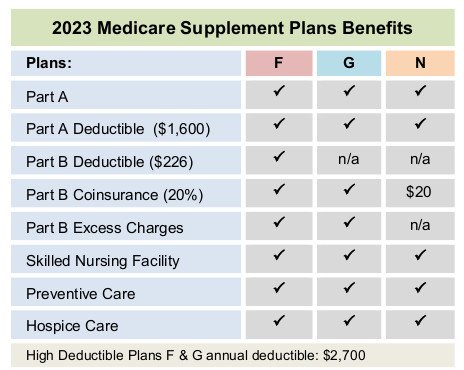
As you can see from the chart, Plan F provides the most comprehensive coverage. Plan G is identical to Plan F except it does not cover the Medicare Part B deductible. Plan N also does not cover the Part B deductible and there are co-payments for doctor visits, emergency room visits, and it does not cover Part B excess charges. Please continue reading for more detailed information.

Plan G Medicare Supplement

For those who are turning 65 on or after January 1st, 2020, Plan G is the best plan today because your only out-of-pocket (OOP) expense is the Medicare Part B deductible, which is currently $226 for all of 2023.

NOTE: That small deductible can change from year to year, but historically, it hasn’t changed significantly. In fact, the Part B deductible decreased from $233 in 2022 to $226 in 2023.

The Part B deductible zeros out every January and starts all over again. Once you meet that small annual deductible, you won’t have any other OOP costs for the remainder of the calendar for any Medicare-approved doctors visits, surgeries, hospitalizations, etc.

Plan F Medicare Supplement

Prior to January 1st, 2020, Plan F was considered to be the best Medicare Supplement plan because there were no deductibles, co-payments, or OOP costs. The only difference between Plan F and Plan G is the Medicare Part B deductible. Plan F pays for that small deductible, and Plan G doesn’t. That is the only difference between the two plans!

NOTE: For those individuals that had Plan F prior to January 1st, 2020, they can still keep their plan and switch to Plan F with other insurance carriers if they want, but Plan F isn’t available for individuals who started Medicare on or after January 1st 2020 because of the Medicare Access and CHIP Reauthorization Act (MACRA) of 2015.

Although Plan F covers the Medicare Part B deductible and Plan G doesn’t, the premiums for Plan F are significantly more than the premiums for Plan G, which is why most people with Plan F have switched to Plan G.

Most People With Plan F Have Switched to Plan G

Most people who had Plan F have switched to Plan G because in most cases, the premiums for Plan G are significantly less, and even if you have to pay the $226 Part B deductible, you still end up saving money by switching to Plan G!

For example, if someone has Plan F and their premium is $250 per month and they can get Plan G for $180 per month, that’s a gross savings of $70 per month or $840 per year! If you subtract the $226 Medicare Part B deductible, that’s still a net savings of $614 per year!

NOTE: If you have Plan F and you want to switch to Plan G, if you have already met your $226 Medicare Part B deductible for this year, you would not have to pay it again until the following year since the Part B deductible is payable only one time per calendar year.

Medicare Supplement Plan N

Plan N isn’t as popular as Plan G because there are more OOP costs, but the premiums are usually a little lower, but not significantly lower than the Plan G premiums. If you are in relatively good health and rarely go to the doctor, you may want to consider Plan N if you want lower monthly premiums and you are willing to incur more OOP costs. However, Plan G is a better option if you’re willing to pay slightly higher premiums for much better coverage than Plan N.

NOTE: If you are not in the best of health and you go to the doctor often, Plan N is not a good choice as you are required to pay co-payments for every office visit, and with all those payments, Plan G would normally be more cost effective.

With Plan N, you are responsible for paying the annual $226 Medicare Part B deductible (like you are with Plan G). You must also pay co-payments of up to $20 per doctor visit and co-payments of up to $50 for emergency room visits. However, if you are admitted to the hospital, the emergency room co-payment is waived.

Another difference between Plan N and Plan G is that Plan G covers the Medicare Part B “excess charges” and Plan N doesn’t. If your doctor doesn’t accept “Assignment” (the amount Medicare agrees to pay for a service), they may charge you up to an additional 15% of the bill. This fee is known as an excess charge.

Between Plan N and Plan G, I would recommend Plan G if the premiums aren’t significantly different and it’s not a financial burden to pay the Plan G premiums.

About Me

I hope that you have found this information to be interesting and informative. I’m an independent insurance agent with over 15 years of experience specializing in Medicare Supplement insurance, primarily in California.

As an independent agent, I work with the major insurance carriers including Mutual of Omaha, Cigna, Blue Shield of CA, Anthem Blue Cross, Health Net, Aetna, etc. I have hundreds of clients, and I shop around for them every year around their birthday to find them the best Medigap rates. Please click here to see some of my client testimonials.

If you have any questions, please don’t hesitate to contact me. If you have any friends that are turning 65 or that have Medicare Supplements, I’m happy to shop around for them, and there is no charge for my service!!! Also, please feel free to forward this blog on to anyone who may be interested!

Thank you!

Ron Lewis
CA agent #0B33674
NV agent #3822123

Ron@RonLewisInsurance.com
866.718.1600 (Toll-free)
760.525.5769 (Cell)
www.MedigapShopper.com

Should You Sign Up for a Medicare Prescription Drug Plan?

I just turned 65 yesterday, August 20th, and my Medicare Part A (Hospital) and Part B (Medical), Medicare Supplement, and Medicare Prescription Drug Plan (PDP), also known as Part D, all started a few weeks ago on August 1st, 2017.

NOTE: For most people, their Medicare benefits usually begin on the 1st of the month when they turn 65.

Fortunately, I’m in pretty good health, and I only take two relatively inexpensive medications. Since there is a late enrollment penalty added to your monthly PDP premiums if you don’t sign up for a PDP when you are first eligible (turning 65 or starting Medicare Part B), I decided that I was going to at least sign up for the cheapest PDP to avoid the penalty later on.

Pills

How Much is the Part D Penalty?

The cost of the late enrollment penalty depends on how long you went without Part D or creditable prescription drug coverage.

According to the Medicare.gov website “Medicare calculates the penalty by multiplying 1% of the “national base beneficiary premium” ($35.63 in 2017) times the number of full, uncovered months you didn’t have Part D or creditable coverage. The monthly premium is rounded to the nearest $.10 and added to your monthly Part D premium.”

NOTE: The national base beneficiary premium may increase each year, so your penalty amount may also increase each year.

The late enrollment penalty is approximately $0.34 per month for every month you could have had prescription drug coverage but didn’t. For example, if you went 10 months without PDP coverage before you started a new PDP, the total penalty would be approximately $3.40 per month ($0.34 x 10 months) on top of the regular prescription drug plan monthly premium. Again, the penalty amount can increase in the future.

Part D Penalty

My Prescription Drug Plan Coverage — Before and After Medicare

Before I started on Medicare, I had some limited prescription drug plan coverage through my Affordable Care Act (Obamacare) health insurance, which wasn’t so “affordable.”

I take two medications: Fluticasone nasal inhaler and Levothyroxine. Through my previous pharmacy, the regular price of the Fluticasone was $56.80 per month, but with my Obamacare insurance, I was paying $20.00 per month. In addition to that, I was paying $12.68 per month for the Levothyroxine.

Altogether, before I started on Medicare, I was paying $32.68 per month for both prescriptions.

In contrast, I recently signed up with the Medicare “Humana Walmart Rx Plan” because it is currently the cheapest and most cost-effective drug plan for my particular situation. During the next Annual Enrollment Period (AEP), which is from October 15th through December 7th each year, I may sign up for a different PDP plan if I find another plan that is better than the one that I currently have.

Regardless of what PDP you currently have, you should always shop around every year during the AEP between October 15th and December 7th.

open-enrollment-street-sign

NOTE: I am not certified to sell prescription drug plans, and I am not recommending, endorsing, or promoting Humana or any particular insurance carrier. My primary focus and area of expertise is with Medicare Supplement insurance plans.

With my Humana PDP, I pay a monthly premium of $17 per month, and I have a $400 per calendar year deductible. However, the two prescriptions that I take are classified as
Tier 1 prescriptions, and under my current plan, Tier 1 and Tier 2 prescriptions are not subject to the deductible, so I don’t have to pay any deductibles for the two prescriptions that I take!

With my Humana PDP, I chose to have my prescriptions mailed to me every three months, so I no longer have to drive to the pharmacy to pick up my prescriptions each month. That’s a nice benefit too!

NOTE: In my particular situation, the mail-order option ended up costing me less than picking my prescriptions up from a pharmacy, but that isn’t always the case.

For the Fluticasone, I am currently paying $8.00 TOTAL for a three-month supply! That comes out to $2.67 per month! For the Levothyroxine, I do not have to pay anything other than my monthly premium!

As mentioned before, I am currently paying $17.00 per month for my Humana PDP premium, and my total out-of-pocket cost for my medications is $2.67 per month for a total cost of $19.67 per month. In contrast, I was paying $32.68 per month prior to Medicare just for my prescriptions, not including my not-so-reasonably-priced health insurance premium.

I am very happy with my Medicare prescription drug plan. For me, it is significantly better than the prescription coverage that I had before I was on Medicare.

happy

Is a Medicare Prescription Drug Plan Good for Everyone?

Fortunately for me, the prescriptions that I take are relatively inexpensive, but I know that isn’t the case for everyone. Some of my clients take a lot of expensive prescriptions, and a PDP doesn’t always save them money or else some of the prescriptions may not be covered at all by the PDP, which is very frustrating.

Some people don’t take any prescriptions at all, and they may question whether it makes sense to sign up for a PDP if they currently don’t need one, even though their health could (and probably will) change at some point in the future.

Because of the late enrollment penalty, I would still recommend signing up for the cheapest PDP, at least for the time being, if it isn’t a financial hardship.

NOTE: This blog addresses my experience with Medicare prescription drug plans. To read about my experience with Medicare Supplement insurance plans, please click here.

Everyone is different, and what is good for one person isn’t necessarily good for another. Should you sign up for a prescription drug plan? That is a personal decision and a question that only you can answer.

*************************

Please click the “Subscribe” button to be notified when I write future blogs.

I am an independent insurance agent specializing in Medicare Supplement insurance plans. I work with all the major insurance carriers in California, Washington, and several other states. If you have any questions, or if you would like for me to shop around for you to save you money on your Medicare Supplement insurance, please don’t hesitate to let me know!

Thank you!

Ron Lewis
www.MedigapExpress.com
Ron@RonLewisInsurance.com
866.718.1600 (Toll-free)

Upcoming Changes for Medicare Supplement Plan F and Plan C in 2020

Change Image

As of January 1st, 2020, “newly eligible” Medicare beneficiaries will no longer be able to purchase Plan F and Plan C Medicare Supplement plans, which are also known as “Medigap” plans because they pick up the “gaps” in coverage that Medicare doesn’t cover.

NOTE: The high-deductible Plan F Medigap plan is also going away.

Individuals that are signing up for Medicare on or after January 1st, 2020, will not be able to sign up for any Medigap plan that covers the Medicare Part B deductible, which is currently $183 per calendar year in 2017.

Of the 10 “standardized” Medigap plans, Plan F and Plan C are the only two plans that cover the Part A (Hospital) and Part B (Medical) deductibles and coinsurance in full. These two plans are the only Medigap plans that offer “first-dollar” coverage for every doctor or hospital visit.

Why Are Plan F and Plan C Going Away?

These changes are taking place because of Section 401 in the Medicare Access and CHIP Reauthorization Act (MACRA) of 2015, which is also known as the “doc fix” law. To view the text, please click here.

In a nutshell, Nutshell ImageCongress passed this legislation to ensure that doctors would be paid adequately for providing Medicare services and to provide an incentive for doctors to continue accepting Medicare patients. Previous legislation had budgeted for doctors to have rate decreases over the years and there was concern that many doctors would stop accepting Medicare patients.


Because of the ever-increasing cost of medical care and the fact that more than 10,000 baby-boomers are turning 65 every day, Medicare is experiencing increased financial strain. Since individuals with Plan F and Plan C have no co-payments or deductibles, lawmakers fear that this lack of cost-sharing results in Medicare abuse, which is driving up costs.

It has been argued that the “first dollar” coverage available from Plan F and Plan C cause Medicare recipients to see their doctors more frequently than they would if they didn’t have all of their deductibles covered and had to pay some out-of-pocket costs when they did go to the doctor. Some claim that these changes will save Medicare billions of dollars each year in medical claim exposure.

In an effort to control costs by reducing claims, Congress has decided that it makes more sense for Medicare recipients to be responsible for more of their out-of-pocket medical expenses. Consequently, Congress has decided to eliminate Plan F and Plan C because they want Medicare beneficiaries to have more “skin in the game.”

No one knows if these measures will really reduce Medicare’s overall annual costs. Some argue that Medicare beneficiaries may end up waiting to get medical care for serious issues, which would ultimately cost Medicare more money in the future.

free-money

What Happens If I Have Plan F or Plan C Before January 2020?

Since the MACRA only prohibits the sale of Medigap Plan F and Plan C to “newly eligible” Medicare beneficiaries on or after January 1st, 2020, if you already have one of these plans in 2020, you will be exempted and “grandfathered” in. You will not lose your coverage!

You will still be able to purchase Plan F and Plan C policies from other insurance carriers after 2020 as long as you can medically qualify or if you are in an Open Enrollment or Guaranteed Issue situation.

If you were eligible for Medicare prior to 2020, but you delayed getting it because you are still working and have employer insurance, you will still be able to enroll in Plan F or Plan C after you stop working and switch back to Medicare.

What Happens If I Won’t Be Eligible for Medicare Until After January 2020?

For those individuals who will not be eligible for Medicare until January 1st, 2020 or later, although you will not be able to get Plan F, you will still be able to get Plan G, which is an excellent Medigap plan that is identical to Plan F in every way except for the $183 per calendar year deductible.

Today, many people that have Plan F have been switching to Plan G because the premiums for Plan G are usually significantly less than the premiums for Plan F. In most cases, Plan G will cost you less and is usually more cost effective, even if you pay for the entire Part B deductible!

Shop Around Every Year!

Since Medicare Supplement rates vary significantly between insurance carriers for the same identical plans and coverage, and since the rates in most states are based on your “attained” age, and they usually go up in price each year, it’s important to shop around every year, preferably during the 30 days before your birthday.

grocery cart image

If you live in California, there is a law called the “California Birthday Rule.” This law guarantees you the right to switch “like for like” Medigap plans, such as Plan F for Plan F, or you can switch to any other Medigap plan with fewer benefits, such as from Plan F to Plan G, etc. You can do this every yearREGARDLESS OF YOUR HEALTH, during the 30 days following your birthday! Most insurance carriers in California let you do this during the 30 days before or after your birthday.

Whether you decide to keep your current Plan C or Plan F, or if you want to find out how much you can save by switching to Plan G, you should take advantage of the California Birthday Rule and compare rates every year to make sure that you aren’t paying too much!

If you have any questions or comments, or if you’d like a free quote or rate comparison, please visit www.MedigapExpress.com or call my cell at (760) 525-5769 or (866) 718-1600 (Toll-free).

Thank you!

Ron Lewis