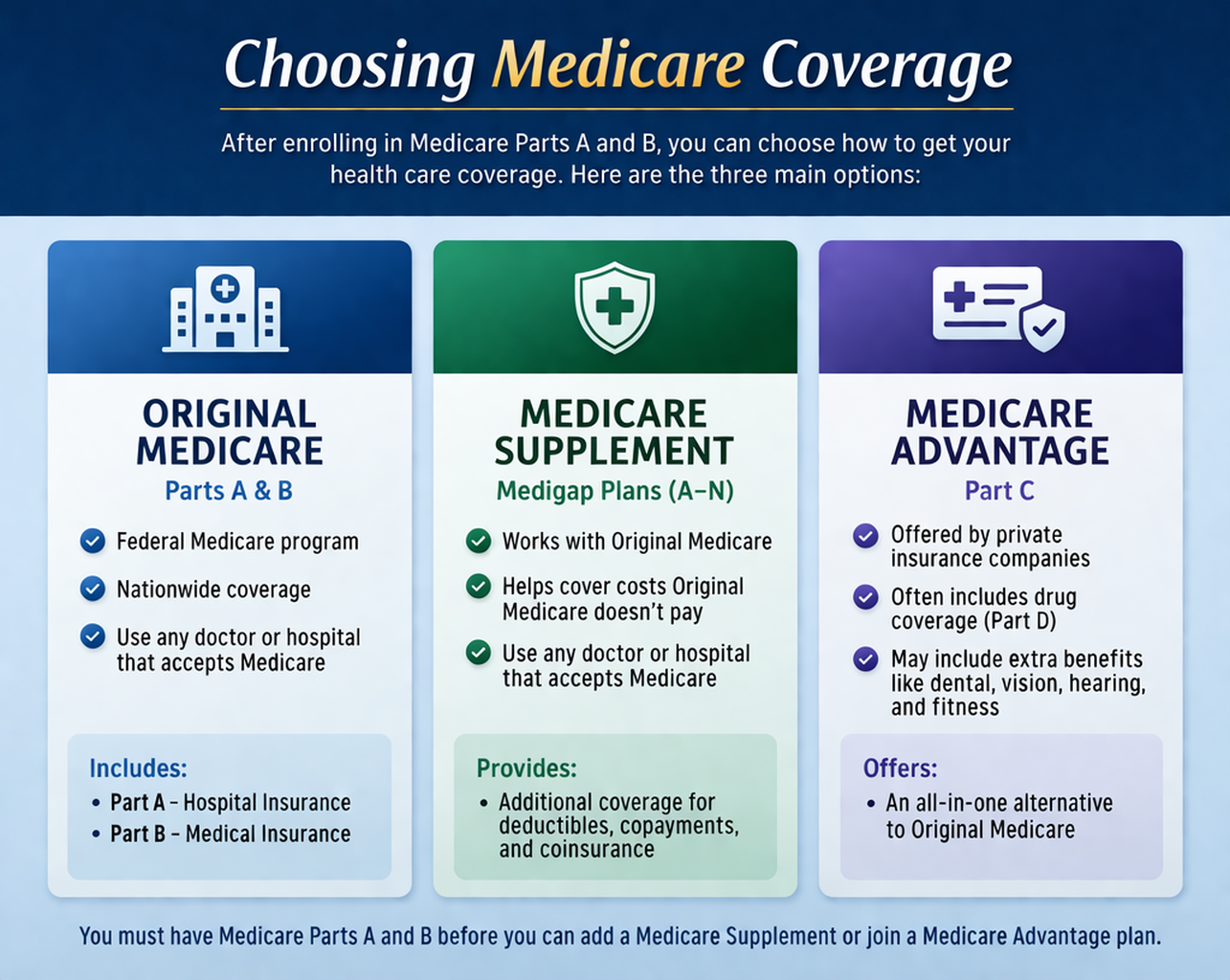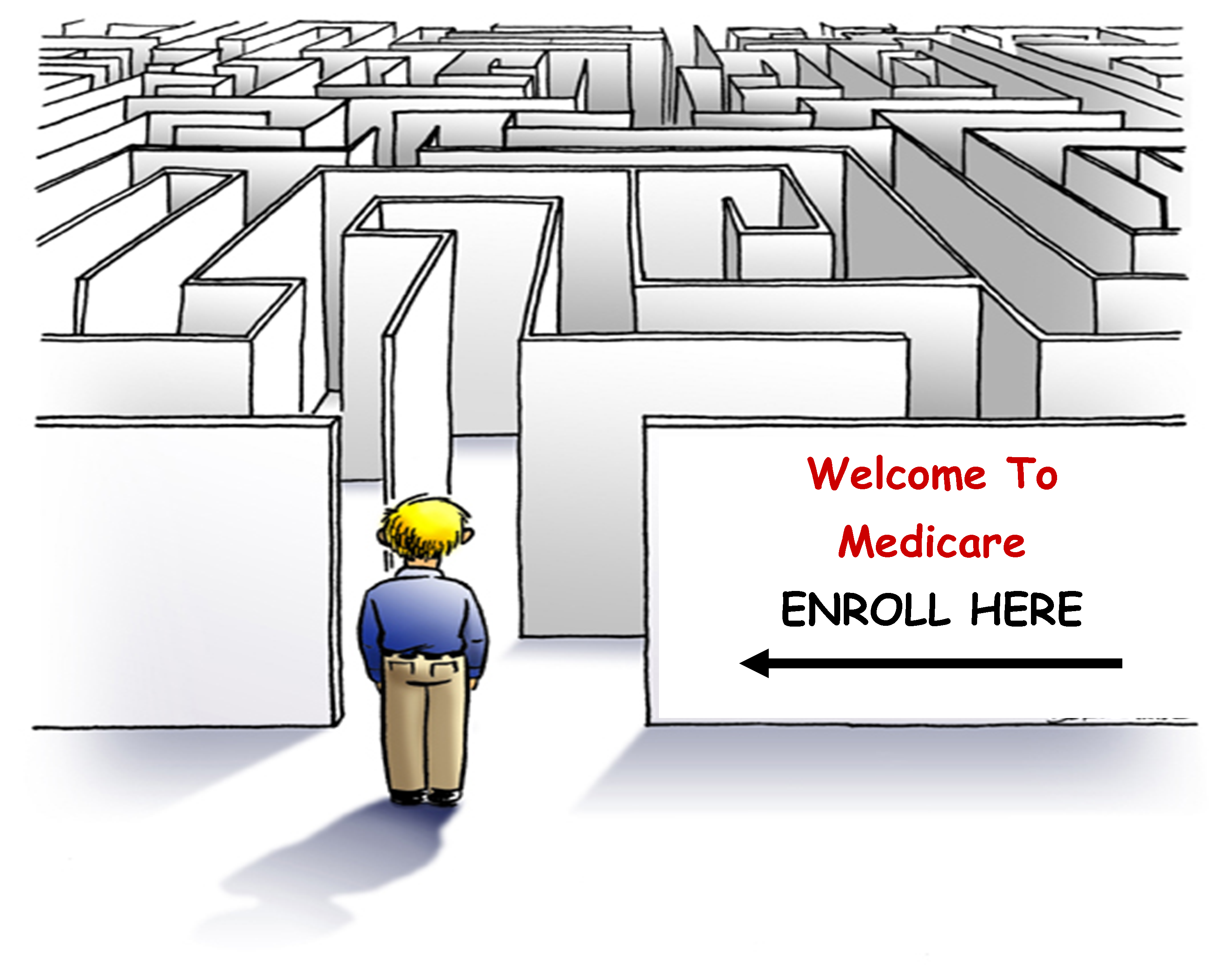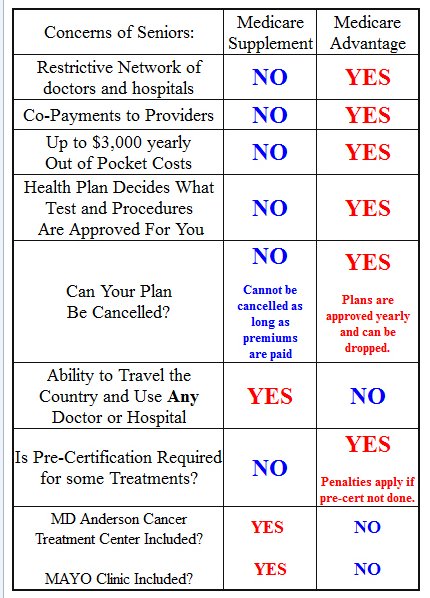
Each year, many people in California decide to leave their Medicare Advantage (Part C) plan and return to Original Medicare (Part A and Part B) with a Medicare Supplement (Medigap) plan. Often, this happens when premiums, copays, or out-of-pocket costs increase, or when clients find their favorite doctors or hospitals are no longer in their plan’s network.
If you’ve ever wondered how to switch from Medicare Advantage to Medigap, it’s important to understand how the process works, and the potential challenges if you have existing health conditions.
You Can Switch Back to Original Medicare — But You’re Not Automatically Guaranteed Medigap Approval
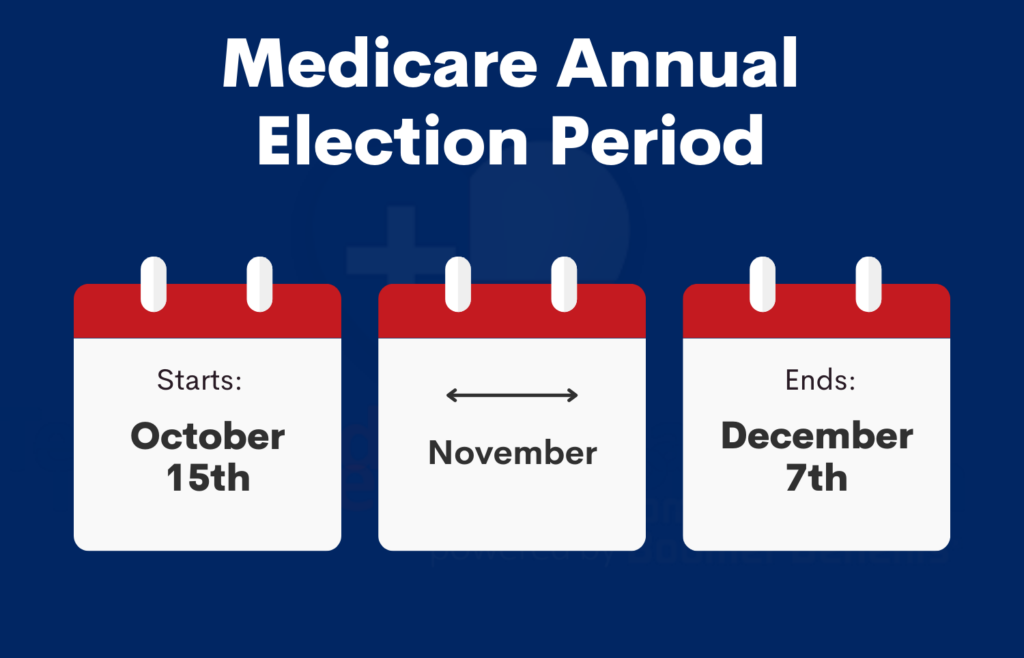
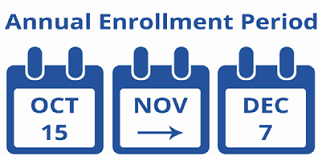
You can drop your Medicare Advantage plan and go back to Original Medicare during certain times of the year, such as the Annual Election Period (AEP), which goes from October 15th through December 7th every year or during the Medicare Advantage Open Enrollment Period, which goes from January 1st through March 31st.
However, many people are surprised to learn that once they return to Original Medicare, they must apply separately for a Medicare Supplement plan, and approval is not guaranteed. In most cases, insurance companies can review your health history, which is called “medical underwriting,” and deny coverage if you have serious or chronic health conditions. That’s why timing and knowing the rules can make all the difference.
Medicare Guaranteed Issue Rights: The Hidden Opportunities
Here’s the good news… even if you have health problems, there are special Guaranteed Issue (GI) rights or situations that often let you enroll in a Medigap plan without health questions or underwriting.
These rights apply in specific situations and many beneficiaries don’t realize they qualify. Some are tied to Medicare Advantage plan changes, others to state-specific protections. In California, there are several lesser-known GI opportunities that can help people switch to Medigap coverage, even when they’ve been told “no” before.
I work with clients every year who thought they couldn’t qualify due to health issues and I’ve helped them get accepted for Medicare Supplement coverage using legitimate Guaranteed Issue options that most agents aren’t aware of or don’t mention to their clients.
Why Work with a Specialist Who Knows the California Rules
The Medicare rules in California are unique. Between the California Birthday Rule and other state-specific guaranteed issue protections, there are several ways to save money and secure coverage without medical underwriting.
As an independent Medicare Supplement insurance specialist, I work with all the major insurance carriers throughout California, Nevada, and several other states. My goal is simple. I want to help you find the best Medicare Supplement plan with the lowest premium and the most reliable coverage, year after year.
Let’s See What You Qualify For
If you’re considering leaving your Medicare Advantage plan or want to see if you qualify for a Guaranteed Issue Medicare Supplement, don’t wait until it’s too late.
There is no cost for my help. I’m paid by the insurance carriers, not my clients. I can review your situation, identify any Guaranteed Issue opportunities, and help you apply for the coverage that fits your needs and budget.
Contact me today to learn your options and see how much you could save on your Medicare Supplement plan.
About the Author
As an independent Medicare Supplement insurance specialist, I work with all the major insurance carriers throughout California, Nevada, and several other states. I shop around for my clients every year during their annual open enrollment period under the California Birthday Rule to help them save money on their Medicare Supplement premiums. Many of my clients have saved hundreds, even thousands of dollars for the same exact plan and coverage! Please click here to read what my clients have to say about my services.
There is no charge for my services as I’m compensated by the insurance carriers, not my clients. My goal is to help you find the lowest premiums and provide the best personal service possible, year after year. Unlike many agents, I won’t disappear after you sign up!
If you enjoyed this blog and found it helpful, please leave your comments, questions, or feedback below and feel free to share this article with your friends!
Thank you!
Ron Lewis Ron@RonLewisInsurance.com www.MedigapShopper.com (760) 525-5769 – Cell (866) 718-1600 – Toll-free
If you’re a Medicare Supplement (Medigap) policyholder living in California, there’s a little-known benefit that could save you hundreds (or even thousands) of dollars a year and many people don’t even know that it exists. It’s called the California Birthday Rule, and it gives you the right to switch your Medigap plan every year around your birthday, REGARDLESS OF YOUR HEALTH!
IMPORTANT: You can change your Medicare Supplement any time of the year, but if you do it around your birthday, it’s a lot easier because you don’t have to answer any health questions, there’s no medical underwriting, and YOU CAN’T BE TURNED DOWN FOR COVERAGE!
Medigap Plans Are Standardized
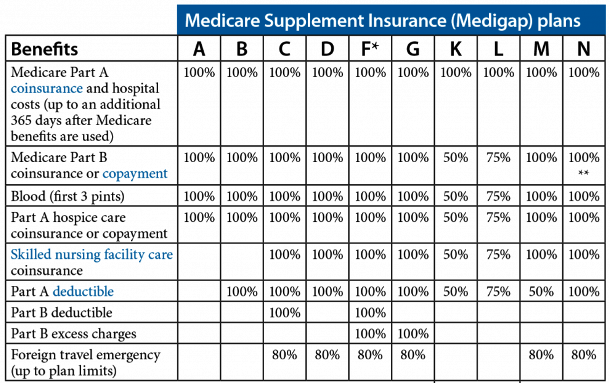
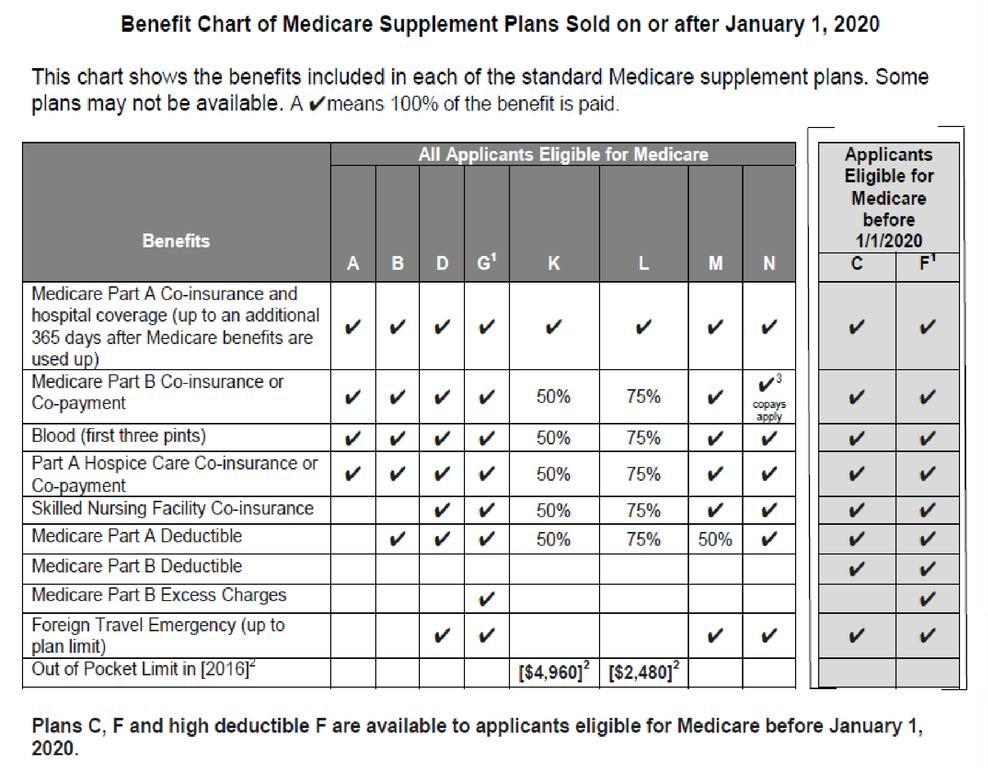
Nationwide, there are 10 standardized Medicare Supplement lettered plans to choose from, Plan A through Plan N. When I say “standardized,” that means that the coverage and benefits for every lettered plan are exactly the same regardless of what insurance carrier you sign up with. In other words, Plan G is Plan G, Plan N is Plan N, etc., regardless of what insurance carrier you are with. So it’s much easier to compare plans since every plan is exactly the same no matter which insurance carrier offers it.
NOTE:Technically, there are actually 12 standardized Medigap plans to choose from because there are high-deductible versions of Plan F and Plan G. In 2025, you will pay a $2,870 deductible before your coverage for either of these plans would begin.
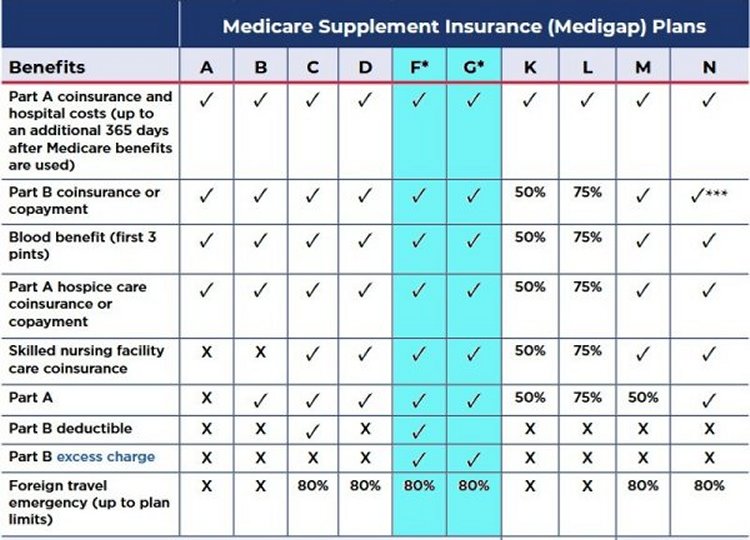
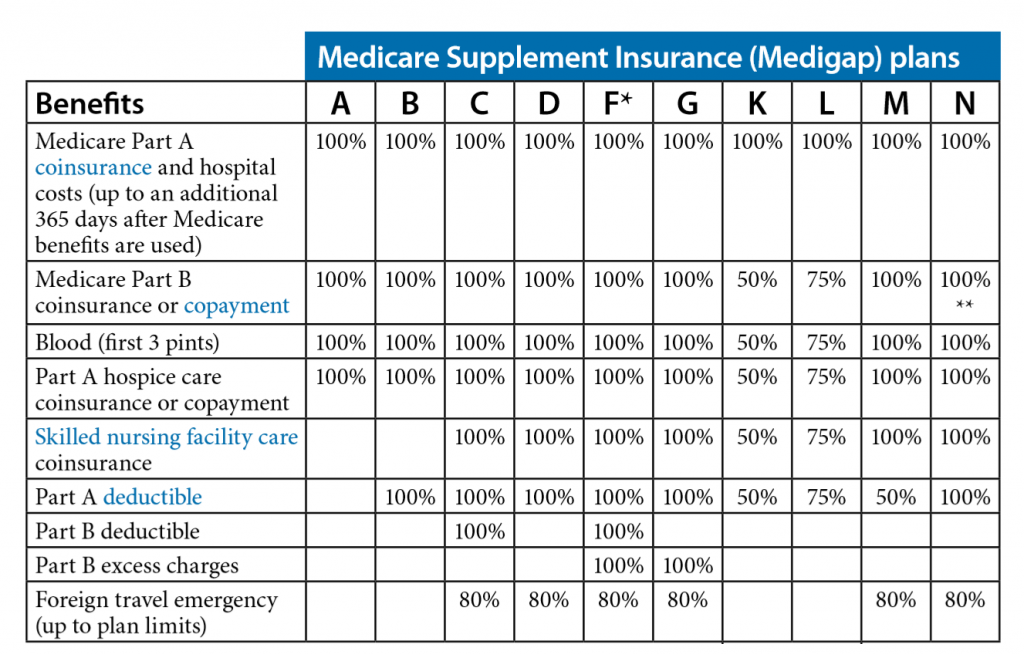
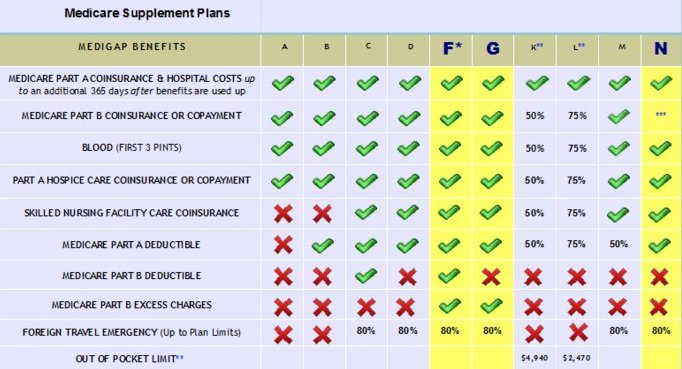
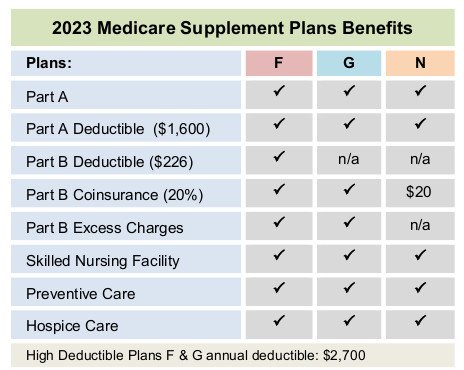
As you can see, the only difference between Plan F and Plan G is the Medicare Part B deductible.
Which Medigap Plan is Best?
For those who are turning 65 or starting Medicare today, the best and most comprehensive Medigap plan is Plan G, which pays for everything except for the Medicare Part B deductible. The current annual Part B deductible (in 2025) is $257. That amount can change from year to year, but historically, it hasn’t changed by much.
Medicare Access and CHIP Reauthorization Act of 2015
Due to the Medicare Access and CHIP Reauthorization Act of 2015 (MACRA), Medigap Plan C and Plan F were discontinued for new Medicare beneficiaries starting on January 1st, 2020. This legislation eliminated the availability of Medigap plans that cover the Medicare Part B deductible for individuals who became eligible for Medicare on or after that date. However, Plan C and Plan F are still available for people who were eligible for Medicare before 2020 or who already have one of those plans. They just aren’t available for those individuals that turned 65 or started Medicare on or after January 1st, 2020.
Let’s look at a common example of how switching under the Birthday Rule can save you money.
Why Plan G is More Popular Than Plan F
If you have a Plan F Medicare Supplement, you’re probably paying more than you need to. It’s usually much cheaper and more cost effective to switch to Plan G because both plans are identical in coverage except for the Medicare Part B deductible, which is $257 in 2025. Plan F covers that small deductible, while Plan G does not. That is the only difference between the two plans, yet the premiums for Plan F are usually significantly higher.
Even though Plan F covers that $257, it often costs $400–$1,000 more per year in premiums than Plan G, so in most cases, you’d save money by paying the lower monthly premium for Plan G and just covering that $257 deductible yourself.
IMPORTANT:If you can save more than $257 per year by switching from Plan F to Plan G, then Plan G is cheaper and more cost effective.
For example, if your Plan F premium is $250 per month and you can get Plan G for $200 per month, that’s a gross savings of $50 per month or $600 per year. If you pay the $257 on your own, your net savings will still be $343 per year ($600 – $257 = $343)! The Medicare Part B deductible is payable only one time per calendar year, so after you pay that small deductible, there is absolutely no difference between Plan F and Plan G for the remainder of the year!
NOTE: If you have Plan F and you switch to Plan G, if you’ve already met your $257 Part B deductible, you won’t pay it again until the following year since that small deductible is payable only one time per calendar year.
What Is the California Birthday Rule?
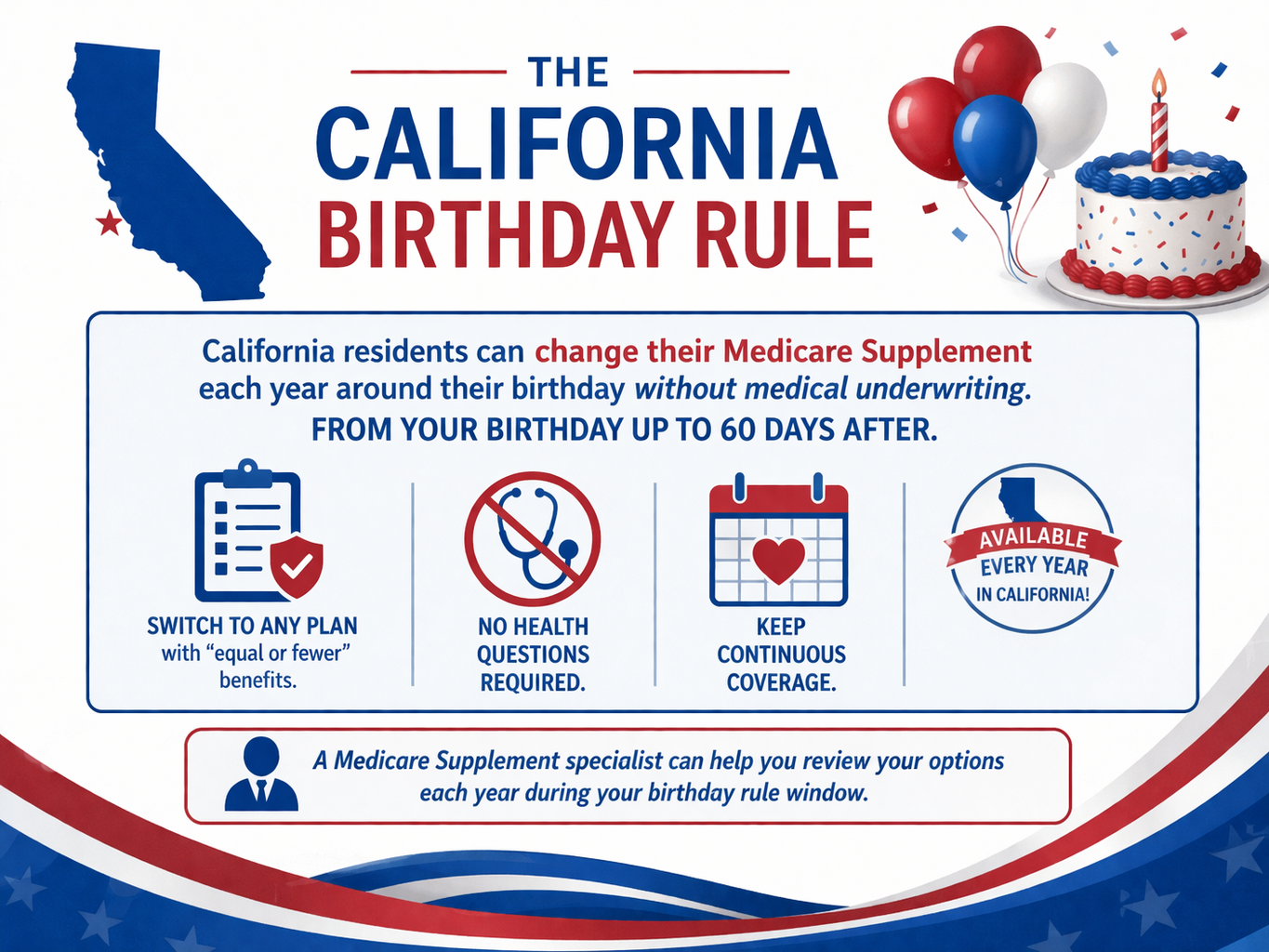
The California Birthday Rule is a special California state law that allows active Medigap policyholders in California to switch to a new Medigap plan with “equal or fewer” benefits every year around their birthday without medical underwriting during a 60-days following their birthday.
NOTE:In California, most carriers accept applications from 30 days before your birthday up to 60 days after your birthday, a 91-day window to switch Medigap plans without medical underwriting.
Most states don’t have a birthday rule, and if you develop a serious health condition, you could be stuck with your current health insurer and Medigap plan. But thanks to the California Birthday Rule, you have a guaranteed open enrollment period every year to shop around and save money on your premiums without worrying about being stuck or declined.
What Does Equal or Fewer Mean?
Again, under the birthday rule, you can switch to any Medigap plan that offers “equal or fewer” benefits than your current plan. In other words, you can switch from your current Medigap plan to any other Medigap plan that offers benefits that are the same or less comprehensive than what you currently have.
For example:
You cannot upgrade to a plan with more benefits (such as Plan N to Plan G).
You can switch to a plan with the same level of benefits (such as Plan G to another Plan G with a different carrier).
You can downgrade to a plan with fewer benefits (such as Plan F to Plan G, Plan G to Plan N, etc.).
This rule exists to prevent people from waiting until they are sick to “upgrade” to more generous coverage. However, it does give you freedom to shop around for lower prices on the same or lesser coverage without worrying about health questions or being declined.
Examples of “Equal or Fewer”
If you have Plan F, you can switch to Plan F with a different insurance carrier or to Plan G, Plan N, etc.
If you have Plan G, you can switch to Plan G with another insurance carrier or to Plan N, etc.
If you have Plan N, you can switch to Plan N with a different insurance carrier or to Plan A, etc.
Even if you’re not sure whether your current plan is the best deal, you can always switch to the same plan with a different insurance carrier during your birthday rule window, often saving hundreds and sometimes thousands of dollars per year without changing any of your benefits.
What States Have a Medigap Birthday Rule?
Today, more states are slowly adding their own birthday rules. Here is a current list of states that have a Medicare birthday rule:
California
Illinois
Idaho
Kentucky
Louisiana
Maryland
Nevada
Oklahoma
Oregon
Utah
Virginia
Wyoming
States with Year-Round Guaranteed Issue or Open Enrollment Rights
These states don’t have a Medicare birthday rule, but they offer year-round guaranteed issue or open enrollment periods without underwriting:
Connecticut
Maine
Missouri
New York
Washington
Do Most People Use the Birthday Rule?
Surprisingly, no! Many people don’t know this rule exists and they stay on overpriced Medigap plans for years thinking they’re stuck because of health issues, etc. If you take advantage of the birthday rule each year, you can keep your premiums under control and avoid being overcharged.
Rates Vary Significantly Between Insurance Carriers
As mentioned before, Medigap plans are “standardized” meaning that Plan G is Plan G, Plan N is Plan N, etc. The coverage and benefits for every Plan G, etc. are exactly the same regardless of what insurance carrier you are with. However, the rates between insurance carriers are not standardized. Every insurance carrier charges their own rates.
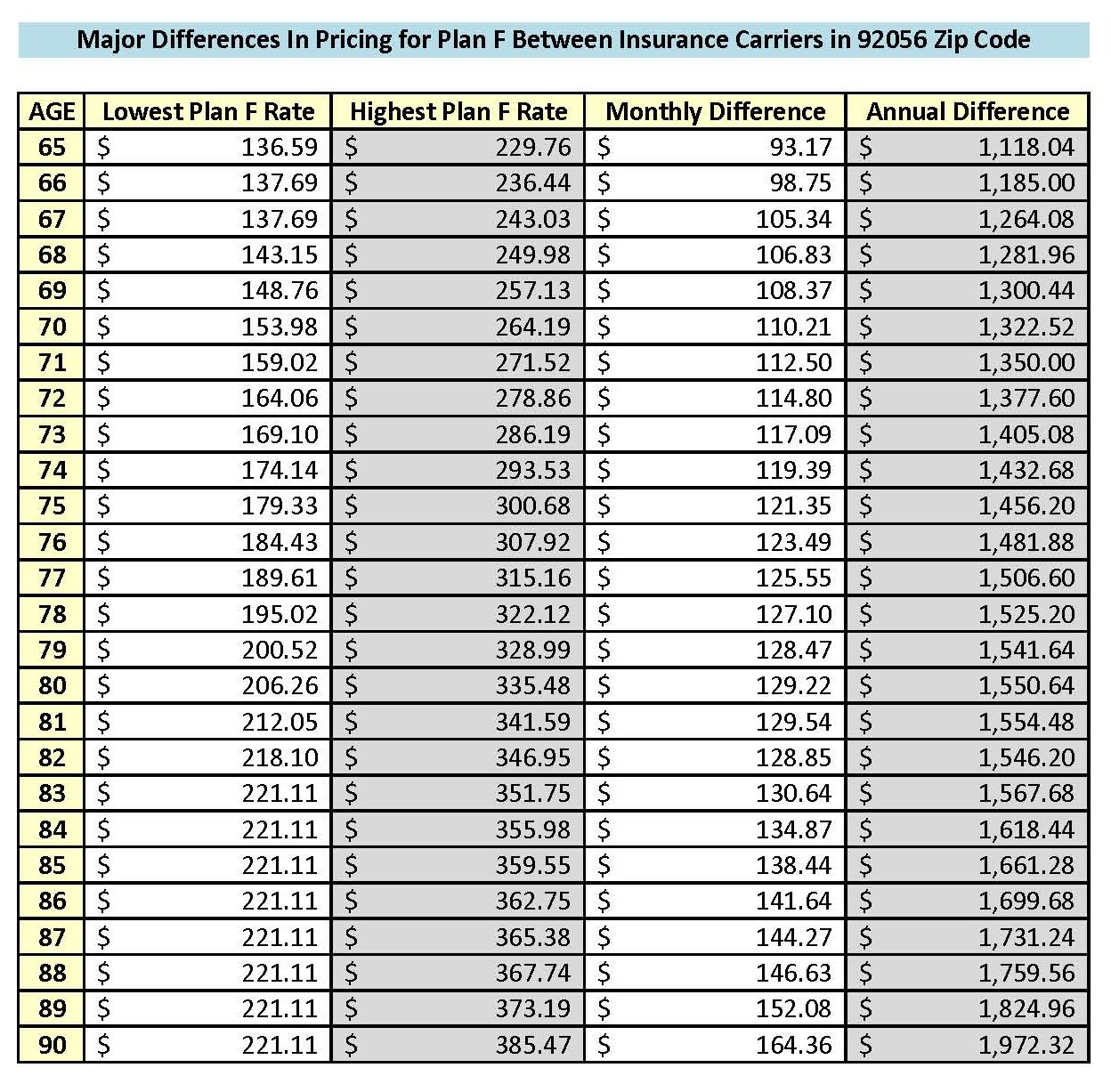
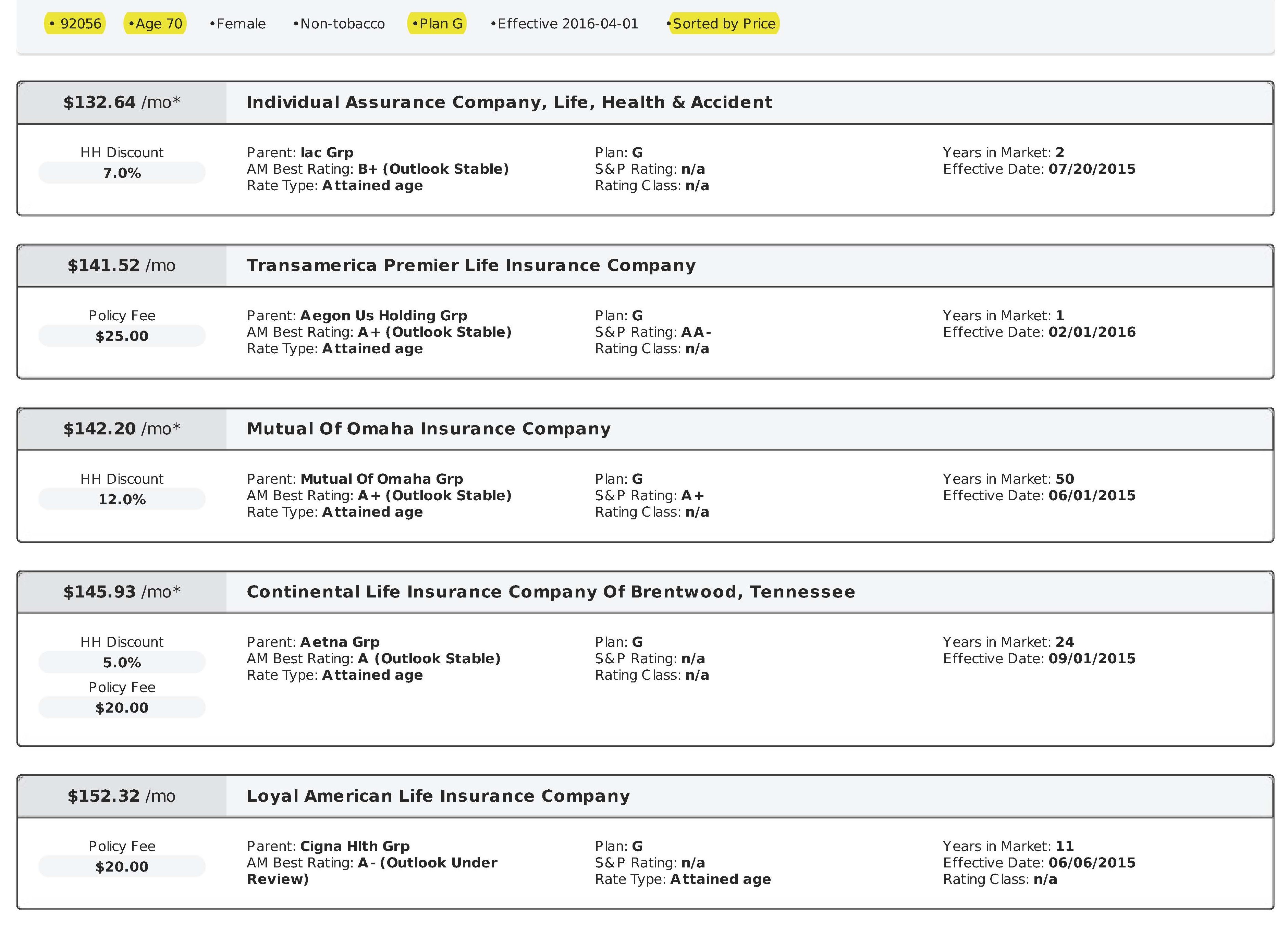
For example, right now in the 92024 zip code (San Diego), the Plan G rates for a 70 year old single female range from $217.78 to $319.79 per month! That’s a difference of $102.01 per month or $1,224.12 per year for the same identical plan and coverage!
NOTE:Several years ago, one of my clients, a husband and wife, moved to San Diego from Los Angeles. They were paying $809.00 per month for Plan G with United American, and I got them Plan G with Mutual of Omaha for $367.01 per month, which was a savings of $441.99 per month or $5,303.88 per year for the save identical plan and coverage! Rates are based primarily on age and zip code, and they are constantly changing. It‘s critically important to shop around every year!
How to Apply and Save Money!
To take advantage of the California birthday rule, you must do the following:
Live in California
Have an active Medigap plan
Switch to a Medigap plan with “equal or fewer” benefits
Apply during the 30 days before up to 60 days after your birthday
Email me at Ron@RonLewisInsurance.com or call me at 760.525.5769 (cell) or 866.718.1600 (toll-free) for a free quote or to switch plans
It only takes a few minutes to apply and there is never a charge for my service!
Conclusion
If you currently have a Medigap plan, you can change your plan every year around your birthday, REGARDLESS OF YOUR HEALTH! If you apply during your annual 60-day open enrollment period under the California Birthday Rule, YOU CANNOT BE TURNED DOWN FOR COVERAGE!
As an independent insurance agent specializing in Medicare Supplements, I work with all the major insurance carriers, not just one. (A “captive” insurance agent can only represent one insurance carrier.) I will do the shopping for you and find you the best rates, not just this year, but I shop around for all my clients every year around their birthday! The monthly premiums are exactly the same whether you let me do the shopping for you to save you money on your premiums or if you contact an insurance carrier directly! Please visit ClientTestimonials to read what some of my clients have to say about me.
Call, text, or email me today, and I’ll help you review your options in just a few minutes with no pressure or obligation. Let me help you save hundreds, or even thousands of dollars, on the exact same Medigap plan you already have. Won’t that be a nice birthday present?
If you liked this blog and found it informative, please click the “Like” button, and please send me your questions, comments, or feedback! And please feel free to share this article with your friends!
Thank you!
Ron Lewis Ron@RonLewisInsurance.com www.MedigapShopper.com (760) 525-5769 – Cell (866) 718-1600 – Toll-free

Medicare fraud is a serious issue that affects millions of Americans each year, and it costs taxpayers billions of dollars. Fraudulent activities not only waste valuable resources but can also put your personal health information at risk. This article takes a closer look at Medicare fraud, how to recognize it, and what you can do to protect yourself.
What is Medicare Fraud?
Medicare fraud occurs when someone intentionally misleads or deceives Medicare for financial gain. Here are some examples:
Billing for services you didn’t receive: Providers may bill Medicare for treatments, tests, or procedures that you didn’t actually receive.
Falsifying diagnoses or treatments: Some fraudulent providers might fabricate medical records to justify unnecessary treatments or prescriptions.
Unnecessary tests or treatments: Some providers might encourage you to undergo tests or treatments that are unnecessary, just so they can bill Medicare for them.
Medicare card theft: Fraudsters may steal your Medicare card to use it for unauthorized services or sell it to others.
How to Identify Medicare Fraud
It’s important to stay vigilant and be aware of potential fraud. Here are a few red flags to watch out for:
Unsolicited Calls or Visits: Be wary of phone calls or home visits from people who say they’re from Medicare or healthcare companies, especially if they are asking for your personal information. Medicare will never call you without reason to request personal information.
Offers of “Free” Services: If someone offers you “free” services in exchange for your Medicare number, that’s a huge red flag. While some services are covered by Medicare, be cautious about anything that sounds too good to be true.
Incorrect or Unfamiliar Charges: Always review your Medicare Summary Notice (MSN) or Explanation of Benefits (EOB). If you see charges for services you didn’t receive, contact the provider immediately.
Pressure to Join a Plan or Buy a Product: Scammers may pressure you to sign up for a plan or buy a product that you don’t need. Take your time to make decisions and consult with a trusted advisor if needed.
How to Protect Yourself From Medicare Fraud?
Here are some ways to protect yourself from Medicare Fraud:
Safeguard Your Medicare Number: Treat your Medicare card like a credit card. Don’t share it with anyone except your trusted healthcare providers.
Be Informed: Know what services and treatments are covered by your Medicare plan. Review your benefits regularly and ask questions if something doesn’t seem right.
Keep Track of Your Medical Bills: Stay organized by keeping records of your appointments, prescriptions, and any medical services you receive. This will make it easier to spot discrepancies on your billing statements.
Report Suspected Fraud: If you believe you’ve been a victim of Medicare fraud or notice suspicious activity, don’t hesitate to report it to:
Medicare: Call 1-800-MEDICARE (1-800-633-4227) or visit www.medicare.gov.
The Department of Health and Human Services Office of Inspector General (OIG): You can file a report online at oig.hhs.gov.
What Happens After Reporting?
Once a fraud case is reported, Medicare’s fraud prevention team will investigate the issue. If fraudulent activity is found, it could result in fines, loss of provider licenses, or even criminal charges against the perpetrator. Additionally, reporting helps Medicare improve fraud detection measures to protect other beneficiaries.
Final Thoughts
Medicare fraud is a real threat, but with awareness and vigilance, you can protect yourself and your healthcare benefits. Always question anything that seems suspicious and don’t hesitate to report anything unusual. Your attention to detail can help stop fraud and safeguard your Medicare benefits.
About Me
I hope that you have found this information to be interesting and informative. I’m an independent insurance agent with over 15 years of experience specializing in Medicare Supplement insurance, primarily in California. As an independent agent, I work with most of the major insurance carriers including Ace Property and Casualty, AFLAC, Mutual of Omaha, Cigna, Blue Shield of CA, Anthem Blue Cross, Health Net, Aetna, etc.
I have hundreds of clients, and I shop around for them every year. Please click here to see some of my client testimonials.
FINAL TIP: If you have any questions, or if you know anyone that is turning 65 or starting Medicare, or if you would like for me to shop around for you, I’m happy to help, and there is no charge for my service!!! Please feel free to call me or send me an email! Also, please feel free to forward this blog to anyone you know who may be interested.
Scripps Will No Longer Accept Medicare Advantage HMO Plans In 2024
Scripps recently began notifying about 32,000 Medicare beneficiaries that beginning on January 1st, 2024, the Scripps Clinic and Scripps Coastal medical groups will no longer accept Medicare Advantage (MA) HMO plans from carriers such as Anthem Blue Cross, Blue Shield of California, Health Net, UnitedHealthcare (UHc), etc. However, doctors from Scripps Clinic and Scripps Coastal will continue to accept Original Medicare Part A (Hospital insurance) and Part B (Medical insurance) as well as Medicare Supplement insurance, aka Medigap.
NOTE:Although Scripps will no longer accept MA HMO plans, I called and asked if they will accept MA PPO plans. I was told that individuals with MA PPO plans can still go to Scripps and see their doctors with those plans, BUT they will be billed as “out of network” instead of “in network” meaning that those individuals could have very high out-of-pocket costs if they continue going to Scripps with MA PPO plans.
If you have to pay out-of-network costs for your MA PPO plan, they are very expensive. In the 92024 zip code, there are 66 MA plans offered in 2024. Of those plans, 56 are HMO’s, and 10 are PPO’s, which are shown below. As you can see, the in-network and out-of-network costs are very expensive for all of the MA PPO plans.
In and Out of Network Costs for 2024 MA PPO Plans Offered In the 92024 (Encinitas) Zip Code:
AARP Medicare Advantage from UHC CA-0035 (PPO) $9,550 In and Out-of-network $4,500 In-network
Aetna Medicare Choice Plan (PPO) $8,950 In and Out-of-network $5,500 In-network
Aetna Medicare Core Plan (PPO) $8,900 In and Out-of-network $3,900 In-network
Aetna Medicare Eagle Plus Plan (PPO) $9,500 In and Out-of-network $6,700 In-network
Alignment Health AVA (PPO) $8,950 In and Out-of-network $3,900 In-network
Blue Shield Select (PPO) $8,950 In and Out-of-network $4,200 In-network
Humana USAA Honor (PPO) $9,550 In and Out-of-network $5,900 In-network
Humana USAA Honor with Rx (PPO) $9,050 In and Out-of-network $6,100 In-network
HumanaChoice H5525-076 (PPO) $7,000 In and Out-of-network $3,900 In-network
HumanaChoice H5525-077 (PPO) $8,900 In and Out-of-network $5,900 In-network
If you get seriously sick with one of these MA PPO plans, you can still end up with very high out-of-pocket costs, even if you stay in-network!
The Problem
More than half of the nation’s seniors have MA plans, but many hospitals and care facilities throughout the country are dropping MA plans altogether. Some of the most common reasons are because of excessive prior authorization denial rates and slow payments from insurers. Also, some MA insurers have faced allegations of billing fraud from the federal government, and they are being investigated by lawmakers over their high denial rates. Please click here to read “Kaiser Permanente Sued By Federal Government Over Alleged Medicare Fraud.”
According to Chris Van Gorder, president and CEO of Scripps Health, “It’s become a game of delay, deny and not pay. The health system is facing a loss of $75 million this year on the MA contracts, which will end Dec. 31 for patients covered by UnitedHealthcare, Anthem Blue Cross, Blue Shield of California, Centene’s Health Net and a few more smaller carriers. If other organizations are experiencing what we are, it’s going to be a short period of time before they start floundering or they get out of Medicare Advantage. I think we will see this trend continue and accelerate unless something changes.” For more information, please click here to read “Hospitals are dropping Medicare Advantage left and right” by Jakob Emerson.
Scripps Health released a statement explaining the reason for their decision. “Scripps has long served seniors and others in our community who are enrolled in Medicare and Medicare Advantage plans. Scripps and health systems across the country are facing unprecedented financial pressures. We are looking at all we do and, when necessary, making difficult decisions to ensure that we can continue to meet the needs of the community we serve. The revenue from Medicare Advantage plans is not sufficient to cover the cost of the patient care we provide.”
Understandably, many Scripps’ patients with MA plans are upset and panicking. If they keep their MA plans, they will no longer be able to keep the the same doctors and specialists they have been going to at Scripps, and they will have to go somewhere else and find new doctors. For those who are undergoing serious procedures such as cancer treatment, etc., this is not a viable option.
Scripps’ Patients Have Three Choices
If you are a Scripps patient with an MA plan, you have three choices for 2024:
You can keep your MA HMO plan (or switch to a different MA HMO plan), but if you do, you will not be able to go to Scripps Clinic or Scripps Coastal in 2024, and you must find new doctors.
You can keep your MA PPO plan (or switch from a MA HMO to a MA PPO plan, and continue going to Scripps and seeing your regular doctors, but you will incur very high out-of-pocket in-network and out-of-network costs.
The third and best option, in my opinion, is to switch back to Original Medicare (Part A and Part B) and get a Medicare Supplement plan.
With the third option, you can continue going to Scripps in 2024 and you can still go to the same doctors, specialists, etc. that you have been going to in the past. For those who are undergoing any serious medical procedures, such as cancer treatment, etc., you will continue in January 2024 with no changes or interruption in service or treatment.
When To Make These Changes
The time to make any of these changes is during the upcoming Annual Enrollment Period (AEP), which begins on October 15th and ends on December 7th every year.
If you want to keep your current MA plan, you don’t have to do anything (as long as it is still being offered in 2024). If you have an MA plan and want to switch to a different MA plan, you must do so during the AEP. You can also apply for or change your Prescription Drug Plan (PDP) or switch back to Original Medicare (Part A and Part B) during the AEP.
NOTE:If you have a Medicare Supplement, the AEP does NOT apply to you unless you want to enroll in or change your PDP. You can change your Medicare Supplement any time of the year.
The Solution
If you would like to continue seeing your doctors at Scripps in 2024, your only option is to drop your MA plan, switch back to Original Medicare, and get a Medicare Supplement. Normally, when you switch from an MA plan to a Medicare Supplement, you must answer health questions and go through medical underwriting. If you have a serious health condition such as cancer, etc., you will not be approved for coverage.
And Now For The Good News!
For all Scripps’ patients that have any kind of a Medicare Advantage plan (HMO or PPO), you can get a Medicare Supplement beginning on 1/1/24 to replace your MA plan REGARDLESS OF YOUR HEALTH! Because of this current situation with Scripps, you will be in a “Guaranteed Issue” situation meaning that you can get the best Medicare Supplement plan available, Plan G, without answering any health questions or being medically underwritten! As a Guaranteed Issue, YOU CANNOT BE TURNED DOWN FOR COVERAGE!
NOTE:With a Plan G Medicare Supplement, your only out-of-pocket cost for the entire calendar year is the Medicare Part B deductible, which will be $240 for all of 2024!
For example, with a Plan G Medicare Supplement, if you have multiple doctor visits, a couple of surgeries, and a hospital confinement in 2024, all you would pay is the $240 Part B deductible and that’s all! That’s a lot better and cheaper than the in-network and out-of-network maximums with MA plans!
Plus, with a Medicare Supplement, you can go to any doctor, specialist, care facility, hospital, etc. ANYWHERE in the US as long as they accept Medicare, and most do, about 93%. If you want to see a specialist, you can go directly to any specialist you want, anywhere in the country. With an MA plan, you must go to your primary care doctor first and get permission to see a specialist that’s in your local network, etc. You have much more freedom of choice with a Medicare Supplement than you do with an MA plan.
Other Guaranteed Issue Situations
There are other Guaranteed Issue situations that will qualify anyone with an MA plan to be able to bypass underwriting and get a Medicare Supplement as a guaranteed issue, REGARDLESS OF THEIR HEALTH. Regardless of your situation with Scripps, everyone with an MA plan should have received their Annual Notice of Change (ANOC) by now. The ANOC is a notice you receive from your Medicare Advantage or Prescription Drug Plan (PDP) every year in late September. The ANOC provides a summary of any changes in the plan’s costs and coverage that will take effect on January 1st of the following year.
If your MA plan did any of the following, you are in a guaranteed issue situation, which will allow you to get a Medicare Supplement, regardless of your health:
If your MA plan increased your premium or co-payments by 15% or more from this year to next year.
If your MA plan reduced any of your benefits next year from what they are this year.
If your MA plan terminated its relationship with your medical provider or the certification of the organization or plan has been terminated, such as Scripps.
Are Medicare Supplement Plans Expensive?
Many people are under the incorrect impression that Medicare Supplement plans are very expensive. I guess that’s kind of a relative question. In California, rates are based primarily on age and zip code, and rates normally go up as we get older.
Nationwide, there are 10 standardized Medicare Supplement plans to choose from, Plan A through Plan N. The term “standardized” means that coverage and benefits for every Plan G, Plan N, etc. are exactly the same, regardless of what insurance carrier you are with. In other words, Plan G is Plan G, Plan N is Plan N, etc. Although these plans and coverage are standardized (exactly the same), the rates are not standardized and prices vary significantly from one insurance carrier to another. For example, in the 92024 zip code (Encinitas), the Plan G rate for a 70 year old ranges from $158.29 per month with Cigna up to $262.04 per month with Humana!
As mentioned before, Plan G is the best Medicare Supplement plan offered today because your only out-of-pocket cost for the entire year is the Medicare Part B deductible, which will be $240 in 2024. As an independent agent, I work with all the major insurance carriers, and I shop around for my clients, every year, to find them the best rates as well as the best insurance carriers.
Do You Want to Change Your MA Plan to a Medicare Supplement Plan?
If you would like to switch from your MA plan to a Medicare Supplement in 2024, I can help you! Please call, text, or email me. My contact information is below. Please send me your birth date, zip code, and whether you live alone or if you have lived with someone else for longer than a year, and I can let you know what the best Medicare Supplement rates are for your age and zip code.
NOTE:Some carriers will give you a household discount (HHD), up to 12%, just for living with someone, even if they don’t have a plan. If this applies to you, please let me know their exact age.
If you’d like to apply for a Medicare Supplement, I can handle everything for you, and there is no charge for my service. If you have any questions or would like a no-obligation quote, please don’t hesitate to let me know.
If you are turning 65 or you are new to Medicare, it can be very confusing trying to figure out which Medicare Supplement plan (aka Medigap plan) is right for you. The purpose of this article is to answer your questions and to make the Medicare transition easier for you and a lot less stressful!
10 Standardized Medicare Supplement Plans To Choose From
Nationwide, there are 10 standardized Medigap plans to choose from, Plan A through Plan N. The term “standardized” means that the coverage and benefits for every Medigap plan are identical regardless of what carrier you sign up with. For example, Plan G is Plan G, Plan N is Plan N, Plan F is Plan F, etc.
Medigap Plans Are Standardized But Premiums Are Not Standardized
While the coverage and benefits for each of these plans are standardized, the monthly premiums are not standardized, and prices vary significantly between insurance carriers for the same identical plan and coverage. Other factors can affect the premiums such as your age, zip code, marital status, whether you use tobacco products, etc.
For example, in the 92024 zip code (Encinitas, CA), the Plan G rates for a 70 year old female range from $152 per month to $262 per month, which is a difference of $110 per month or $1,320 per year for the same identical plan and coverage! In California, rates usually go up every year as we get older. For this reason, it’s important to shop around every year to make sure you aren’t paying more than you should be! I periodically stay in touch with my clients, and I shop around for them every year around their birthday.
IMPORTANT:As an independent insurance agent, I work with the major insurance carriers, not one particular company. If you or someone you know has a Medigap plan, I’m happy to shop around for you, and there is no charge for my service!
The California Birthday Rule
In California, we have a law called the California Birthday Rule. This law applies to all California residents who already have a Medigap policy.
Under the birthday rule, you have an annual 90-day open enrollment period that begins 30 days before your birthday and ends 60 days after your birthday. During this period, you can switch to any other Medigap policy that has “equal or fewer” benefits.
For example, if you have Plan G with Carrier A, you can switch to Plan G with Carrier B, regardless of your health and without answering any health questions. There is no medical underwriting and you cannot be turned down for coverage! If you have Plan G, you can also switch to Plan N because Plan N has fewer benefits than Plan G.
If you have Plan N, you can switch to Plan N with another carrier, but you cannot switch to Plan G because Plan G has more benefits than Plan N, etc.
NOTE:You can change your Medigap plan any time of the year, but if you do so outside of your 90-day annual open enrollment period under the California Birthday Rule, you will have to answer health questions and be medically underwritten, and you can be turned down for certain health conditions.
The Three Best Medicare Supplement Plans
Although there are 10 standardized Medigap plans to choose from, Plan F, Plan G, and Plan N are the three best and most popular plans.
As you can see from the chart, Plan F provides the most comprehensive coverage. Plan G is identical to Plan F except it does not cover the Medicare Part B deductible. Plan N also does not cover the Part B deductible and there are co-payments for doctor visits, emergency room visits, and it does not cover Part B excess charges. Please continue reading for more detailed information.
Plan G Medicare Supplement
For those who are turning 65 on or after January 1st, 2020, Plan G is the best plan today because your only out-of-pocket (OOP) expense is the Medicare Part B deductible, which is currently $226 for all of 2023.
NOTE: That small deductible can change from year to year, but historically, it hasn’t changed significantly. In fact, the Part B deductible decreased from $233 in 2022 to $226 in 2023.
The Part B deductible zeros out every January and starts all over again. Once you meet that small annual deductible, you won’t have any other OOP costs for the remainder of the calendar for any Medicare-approved doctors visits, surgeries, hospitalizations, etc.
Plan F Medicare Supplement
Prior to January 1st, 2020, Plan F was considered to be the best Medicare Supplement plan because there were no deductibles, co-payments, or OOP costs. The only difference between Plan F and Plan G is the Medicare Part B deductible. Plan F pays for that small deductible, and Plan G doesn’t. That is the only difference between the two plans!
NOTE: For those individuals that had Plan F prior to January 1st, 2020, they can still keep their plan and switch to Plan F with other insurance carriers if they want, but Plan F isn’t available for individuals who started Medicare on or after January 1st 2020 because of the Medicare Access and CHIP Reauthorization Act (MACRA) of 2015.
Although Plan F covers the Medicare Part B deductible and Plan G doesn’t, the premiums for Plan F are significantly more than the premiums for Plan G, which is why most people with Plan F have switched to Plan G.
Most People With Plan F Have Switched to Plan G
Most people who had Plan F have switched to Plan G because in most cases, the premiums for Plan G are significantly less, and even if you have to pay the $226 Part B deductible, you still end up saving money by switching to Plan G!
For example, if someone has Plan F and their premium is $250 per month and they can get Plan G for $180 per month, that’s a gross savings of $70 per month or $840 per year! If you subtract the $226 Medicare Part B deductible, that’s still a net savings of $614 per year!
NOTE:If you have Plan F and you want to switch to Plan G, if you have already met your $226 Medicare Part B deductible for this year, you would not have to pay it again until the following year since the Part B deductible is payable only one time per calendar year.
Medicare Supplement Plan N
Plan N isn’t as popular as Plan G because there are more OOP costs, but the premiums are usually a little lower, but not significantly lower than the Plan G premiums. If you are in relatively good health and rarely go to the doctor, you may want to consider Plan N if you want lower monthly premiums and you are willing to incur more OOP costs. However, Plan G is a better option if you’re willing to pay slightly higher premiums for much better coverage than Plan N.
NOTE:If you are not in the best of health and you go to the doctor often, Plan N is not a good choice as you are required to pay co-payments for every office visit, and with all those payments, Plan G would normally be more cost effective.
With Plan N, you are responsible for paying the annual $226 Medicare Part B deductible (like you are with Plan G). You must also pay co-payments of up to $20 per doctor visit and co-payments of up to $50 for emergency room visits. However, if you are admitted to the hospital, the emergency room co-payment is waived.
Another difference between Plan N and Plan G is that Plan G covers the Medicare Part B “excess charges” and Plan N doesn’t. If your doctor doesn’t accept “Assignment” (the amount Medicare agrees to pay for a service), they may charge you up to an additional 15% of the bill. This fee is known as an excess charge.
Between Plan N and Plan G, I would recommend Plan G if the premiums aren’t significantly different and it’s not a financial burden to pay the Plan G premiums.
About Me
I hope that you have found this information to be interesting and informative. I’m an independent insurance agent with over 15 years of experience specializing in Medicare Supplement insurance, primarily in California.
As an independent agent, I work with the major insurance carriers including Mutual of Omaha, Cigna, Blue Shield of CA, Anthem Blue Cross, Health Net, Aetna, etc. I have hundreds of clients, and I shop around for them every year around their birthday to find them the best Medigap rates. Please click here to see some of my client testimonials.
If you have any questions, please don’t hesitate to contact me. If you have any friends that are turning 65 or that have Medicare Supplements, I’m happy to shop around for them, and there is no charge for my service!!! Also, please feel free to forward this blog on to anyone who may be interested!
Medicare has a new initiative that will cover up to EIGHT over-the-counter COVID-19 tests each calendar month, at no cost to you.
Who’s Eligible?
Medicare will cover these tests if you have Medicare Part B (Medical Insurance). Medicare won’t cover over-the-counter COVID-19 tests if you only have Medicare Part A (Hospital Insurance). However, you may be able to get free tests through other programs.
When Did This Program Begin?
This initiative started on April 4th, 2022, and continues until the COVID-19 Public Health Emergency (PHE) ends. People with Medicare Part B can get up to EIGHT free over-the-counter tests per calendar month, and can then get another set of eight free over-the-counter tests during each subsequent calendar month through the end of the COVID PHE.
How Can I Get These Free Covid Test Kits?
You can get over-the-counter COVID-19 tests at any pharmacy or health care provider that participates in this initiative. Check with your pharmacy or health care provider to see if they are participating. If so, they can provide your tests and will bill Medicare on your behalf. A partial list of participating pharmacies can be found here. You should bring your red, white, and blue Medicare card to get your free tests, but the pharmacy may be able to get the information it needs to bill Medicare without the card.
I picked up eight free Covid test kits yesterday from my local Safeway pharmacy. The pharmacist placed the order in the morning, and I picked them up yesterday afternoon. On a personal note, the only thing I didn’t like is that the Flowflex test kits are made in China. I’d feel more comfortable if these kits were made in the USA.
NOTE:Some pharmacies also offer free N95 face masks.
Looking for a Great Dental, Vision, and Hearing Plan?
If you are looking for a dental plan, I would recommend that you consider Manhattan Life’s Dental, Vision, and Hearing (DVH) insurance plan. This plan can be used for dental only, or a combination of dental, vision, and hearing.
There is an annual deductible of $100 and unlike most dental plans, there are no required networks; you can go to the dentist of your choice!
NOTE:If you go to a dentist that’s in the Careington network, it will stretch your benefit dollars, but that is up to you.
There are three policy year benefit options available: $1,000 per year, $1,500 per year, or $3,000 per year.
If you are between the ages of 65 to 74, the $1000 plan is $37.58 per month, the $1,500 plan is $49.67 per month, and the $3,000 plan is $64.42 per month.
If you are between the ages of 75 to 85, the $1000 plan is $43.17 per month, the $1,500 plan is $57.08 per month, and the $3,000 plan is $74.08 per month.
Unfortunately, these plans are not available for ages 86 and older.
These plans are guaranteed issue and guaranteed renewable for life. During the first year, the plan will pay 60% of the costs. During the second year, the plan will pay 70% of the costs, and during the third year and after, the plan will pay 80% of the costs!
NOTE:Sometimes these percentages are based on “usual and customary” costs, but I recently bought new hearing aids at Costco for $1,800, and Manhattan Life paid 80% of the actual cost of the hearing aids!
For dental coverage, there are no waiting periods for Preventative Services such as semi-annual exams, cleaning and x-rays. There are no waiting periods for Basic Services such as x-ray, fillings and extractions (other than full mouth). For Major Services such as bridges, crowns, full-mouth dentures or partials, full-mouth extractions, and root canals, there is a 12-month waiting period, which is normal.
For vision coverage, basic eye exams and eye refractions are covered immediately, but there is a six-month wait for eyeglasses and contact lenses.
For hearing coverage, hearing exams are covered immediately, but there is a 12-month wait for new hearing aids and existing hearing aid repairs. After the initial 12-month waiting period, you will be reimbursed for 70% of the cost of your hearing aids after you’ve met the $100 annual deductible. If you don’t get hearing aids until you’ve had your plan for three or more years, like I did, hearing aids are covered at 80%!
NOTE: Unlike many dental plans, the annual deductible is based on a policy year, not a calendar year. So your first year is 12 months from the date your policy begins. Most other insurance carriers use a calendar year deductible, so if your plan starts on November 1st, your deductible starts all over again on January 1st, etc.
How Do I Get More Information or Sign Up For Coverage?
Please click here to find out more or to sign up for the Manhattan Dental, Vision, and Hearing insurance plan! There are two plans to choose from. Select “Dental, Vision, and Hearing Insurance,” not “DVH Select!”
Medicare Part A and Part B Premium and Deductible Changes for 2023
On September 27, 2022, the Centers for Medicare & Medicaid Services (CMS) released the 2023 premiums, deductibles, and coinsurance amounts for the Medicare Part A and Part B programs.
Medicare Part A Premium and Deductible
Medicare Part A covers inpatient hospital, skilled nursing facility, hospice, inpatient rehabilitation, and some home health care services. About 99% of Medicare beneficiaries do not have a Part A premium since they have at least 40 quarters of Medicare-covered employment.
The Medicare Part A inpatient hospital deductible that beneficiaries pay if admitted to the hospital will be $1,600 in 2023, an increase of $44 from $1,556 in 2022. The Part A inpatient hospital deductible covers beneficiaries’ share of costs for the first 60 days of Medicare-covered inpatient hospital care in a benefit period.
In 2023, beneficiaries must pay a coinsurance amount of $400 per day for the 61st through 90th day of a hospitalization ($389 in 2022) in a benefit period and $800 per day for lifetime reserve days ($778 in 2022). For beneficiaries in skilled nursing facilities, the daily coinsurance for days 21 through 100 of extended care services in a benefit period will be $200.00 in 2023 ($194.50 in 2022).
Medicare Part B Premium and Deductible
Medicare Part B covers physician services, outpatient hospital services, certain home health services, durable medical equipment, and certain other medical and health services not covered by Medicare Part A.
Each year the Medicare Part B premium, deductible, and coinsurance rates are determined according to the Social Security Act. The standard monthly premium for Medicare Part B enrollees will be $164.90 for 2023, a decrease of $5.20 from $170.10 in 2022. The annual deductible for all Medicare Part B beneficiaries is $226 in 2023, a decrease of $7 from the annual deductible of $233 in 2022.
NOTE:If you have a Plan G Medicare Supplement, the Part B deductible that you are responsible for paying has been reduced from $233 to $226 in 2023.
The new 2023 Medicare & You guidebook was recently released. It is an excellent resource with a lot of great information. Please click here to download your free copy!
Get Your Free Guide to Health Insurance Booklet!
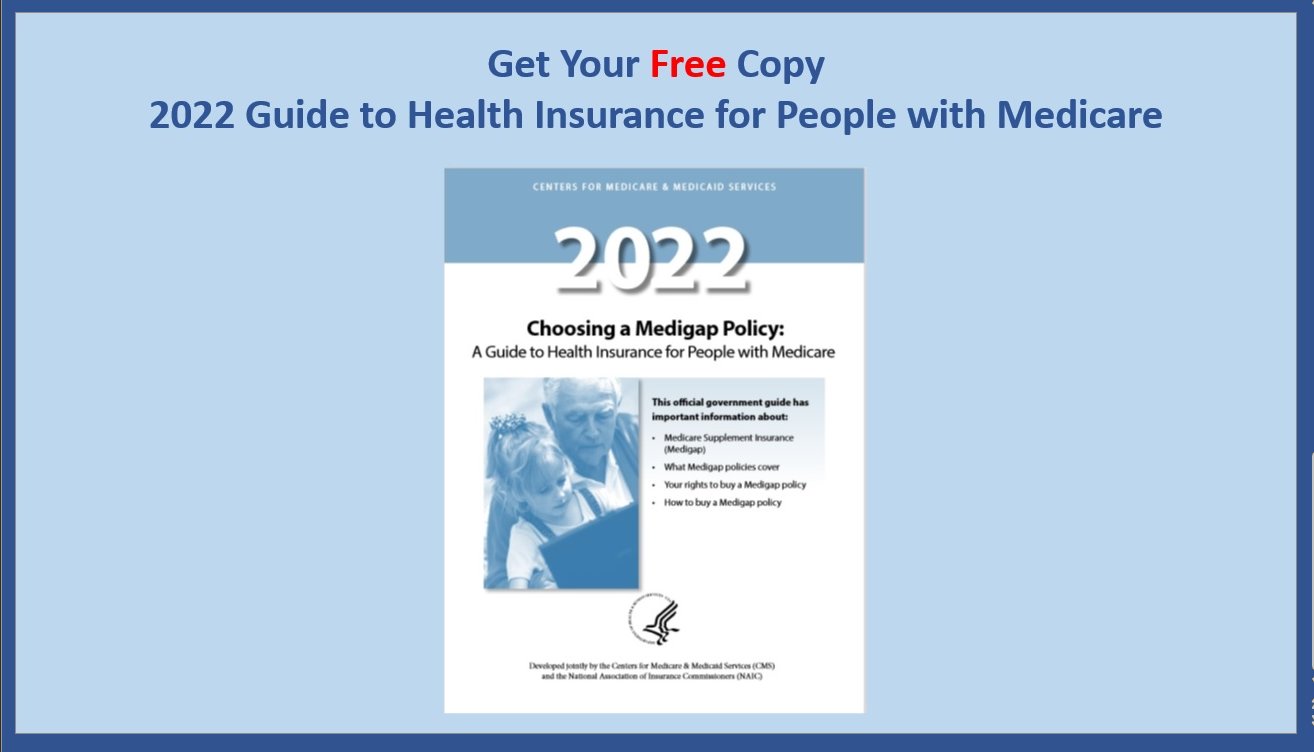
The 2022 Guide to Health Insurance for People with Medicare is also an excellent resource for Medicare information. Please click here to download your free copy!
About Me
As an independent insurance agent, I work with ALL the major Medicare Supplement insurance carriers. I will shop around for you, EVERY YEAR, to find you the best Medicare Supplement rates!
If you have any questions or if you know someone that is turning 65 or would like to save money on their Medicare Supplement insurance, please don’t hesitate to let me know! There is no charge for my service!!!
The Centers for Medicare & Medicaid Services (CMS) recently released their 2023 final rule, which includes two requirements that will have a significant impact on independent agents and brokers who sell Medicare Advantage (MA) and Prescription Drug Plans (PDP’s). In my opinion, this new CMS requirement will adversely affect Medicare beneficiaries because many independent insurance agents and brokers will no longer market or sell MA or PDP’s because of these onerous rules. Consequently, many Medicare beneficiaries will be left on their own to shop for these plans.
Although these new marketing guideline changes are for calendar year 2023, they begin on October 1st, 2022, just before the start of the 2023 Annual Election Period (AEP) for Medicare Advantage and prescription drug plans.
NOTE:The AEP begins on October 15th each year and ends on December 7th. Unless you are in a Special Enrollment Period (SEP), this is the only time of year you can switch to or from an MA or a PDP. With Medicare Supplements, you can change your plan any time of the year.
This new CMS ruling is in response to misleading TV commercials by Third Party Marketing Organizations (TPMO’s) and numerous consumer complaints to CMS. Under these new guidelines, the definition of TPMO’s has been expanded to include agents and brokers. The new definition of TPMO is too broad and will negatively impact many entities that are acting responsibly such as individual agents and brokers who will now be subject to new call recording requirements (see next section). It has been argued that consumer dissatisfaction is not usually with their insurance agent but with TPMO call centers that solicit beneficiaries to switch plans that do not necessarily meet their needs.
Do you recall those TV commercials and pitches from celebrities and pitchmen like Joe Namath, William Shatner, Jimmie Walker, etc.? They promise things from free meal delivery to money deposited in your Social Security account. A few MA plans may offer meal delivery for certain qualified individuals, but only one or two plans in your county may offer those benefits, but most don’t. And while the dental and vision coverage of MA plans may sound great, many plans only include routine visits, not more expensive items like dental implants, eyeglasses, etc.
There are a couple of things you need to consider before you race to your phone to “Call Now.” First, Joe Namath, while he may be a perfectly upstanding gentleman, is no Medicare expert. He is a paid endorser. In fact, I doubt he even understands what a Medicare Advantage plan is. Even if he is on a Medicare Advantage plan, I doubt he is concerned with the potential out of pocket costs involved. I believe his $25 million net worth may place him a little out of touch with the average American budget. Second, be aware that he is speaking on behalf of the Medicare Coverage Hotline, not Medicare. And if you were to pause the commercial on the last slide, you would see that The Medicare Coverage Hotline is a for-profit lead generation campaign. This means that they are simply trying to get you to call their 800 number so they can sell you as a lead to an insurance agent.
Agents and brokers must now record all sales calls with potential clients in their entirety including the enrollment process. These recordings must be retained in a HIPAA-compliant manner for 10 years! This applies to all new and existing clients.
What is considered a sales call? Anything that falls under the “chain of enrollment,” which is defined as the events from the point when a Medicare beneficiary becomes aware of an MA or PDP to the end of the enrollment process. This means when an agent is calling leads, scheduling appointments, collecting drug and provider lists and conducting education meetings and phone enrollments. All of these calls would fall under this category and must be recorded!
NOTE:Medicare Supplements are not included in the new call recording rules. However, if an agent is selling a Medicare Supplement and a PDP, the call must be recorded.
Zoom meetings must also be recorded. Only in-person, face-to-face marketing and sales appointments are excluded, however any follow-up calls related to sales and completing the enrollment process must be recorded. Sales calls conducted on cell phones must also be recorded.
Phone Recording Problems for Agents and Medicare Beneficiaries
This new phone recording requirement will add an additional burden to insurance agents attempting to assist Medicare beneficiaries when selecting suitable health and drug plans. According to the The National Association of Health Underwriters (NAHU), who are advocating against these new CMS changes, “The cost of setting up a HIPAA-compliant audio recording system with adequate and protected storage capabilities far exceeds the abilities of many of these licensed and certified agents who are now facing a decision as to whether to participate in this fall’s AEP.”
There is also a concern from Medicare beneficiaries who do not wish to have their enrollment recorded. An enrollment conversation can last hours, during which beneficiaries may disclose several private details about their health, financials and personal life. Many seniors are not comfortable with the requirement that these conversations be recorded and stored for up to 10 years, regardless of the protections that may be put in place for the recordings.
NAHU
New Disclaimer Requirement
When discussing MA or PDP’s, insurance agents must use the following disclaimer:
“We do not offer every plan available in your area. Any information we provide is limited to those plans we do offer in your area. Please contact Medicare.gov or 1-800-MEDICARE to get information on all your options.”
Agents must include the new disclaimer in the following places:
Verbally stated during the first minute of a sales phone call
Electronically conveyed when communicating with a potential client via email, online chat, or other electronic form of communication
Prominently displayed on the agent’s website
On all marketing materials, in print (12-point font) and television advertisements
Contact Congress Today to Delay this New CMS Marketing Rule
Please click here to contact your member of Congress to request that CMS implement a delay of six to 12 months, during which CMS will work with stakeholders to develop marketing regulations that will protect Medicare beneficiaries while allowing them access to their trusted independent agent or broker.
As of July 1st, 2020, under Senate Bill No. 407, the California Birthday Rule will be changing. Under the current law, for those individuals that have a Medicare Supplement, also known as Medigap, you can change your current plan to any Medigap plan that offers benefits “equal to or lesser than” your current plan during the 30 days following your birthday each year.
Under the new law, you will have the same opportunity to change plans, but the 30 day period has been extended to 60 days.
Nationwide, there are 10 standardized Medigap plans to choose from, Plan A through Plan N. The term “standardized” means that every Plan F, every Plan G, every Plan N, etc. has the same exact coverage and benefits no matter what insurance carrier you have your coverage with. In other words, Plan F is Plan F, Plan G is Plan G, Plan N is Plan N, etc. Because Medigap plans are standardized, it is much easier to compare “apples with apples.”
Medigap Plans Are Standardized but Rates Aren’t
Although Medigap plans are standardized, Medigap rates are not standardized, and they vary widely between insurance carriers. For example, in the 92009 zip code in San Diego, for a 72 year old male, Plan G rates range from $165.78 per month to $223.47 per month. That’s a difference of $57.69 per month or $692.28 per year for the same identical plan and coverage!
Medigap rates are based primarily on your age and zip code, and whether you use tobacco or not. In California, rates usually increase every year as we get older. An insurance carrier that has competitive rates this year may increase rates and not be as competitive next year. For this reason, it is very important to take advantage of the California Birthday Rule and shop around every year to make sure that you aren’t paying too much money for your Medigap insurance premiums.
This is a free service that I provide to all of my California clients every year around their birthday.
NOTE:You can change your Medigap plan or insurance carrier any time of the year, but if you do so other than around your birthday, you will have to answer health questions on the application, and your application will be medically underwritten, and you could be turned down for coverage. If you have a serious health condition, you should definitely take advantage of the California Birthday Rule and apply around your birthday. That way, you cannot be turned down for coverage, REGARDLESS OF YOUR HEALTH.
Innovative Medigap Plans Are Also Changing On July 1st
There is another significant change that will be occurring beginning on July 1st under Senate Bill No. 407. Several insurance carriers have recently introduced new “Innovative” Medigap plans that are the same as the standardized plans, but they also include some additional non-medical coverage for such things as hearing and vision.
For example, Blue Shield of California replaced their “standardized” Plan F with a different plan called “Plan F Extra.” Anthem Blue Cross offers two different Plan F Medigap plans, Plan F and “Plan F Innovative,” which also includes some additional coverage for vision and hearing. And Health Net now offers two different Plan F supplements as well, Plan F and “Plan F Innovative.” Blue Shield currently offers two Plan G Medigap plan, Plan G and “Plan G Extra,” and Health Net offers Plan G and and a “Plan G Innovative” plan as well.
As you can see, the recent introduction to these newer innovative plans has made the Medigap marketplace confusing and defeated the purpose of having standardized Medigap plans. It is no longer so easy to compare Medigap plans and benefits because the “extra” and “innovative” benefits are all similar yet slightly different from each other.
The real problem however, is that when someone wants to take advantage of their open enrollment period under the California Birthday Rule, Blue Shield and Anthem Blue Cross do not allow someone with a “regular” Plan F or Plan G to switch to one of their “Extra” or “Innovative” plans. Both of these companies claim that their innovative plans have “richer” benefits, and they do not qualify under the California Birthday Rule.
Furthermore, Blue Shield no longer offers their “regular” Plan F, only their Plan F Extra, so this has prevented anyone with Plan F with a different insurance carrier to switch to Blue Shield’s Plan F during their annual open enrollment period under the birthday rule. And you would think that someone with Blue Shield’s Plan F Extra could switch to Anthem’s Plan F Innovative plan under the California Rule or vice versa around their birthday, but no. Neither carrier will accept these plans during someone’s 30 day open enrollment period because they consider their plans superior to the other carrier’s plan.
NOTE:Health Net has always allowed someone with the “regular” Plan F or Plan G to switch to their Plan F Innovative or Plan G Innovative plans.
As of July 1st, 2020, Blue Shield of California, Anthem Blue Cross, and all insurance carriers are now required to accept any Plan F or Plan G Medigap plans for any of their innovative Medigap plans under the California Birthday Rule! For example, if you have Plan F with Mutual of Omaha, you can now switch to Blue Shield’s Plan F Extra or Anthem’s Plan F Innovative plan under the birthday rule.
Which is Better, Plan F or Plan G?
Many people with Plan F have switched to Plan G because both plans are identical except Plan F covers the Medicare Part B deductible, which is currently $198 per calendar year, and Plan G does not cover the Part B deductible. Other than that, both plans are identical in coverage.
NOTE:The Medicare Part B deductible can change from year to year, but historically, it has never increased significantly.
Since the only difference between Plan F and Plan G is the $198 Medicare Part B deductible, if you can save more than $198 per year on your premiums by switching from Plan F to Plan G, then Plan G ends up being more cost effective.
If you are saving exactly $198 per year, you are breaking even, and you’re better off staying with Plan F. If you are saving $300 or more per year by switching, it will definitely cost you less money by switching from Plan F to Plan G.
NOTE:If you decide to switch from Plan F to Plan G, and you have already met the $198 Medicare Part B deductible for the current year, you would not have to pay that deductible again until the following year.
Conclusion
As of July 1st, 2020, your annual open enrollment period under the California Birthday Rule is increasing from 30 to 60 days after your birthday. Most carriers will let you apply for coverage during the 30 days prior to your birthday, but the effective date of your new policy would normally be the 1st of the month following your birthday. And if you have Plan F or Plan G with another insurance carrier and you want to switch to an “Innovative” plan under the birthday rule with Blue Shield of CA, Anthem Blue Cross, Health Net, etc., you can now do so.
Since rates vary significantly between insurance carriers for the same identical plan and coverage, it is important to shop around, EVERY YEAR, to make sure that you aren’t paying too much.
As an independent insurance agent specializing in Medicare Supplement (Medigap) insurance, I work with all the major insurance carriers in California and several other states. If you have any questions or if you would like for me to shop around for you to save you money on your Medicare Supplement insurance, please don’t hesitate to let me know.
Ron Lewis
CA Lic# 0B33674
760.525.5769 (Cell)
760.718.1600 (Toll-free)
Ron@RonLewisInsurance.com www.MedigapExpress.com
Under the California Birthday Rule, you can change your Medicare Supplement, also known as Medigap, every year during the 30 days following your birthday, to any other Medigap plan that has “equal or lesser” benefits.
For example, you can switch from Plan F to Plan F, Plan G to Plan G, Plan F to Plan G, Plan G to Plan N, etc. You just can’t switch from Plan G to Plan F, etc. under the birthday rule. You can do this REGARDLESS OF YOUR HEALTH and without answering any of the health questions on the application. You CANNOT be turned down for coverage!
NOTE:You can change Medigap plans any time of the year, but if you do so at any time other than around your birthday, you will have to answer the health questions on the application and your application will be medically underwritten.
Most states don’t have a birthday rule, so this law is definitely beneficial for California residents because in other states, if your health should change and your rates go up significantly, or you are not happy with your Medigap plan or carrier, you could be stuck because your application will be medically underwritten.
As of July 1st, 2020, the 30-day annual open enrollment period under the California Birthday Rule will be increasing from 30 to 60 days. Most carriers will let you apply for a Medigap plan under the birthday rule during the 30 days before or after your birthday; the new rule will be a 90-day window starting 30 days before and up to 60 days after your birthday each year.
Some carriers, such as Health Net, Mutual of Omaha, and Transamerica, have already implemented these changes. With these carriers, you can now qualify as a “guaranteed issue” under the California Birthday Rule during the 30 days before and up to 60 days following your birthday. These new changes with other carriers such as Anthem Blue Cross, Blue Shield of California, and Cigna won’t go into effect until July 1st, 2020.
10 Standardized Plans To Choose From
Nationwide, there are 10 standardized Medigap plans to choose from, Plan A through Plan N. The term “standardized” means that the coverage and benefits for every Plan F, Plan G, Plan N, etc. are exactly the same no matter what carrier you are with. Plan F is Plan F, Plan G is Plan G, etc.
Medigap Premiums Are Not Standardized
Although Medigap plans are standardized, the premiums for these plans are not standardized, and the rates vary significantly from one insurance carrier to another for the same exact plan and coverage.
Under the California Birthday Rule, the main reason you would want to change plans is to save money on your Medigap insurance premiums. In California, there are over two dozen Medigap insurance carriers to choose from. The only difference between them is the price.
For example, Julie will be turning 70 on April 25th, and her Plan G rate with Humana has increased to $205.00 per month. I contact Julie during the 30 days before her birthday (as I do for my clients) to compare rates and review her Medigap options. I let her know that she can get the same exact plan and coverage she now has (Plan G) with Transamerica for $153.00 per month.
Because Julie has had some serious health issues recently, she normally would not be able to change her Medigap insurance coverage. However, because of the California Birthday Rule, Julie can apply for Plan G with Transamerica during the 30 days before her birthday, and her new Plan G coverage will begin on May 1st. (Coverage usually begins on the first of the month following your birthday.) Because of the California Birthday Rule, Julie is now saving $52 per month or $624 per year for the same exact plan and coverage she had before by switching her Plan G from Humana to Transamerica.
NOTE:As of Julie 1st, 2020, Julie can take advantage of the California Birthday Rule every year during the 30 days prior to her birthday and up to 60 days following her birthday. As mentioned earlier, some carriers have already made this change.
Rates Vary Significantly Between Insurance Carriers
Although Medigap plans are standardized, Medigap rates are not standardized, and they vary significantly between insurance carriers. For example, in the 92009 zip code (Carlsbad, California), the Plan G rates for a 70 year old single female range from $152.14 per month with Transamerica to $269.87 per month with UnitedHealthcare (UHc) through AARP! That is a difference of $117.73 per month or $1,412.76 per year!
The Application Process
Most Medigap insurance carriers in California use online applications. I work with clients throughout California and in several different states, so it’s not necessary to meet face to face. The application process is simple, and it usually takes less than 15 minutes to complete.
In addition to the application, most carriers request a copy of your current Medigap card showing which plan you currently have. Some carriers also want something such as a copy of a current bill or bank statement showing that a recent payment has been made. Once the application has been submitted, the entire application process takes about a week or two to complete.
New MACRA Law
As of January 1st, 2020, the Medicare Access and CHIP Reauthorization Act (MACRA) went into effect. Under MACRA, if you turn 65 or become eligible for Medicare Part B on or after January 1st, 2020, Plan F and Plan C will not be an option for you since they pay the Medicare Part B deductible, which is $198 per calendar year in 2020. If you turned 65 or became eligible for Medicare prior to January 1st, 2020, then you can still sign up for Plan F, Plan C, etc., and those plans will still be available in the future.
Not All Insurance Carriers Are the Same
Although Medigap plans are standardized, some insurance carriers include some “extra” benefits with their plans such as free gym memberships, vision, hearing, and free personal emergency response systems (PERS), etc. Some insurance carriers guarantee and lock their rates for the first 12 months while others don’t. Some have better customer service, etc. It’s important to shop around and compare rates and to find the right plan and insurance carrier for you. I can help you with that.
For More Information
As an independent insurance agent, I work with all the major insurance carriers in California and several other states. I shop around for my clients, every year, to find them the best rates.
If you have any questions about the California Birthday Rule, etc. or if you would like a free, no-obligation Medigap quote, please don’t hesitate to contact me toll-free at (866) 718-1600 or at Ron@RonLewisInsurance.com. And please feel free to visit my website!

I wasn’t happy about turning 65, but as far as my medical and Prescription Drug Plan (PDP) coverage is concerned, Medicare is the best!
When it comes to my health insurance, I couldn’t be happier! Before I got on Medicare, I was paying a very high monthly premium for an Affordable Care Act (ACA) “Bronze” plan that had a $5,000 per calendar year deductible. Consequently, I rarely used my ACA health insurance benefits because of the ridiculously high deductible, but at least I had maternity coverage! (Pardon my sarcasm. 😉
Now, my Medicare Part B premium is $144.60 per month and my Medicare Supplement is $162.00 per month, so I’m currently paying a total of $306.60 per month with a ZERO deductible for my health insurance! My current health insurance is so much better than before!
Medicare Does Not Cover Outpatient Prescription Drugs
Medicare and Medicare Supplements do not cover outpatient prescription drugs, so most people sign up for a standalone PDP, also known as Medicare Part D. It is not required that you sign up for a PDP when you first turn 65 or begin your Medicare Part B (Medical insurance), but a lifetime monthly penalty will be added on if you sign up later on.
The Medicare Part D penalty is calculated by multiplying 1% of the “national base beneficiary premium” ($32.74 in 2020) by the number of full months that you were eligible for, but didn’t enroll in, a Medicare PDP and went without other creditable prescription drug coverage.
The penalty comes out to approximately $0.33 per month for every month you were eligible for a PDP but didn’t have one. So, to use round numbers, if you went 10 months without a PDP and then signed up for one, the monthly lifetime penalty would be about $3.30 per month on top of the regular monthly PDP premium.
NOTE:The penalty amount is re-calculated each year based on the new base beneficiary premium amount, so it may go up or down each year.
I’ve heard many people say that they are “healthy” and they don’t take prescriptions, so they don’t feel the need to sign up for a PDP when they start Medicare. Unless it’s a financial burden for you to sign up for one, I always advise my clients to at least sign up for the cheapest plan, which is only about $12.80 to $13.20 per month, depending upon where you live.
NOTE:Medicare Supplement insurance is my primary focus and specialization. I am not certified to sell PDP’s. If you want to apply, you can call the insurance carrier directly and have them enroll you on the phone, or you can enroll on your own on the Medicare.gov website.Please click here to see a short video I made that explains how to sign up for a prescription drug plan.
It’s Important to Shop Around Each Year
As with Medicare Supplement insurance, it’s important to shop around each year to make sure that you aren’t paying too much for your PDP. What is good this year, may not be so good (or affordable) next year. PDP rates can vary significantly from one PDP to another and from one pharmacy to another!
The Annual Election Period (AEP) goes from October 15th through December 7th each year. If you have a PDP or if you will be getting one, you should shop around every year during the AEP to see if there is a better plan for the following year because drug formularies and prices change from year to year. Coverage would begin in the following January.
Example of the Savings You Can Have With a PDP
In 2020, I switched my PDP to Clear Spring Health Premiere RX, and I’m currently paying $12.80 per month for my plan. Although I’m in relatively good health, I take three prescriptions on a regular basis:
Levothyroxine Sodium
Fluticasone Propionate nasal spray
Latanoprost OP eye drops
The Von’s pharmacy is close to where I live and “in network” with my Clear Spring Health PDP. If I didn’t have a PDP, I would be paying $61.69 per month for the Levothyroxine Sodium, $62.69 per month for the Fluticasone Propionate, and $42.99 per month for the Latanoprost eye drops for a total of $167.37per month or $2,008.44 per year!
With my PDP, I am paying $2.00 per month for the Levothyroxine Sodium, $6.00 per month for the Fluticasone Propionate, and $6.00 per month for the Latanoprost eye drops for a total of $14.00per month in co-payments for all three of my prescriptions. When you factor in my monthly premium for my PDP of $12.80 per month, altogether, the total cost (premiums and co-payments) for my Clear Spring Health PDP is $26.80per month or $321.60per year!
In other words, I am saving $1,686.84 per year by having a prescription drug plan with Clear Spring Health ($2,008.44 – 321.60)!
What About GoodRx.com?
GoodRx.com is an excellent website to use regardless of whether you have a PDP or not. Please click here to see a short video I made about how to use the GoodRx website. Sometimes it is cheaper to use GoodRx than your PDP. One of the main problems with GoodRx is that sometimes you can find great deals on the website, but not always. Some people take some very expensive medications that are not on the GoodRx website, so it’s really hit and miss.
I looked up the three prescriptions mentioned above, and here are the current GoodRx costs in my zip code:
Levothyroxine Sodium – $18.19
Fluticasone Propionate nasal spray – $12.14
Latanoprost OP eye drops – $15.32
The total cost for all three of these prescriptions at GoodRx is currently $45.65 per month or $547.80 per year. In comparison, with my PDP, my total cost is $26.80 per month or $321.60per year! In this example, I am still saving over $225 per year by having a prescription drug plan. Also, the drug prices can change from month to month with GoodRx and you may have to run around to different pharmacies every month to pick up your various prescriptions.
PDP’s covers most prescription medications and some chemotherapy treatments and drugs. If Part B doesn’t cover a cancer drug, your Part D plan may cover it. PDP’s also cover all commercially available vaccines, except those covered by Medicare Part B, when they are reasonable and necessary to prevent illness.
Conclusion
Some PDP’s are good for some people but not others. It really depends upon what prescriptions you are taking, but I would always recommend that you go to the Medicare.gov website and check out the Medicare Plan Finder tool to see if a PDP makes sense for you or not. There are pros and cons to each, but in most cases, I would still recommend that you sign up for Medicare Part D, a prescription drug plan.
The new 2019 Medicare deductibles, coinsurance, and out-of-pocket limits were recently released, and they go into effect on January 1st, 2019.
Medicare Part A (Hospital Insurance)
Part A Deductible: This deductible is increasing $24 to $1,364 per benefit period.
Part A Coinsurance: Inpatient Hospital Care (Days 61-90). Increasing $6 to $341 per day.
Lifetime Reserve Coinsurance: Inpatient Hospital Care (Days 91-150). Increasing $12 to $682 per day.
Skilled Nursing Facility (SNF) Coinsurance: (Days 21 through 100) Increasing $3 to $170.50 per day.
NOTE: A benefit period begins on the first day you receive service as an inpatient in a hospital and ends after you have been out of the hospital and not received skilled care in any other facility for 60 days in a row. This is not an annual deductible; there can be multiple benefit periods (up to six) in a calendar year!
Medicare Part B (Medical Insurance)
Part B Annual Deductible: Increasing $2 to $185 per year.
NOTE: For those of you with a Plan G Medicare Supplement (also known as Medigap because it picks up the gap in coverage not covered by Medicare), Plan G is identical to Plan F with the exception of the Part B deductible. Once this deductible has been met, Plan F and Plan G are exactly the same. If you are saving more than $185 per year on your premiums by switching from Plan F to Plan G, then Plan G ends up costing less than Plan F.
Medicare Supplement Plan-Specific Deductibles and Out-of-Pocket Limits
High Deductible Plan F Annual Deductible: Increasing $60 to $2,300 per calendar year.
Plan K Annual Out-of-Pocket Limit: Increasing $320 to $5,560 per calendar year.
Plan L Annual Out-of-Pocket Limit: Increasing $160 to $2,780 per calendar year.
Part D Prescription Drug Plans
The new 2019 Part D deductible is $415 once a year.
How Do These Changes Affect My Medicare Supplement?
If you have a Medicare Supplement, your benefits are automatically adjusted every year to cover the new deductibles, co-payments, and coinsurance amounts in 2019.
Do You Have a Medicare Supplement Plan?
If you have a Medicare Supplement plan, contact me for a free quote! As an independent insurance agent, I work with all the major insurance carriers, and more than likely, I can save you hundreds of dollars on your Medicare Supplement premiums for the same exact plan and coverage!
If you have any questions or comments, please let me know!
Although the topic of this blog isn’t specifically insurance-related, I thought I’d pass this information on as a “public service announcement.”
Fortunately, I don’t usually have to call or deal with the Internal Revenue Service (IRS) much, but something unexpected came up with my social security, and I had to call the IRS. I was literally on the phone for hours pushing buttons and listening to a myriad of endless options. I was unable to speak with a live person, which is why I called in the first place.
Finally, out of frustration, I tried googling different ways to contact the IRS, and I found that a lot of other people were having the same problem that I was having. It seems that the IRS wants to make it as difficult as possible for someone to be able to reach one of their phone representatives.
I know that most people don’t need to call the IRS on a frequent basis, but in case you ever need to call them, here are the steps that you need to follow to actually speak with a real live human being at the IRS:
Call the IRS at 1-800-829-1040 between the hours of 7 AM – 7 PM local time, Monday through Friday.
Choose your language.
Choose option 2 for “personal income tax.” (Do NOT choose option 1 for refund information. If you choose refund information, it will send you to an automated phone line.)
Press 1 for “form, tax history, or payment.”
Press 3 “for all other questions.”
Press 2 for “all other questions.”
When asked to enter your social security number (SSN) or employment identification number (EIN) to access your account information, don’t enter anything. (After it asks you twice, you will get another menu.)
Press 2 for “personal or individual tax questions.”
After that, you should be transferred to an IRS agent.
I also tried calling a couple of “local” IRS offices, but it was just as challenging trying to talk with a live person. I tried the steps shown above, and they work! I hope that you don’t have to call or deal with the IRS, but if you need to call them, I think that you will find these steps to be helpful.
You can also access a lot of useful information on the IRS website, which is www.irs.gov.
Do You Have a Medicare Supplement Plan?
If you have a Medicare Supplement plan, contact me for a free quote! As an independent insurance agent, I work with all the major insurance carriers, and more than likely, I can save you hundreds of dollars on your Medicare Supplement premiums for the same exact plan and coverage!
If you have any questions or comments, please let me know!
The Annual Enrollment Period (AEP), which is from October 15th through December 7th each year, is almost here!
If you currently have a Medicare Advantage (MA) plan, you should switch back to Original Medicare and get a Medicare Supplement plan instead!
IMPORTANT:If you have a Medicare Supplement plan (aka “Medigap” because it picks up the “gap” in Medicare coverage) the AEP does not apply to you unless you want to enroll in or change your Prescription Drug Plan (PDP).
Why Medicare Supplement Plans Are Better
With Original Medicare (Part A and Part B) and a Medicare Supplement, you have much more freedom of choice and lower costs than you do with an MA plan!
NOTE:Medicare Part A is hospital insurance and Part B is medical insurance.
Which Plan Gives You the Most Freedom?
With an MA plan, you are locked into the plan’s network of doctors, specialists, hospitals, and care facilities. If you want to see a specialist, you often have to see your preferred care provider first, who acts as a gatekeeper, before you can see a specialist within your network. If you want to see a specialist or doctor that is outside of your network, good luck! That will cost you a lot more in out-of-pocket (OOP) costs.
With a Medicare Supplement plan, you can go to ANY doctor, specialist, hospital, or care facility in the US as long as they accept Medicare!
For example, the MD Anderson Cancer Treatment Center in Texas accepts Medicare and therefore, they accept ALL Medicare Supplement plans. They don’t, however, accept most MA plans!
Which Plan Has Lower Out-Of-Pocket Costs?
With an MA plan, your OOP costs can be as high as $6,700 per calendar year and even higher if you go to doctors and/or care facilities that are outside of your network! With a Plan F or Plan G Medicare Supplement (the two best Medigap plans), the most you would normally pay in OOP costs in a calendar year is either $0 with Plan F or $183 with
Plan G!
NOTE:The $183 is the Medicare Part B (Medical) deductible, which is $183 per calendar year in 2017. That amount can change from year to year, but historically, it has always been very stable.
Maximum Out-Of-Pocket Costs for MA Plans in San Diego
The following data was obtained from the Medicare.gov website and shows the current OOP costs for MA plans in the 92009 zip code in San Diego. These costs currently range from $3,300 to $6,700 per calendar year!
If you go out-of-network with your MA plan, your OOP costs will be even higher!
Current (in-network) Maximum OOP Costs for MA Plans in the 92009 Zip Code:
AARP MedicareComplete SecureHorizons Plan 4 (HMO) – $3,400
AARP MedicareComplete SecureHorizons Premier (HMO) – $4,300
AARP MedicareComplete SecureHorizons Value (HMO) – $5,300
Aetna Medicare Choice Plan (PPO) – $6,000
Aetna Medicare Select Plan (HMO) – $3,400
Anthem MediBlue Coordination Plus (HMO) – $6,700
Anthem MediBlue Plus (HMO) – $3,400
Blue Shield 65 Plus (HMO) – $3,400
Brand New Day Classic Care Drug Savings (HMO) – $3,400
Brand New Day Classic Choice for Medi-Medi (HMO) – $6,700
Care1st AdvantageOptimum Plan (HMO) – $3,400
Coordinated Choice Plan (HMO) – $6,700
Health Net Healthy Heart (HMO) – $3,400
Health Net Seniority Plus Sapphire (HMO) – $6,700
Health Net Seniority Plus Sapphire Premier (HMO) – $6,700
Humana Gold Plus H5619-016 (HMO) – $4,900
Humana Value Plus H5619-037 (HMO) – $6,700
Kaiser Permanente Senior Advantage San Diego (HMO) – $4,900
Scripps Classic offered by SCAN Health Plan (HMO) – $3,400
Scripps Plus offered by SCAN Health Plan (HMO) – $6,700
Scripps Signature offered by SCAN Health Plan (HMO) – $4,000
Sharp Direct Advantage Gold Card (HMO) – $3,400
Sharp Direct Advantage Platinum Card (HMO) – $3,300
Sharp SecureHorizons Plan by UnitedHealthcare (HMO) – $3,400
In contrast, in a calendar year, your maximum OOP costs are either $0 with a Plan F Medicare Supplement or $183 with a Plan G Medicare Supplement!
Is Your MA Plan’s Maximum OOP Costs Really No More Than $6,700 Per Year?
If you stay within your MA plan’s network, your maximum OOP costs are not supposed to be more than $6,700 per calendar year. However, if you go outside of the plan’s network, your OOP costs can be significantly higher than that!
Suppose that you get really sick and need expensive treatment such as Chemotherapy, etc. in the second half of the year. You could end up paying up to $6,700 (or whatever your plan’s maximum OOP cost is) by the end of the calendar year and guess what? Your OOP maximum zeros out in January, and it starts all over again!
If you are still receiving expensive medical care in the beginning of the year, you could potentially end up paying your maximum OOP cost two different times in a
12-month period! For example, if your maximum OOP cost is $6,700, your total OOP cost in a 12-month period, not a calendar year, could be more than $13,400!
Which Plan Has Lower Co-Payments?
If you have an MA plan, you will make a co-payment almost every time you go to the doctor, see a specialist, a physical therapist, etc. With most Medicare Supplement plans, there are no co-payments for doctor’s visits, etc.
How Difficult is it to Switch From an MA Plan to Original Medicare and a Medicare Supplement Plan?
That depends if you are in a Special Enrollment Period (SEP).
Special Enrollment Period
If you currently have an MA plan, and you are in a SEP, you can switch to Original Medicare and to any six of the 10 “standardized” Medicare Supplement plans any time of the year, REGARDLESS of your health.
The six “guaranteed issue” Medicare Supplement plans are plans A, B, C, F, K, and L. In other words, if you are in a SEP, you are guaranteed the right to get a Plan F Medicare Supplement, but not a Plan G supplement, etc.
NOTE:You could apply for Plan G, but you would be medically underwritten, and you could be turned down for certain medical conditions.
The 10 Standardized Medicare Supplement Plans
Nationwide, there are 10 “standardized” Medicare Supplement plans to choose from (Plans A through N). The term “standardized” means that the benefits and coverage for every Plan F, Plan G, etc. is exactly the same with every insurance carrier. Unlike MA plans, which are not standardized, it’s much easier to compare “apples with apples” with Medicare Supplement plans.
Medicare Supplement rates are not standardized. They vary significantly between insurance carriers. For that reason, it’s very important to shop around every year!
NOTE:In the preceding chart, notice that the only difference between Plan F and Plan G is the $183 per calendar year Part B deductible.
SEP Situations
Here are some SEP situations that would guarantee you the right to switch back to Original Medicare and a Medicare Supplement plan:
The plan is leaving the Medicare program or stops service in your area.
You move out of the plan’s service area.
You leave the plan because the company has not followed certain rules or has misled you.
You decide to switch to Original Medicare within the first year of joining an MA plan when first eligible for Medicare Part A at age 65.
If you are in one of these situations, you cannot be turned down for Medicare Supplement insurance coverage, regardless of your health!
If You Are Not In a Special Enrollment Period
If you are not in a SEP, you will have to wait until the AEP (between October 15th and December 7th) to switch back to Original Medicare (Part A and Part B) on January 1st of the following year.
Although you can switch back to Original Medicare, there is no guarantee that you will be able to get a Medicare Supplement plan because you will be medically underwritten, and you must be in relatively good health to qualify for a Medicare Supplement plan.
If You Have Serious Health Conditions, You May Not Be Able to Get a Medicare Supplement Plan!
If you are not in a SEP and you are coming off of an MA plan during the AEP, you would normally have to meet minimum underwriting requirements to qualify for a Medicare Supplement plan, and you could be turned down for coverage.
If you live in California and you have serious health issues, more than likely, I can still get you a Medicare Supplement without having to answer any medical questions on the application! Call me for more details!
The Pros and Cons of MA Plans and Medicare Supplement Plans
Is there really an advantage to having a Medicare Advantage plan? Let’s take a look at the pros and cons of each, and you can decide for yourself.
MA Plan Advantages
Here are some benefits of having an MA plan:
MA premiums can be very low, and some plans have no monthly premiums at all.
Some MA plans include Medicare prescription drug coverage (Part D).
Maximum OOP costs are “limited.” Plans vary, but in 2017, the most you can pay in OOP costs is $6,700 per calendar year. (I wouldn’t really call this a “benefit” since $6,700 is a lot of money! With a Plan F Medicare Supplement, you won’t pay any OOP costs!)
Some MA plans offer additional benefits such as vision, hearing, dental, and other health and wellness programs. (Note that some Medicare Supplement plans also offer additional benefits such as free gym memberships, vision, and hearing aid benefits.)
Medicare Supplement Plan Advantages
Here are some benefits of having a Medicare Supplement plan:
You have much more FREEDOM of choice with a Medicare Supplement than you do with an MA plan because you can go to ANY doctor, hospital, specialist, or care facility in the United States as long as they accept Medicare. (You can’t do that with an MA plan.)
You have much for financial stability with a Medicare Supplement than an MA plan because there are no unexpected spikes in costs and OOP expenses for co-payments, hospitalizations, surgeries, chemotherapy, etc.
With a Plan F or Plan G Medicare Supplement, other than your premiums, your maximum OOP costs in a calendar year will be either $0 (Plan F) or $183 (Plan G) per calendar year in 2017. With an MA plan, your maximum OOP costs can be as high as $6,700 per calendar year!
Chemotherapy is very expensive. With an MA plan, you have to pay the entire 20% Medicare Part B co-payment for chemotherapy, which can cost thousands of dollars. With a Plan F or Plan G Medicare Supplement, the most you will pay for Chemotherapy is either $0 (Plan F) or $183 (Plan G)!
You are not limited to a specific geographic region or a restrictive network of doctors, hospitals, specialists, care facilities, etc. like you are with an MA plan. With most MA plans, you must use their providers or you may pay more or all of the costs if you go out of their network.
With a Medicare Supplement, you can go directly to the specialist of your choice, ANYWHERE in the United States, as long as they accept Medicare. With most MA plans, you must go through your primary care doctor first (the “gatekeeper”) before you can see a specialist within your network.
There are no HMO or PPO plans or networks with Medicare Supplements. If you have an MA plan and you go to a doctor, other health care provider, facility, or supplier that doesn’t belong to the plan’s network for non‑emergency or non-urgent care services, your services may not be covered, or your costs could be higher.
If you want to go to a renowned treatment center such as the MD Anderson Cancer Treatment Center in Texas, you can do so with any Medicare Supplement, as long as they accept Medicare. You can’t do that with most MA plans.
If you move to another part of the country, you can keep your Medicare Supplement, but you cannot keep your MA plan if you move out of your network.
There are only 10 “standardized” Medicare Supplement plans to choose from, (Plan A through Plan N). Since Medicare Supplements are standardized, the coverage and benefits for every Plan F, Plan G, etc. is exactly the same with every insurance carrier, so it’s much easier to shop around and compare “apples with apples.” MA plans are not standardized, and the co-payments, deductibles, out of pocket costs, etc. vary significantly between MA plans, and they change every year making them unnecessarily complicated and confusing.
Your Medicare Supplement plan cannot be cancelled as long as you pay your premiums. MA plans are annual contracts, and they can be cancelled or benefits changed at the end of each calendar year.
There are no provider networks with Medicare Supplements. With MA plans, providers can join or leave a plan’s provider network anytime during the year meaning that you could have to start shopping around for a new doctor while simultaneously undergoing Chemotherapy or other specialized medical treatments.
There is no AEP for Medicare Supplements, and you don’t have to shop around every year and make sure that your coverage, co-payments, co-insurance, deductibles, and benefits haven’t changed since the previous year. If there are any Medicare changes from one calendar year to the next, your Medicare Supplement will automatically pay the difference.
You can travel around the US for as long as you want (or even move to a different geographic location), and your Medicare Supplement cannot be cancelled for leaving your “service area.” With most MA plans, if you travel outside of the MA plan’s service area for more than six months, you could be disenrolled from the plan.
With most Medicare Supplements, there are no co-payments when you go to the doctor. With most MA plans, you have to pay co-payments when you go to the doctor.
With Medicare Supplements, pre-certification is not required for surgeries, etc. as long as the procedure is “medically necessary.” With most MA plans, pre-certification is required for surgeries or before getting expensive treatments.
You can switch Medicare Supplement plans or insurance carriers any time of the year as long as you meet minimum health and underwriting requirements. With an MA plan, you can only join or leave an MA plan during the AEP. Otherwise, you are locked into your plan for the entire calendar year, except for certain circumstances, such as moving out of your plan’s service area, etc.)
As you can see, you are much better off with a Medicare Supplement plan than you are with a Medicare Advantage plan!
Conclusion
If you currently have a Medicare Advantage (MA) plan, you have given up your Original Medicare rights that you have worked so hard for, and you are compromising your freedom to go to the best doctors, hospitals, specialists, neurosurgeons, care facilities, etc. in the United States.
I would strongly urge you to switch back to Original Medicare and get a Medicare Supplement plan during the upcoming AEP, between October 15th and December 7th)! Contact me TODAY for more information or a free quote!
As an independent insurance agent specializing in Medicare Supplements, I work with ALL of the major insurance carriers, not one particular company. I will shop around for you, every year, and save you money on your Medicare Supplement insurance!
If you live in California and you have a serious medical condition, more than likely, I can still get you a Medicare Supplement at a competitive price without answering any of the health questions on the application!
I hope that you have found this article to be helpful and informative. Please feel free to forward this article to anyone who may be interested.
Your comments and feedback are appreciated! If you have any questions, please contact me… I’m always happy to help!
In several months from now, a good friend of mine will be turning 65 years old. While he is not anxious to get any older than he already is, he is happy about one thing… he will be getting off of Obamacare and onto Medicare!
My friend used to have a really good, low-deductible health insurance plan that was very affordable. But under Obamacare, all of that changed. The quality of his health insurance decreased significantly while his Affordable Care Act (ACA) premiums, co-payments, and deductibles increased dramatically. But fortunately, he now has maternity coverage, which is something that he never had before! Sorry about the sarcasm!
When he goes onto Medicare, it will be just the opposite; the quality of his health insurance will increase significantly while the cost of his premiums, co-payments, co-insurance, and deductibles will all decrease!
Current Coverage
For example, he currently has a Bronze 60 ACA plan. The annual deductible is $4,800 per calendar year if he goes to “participating” providers and $9,000 per calendar year if he goes to “non-participating” providers! According to his health plan, “You must pay all the costs up to the deductible amount before this plan begins to pay for covered services you use. The integrated deductible applies to both medical and pharmacy services.” Therefore, the deductibles apply to prescription drug coverage as well.
Once the deductible is met, my friend must pay 40% of the remaining costs until he has reached the maximum out-of-pocket (OOP) cost, which is $6,550 per calendar year for “participating” providers and $9,650 per calendar year for “non-participating” providers.
NOTE:According to his current health insurance plan, OOP costs do not include “Premiums, balance-billed charges, some co-payments, charges in excess of specified benefit maximums, and health care this plan doesn’t cover.” So, total OOP costs are really much higher than $6,550 or $9,650 per calendar year when you factor in premiums and other miscellaneous costs.
The deductible and OOP costs start all over again every January. If he got really sick in the last six months of the year, there is a real possibility that he could reach his maximum OOP costs of $6,550 (or $9,650) again in the first six months of the following year. That means that he could potentially have total OOP costs in excess of $13,100 to $19,300 in a twelve-month period, not including his premiums!
My friend has a subsidized plan through Covered California. Although he pays $268.52 per month for his Bronze 60 PPO plan, the full premium that others are paying for the same identical (non-subsidized) plan is $784.79 per month, which isn’t exactly cheap for a high-deductible, catastrophic plan! I’m pretty sure you can buy or lease a luxury automobile for a lot less than that!
Medicare Coverage
In contrast, he won’t have to pay anything for his Medicare Part A (Hospital) insurance, and he will pay $134.00 per month for his Medicare Part B (Medical) insurance. In addition to his Original Medicare, he will need to take out a Medicare Supplement plan to pick up the difference in co-payments, deductibles, and co-insurance that Medicare does not pay.
Medicare Supplement Coverage
Of the 10 standardized Medicare Supplement plans (aka Medigap plans because they pick up the “gaps” in coverage that are not covered by Medicare), Plan F and Plan G are the two best plans:
Plan F pays for ALL of the co-payments, deductibles, and co-insurance that is not covered by Medicare. With Plan F, there are NO DEDUCTIBLES OR OUT-OF-POCKET COSTS!
Plan G is identical to Plan F except for the $183 per calendar year deductible for outpatient treatment such as physician services, inpatient and outpatient medical and surgical services and supplies, physical and speech therapy, diagnostic tests, and durable medical equipment.
NOTE:In 2017, the Part B deductible is $183 per calendar year. This amount can change from year to year, but historically, it has been very stable. With Plan G, once you have met the $183 per calendar year deductible, there are no other out of pocket costs, and Plan G is exactly the same as Plan F. The monthly premiums for Plan G are usually significantly less than the monthly premiums for Plan F, so Plan G usually ends up being more cost effective than Plan F.
For this reason, many people with Plan F have been switching to Plan G. Also, beginning on January 1st, 2020, Plan F will no longer be available for new people who are turning 65.
Although my friend’s ACA health plan is a PPO, he is still restricted to doctors, specialists, hospitals, care facilities, etc. that are within his health plan’s network. If he goes out of the network or goes to “non-participating” providers, he pays even more!
With Original Medicare and Medicare Supplements, there are no networks, HMO’s, or PPO’s, so my friend will have much more freedom of choice than he presently has with his ACA plan.
With a Medicare Supplement plan, you can go to ANY doctor, specialist, care facility, or hospital in the United States, as long as they accept Medicare! If you later move to another state, you can keep your Medicare Supplement plan and use it ANYWHERE in the US!
Medicare Supplement Premiums
In California, Medicare Supplement rates are based primarily on your age and zip code. If my friend decides to splurge and go with Plan F (the “Cadillac” plan) he will have a $0 deductible and no out-of-pocket costs! For age 65, his monthly premium will be as low as $132.00per month!
Rates can vary significantly between insurance carriers for the same identical plan and coverage, so it’s important to shop around every year!
If my friend wants to save money on his Medicare Supplement premiums by signing up with Plan G, his maximum calendar year deductible AND out-of-pocket costs combined will be $183 per calendar year, and his monthly premium will be as low as $119.36 per month!
Scenario #1 – Total Costs if My Friend Signs up with Plan F
If he decides to sign up with Plan F, the most expensive Medicare Supplement plan, his total monthly premiums for his Medicare Part A ($0), Medicare Part B ($134.00), and his Plan F Medicare Supplement ($132.00) will be $266.00per month!
NOTE:If he wants to, my friend can also pick up a good Prescription Drug Plan (PDP) for $17.00 per month.
Scenario #2 – Total Costs if My Friend Signs up with Plan G
If he decides to sign up with Plan G, the most popular Medicare Supplement plan, his total monthly premiums for his Medicare Part A ($0), Medicare Part B ($134.00) and his Plan G Medicare Supplement ($119.36) will be $253.36per month!
Conclusion
My friend is currently paying $268.52 per month for a high-deductible, catastrophic ACA health insurance plan that is basically worthless.
If he decides to sign up for a Plan F Medicare Supplement with no deductibles or out-of-pocket costs, his total cost for coverage under Medicare and his Medicare Supplement will be $266.00 per month!
If he decides to sign up for a Plan G Medicare Supplement with a $183 per calendar year deductible and no out-of-pocket costs, his total cost for coverage under Medicare and his Medicare Supplement will be $253.36 per month!
And now you know why my friend is smiling about his upcoming 65th birthday…
“Hello Medicare, and good riddance Obamacare!”
As of January 1st, 2020, “newly eligible” Medicare beneficiaries will no longer be able to purchase Plan F and Plan C Medicare Supplement plans, which are also known as “Medigap” plans because they pick up the “gaps” in coverage that Medicare doesn’t cover.
NOTE:The high-deductible Plan F Medigap plan is also going away.
Individuals that are signing up for Medicare on or after January 1st, 2020, will not be able to sign up for any Medigap plan that covers the Medicare Part B deductible, which is currently $183 per calendar year in 2017.
Of the 10 “standardized” Medigap plans, Plan F and Plan C are the only two plans that cover the Part A (Hospital) and Part B (Medical) deductibles and coinsurance in full. These two plans are the only Medigap plans that offer “first-dollar” coverage for every doctor or hospital visit.
Why Are Plan F and Plan C Going Away?
These changes are taking place because of Section 401 in the Medicare Access and CHIP Reauthorization Act (MACRA) of 2015, which is also known as the “doc fix” law. To view the text, please click here.
In a nutshell, Congress passed this legislation to ensure that doctors would be paid adequately for providing Medicare services and to provide an incentive for doctors to continue accepting Medicare patients. Previous legislation had budgeted for doctors to have rate decreases over the years and there was concern that many doctors would stop accepting Medicare patients.
Because of the ever-increasing cost of medical care and the fact that more than 10,000 baby-boomers are turning 65 every day, Medicare is experiencing increased financial strain. Since individuals with Plan F and Plan C have no co-payments or deductibles, lawmakers fear that this lack of cost-sharing results in Medicare abuse, which is driving up costs.
It has been argued that the “first dollar” coverage available from Plan F and Plan C cause Medicare recipients to see their doctors more frequently than they would if they didn’t have all of their deductibles covered and had to pay some out-of-pocket costs when they did go to the doctor. Some claim that these changes will save Medicare billions of dollars each year in medical claim exposure.
In an effort to control costs by reducing claims, Congress has decided that it makes more sense for Medicare recipients to be responsible for more of their out-of-pocket medical expenses. Consequently, Congress has decided to eliminate Plan F and Plan C because they want Medicare beneficiaries to have more “skin in the game.”
No one knows if these measures will really reduce Medicare’s overall annual costs. Some argue that Medicare beneficiaries may end up waiting to get medical care for serious issues, which would ultimately cost Medicare more money in the future.
What Happens If I Have Plan F or Plan C Before January 2020?
Since the MACRA only prohibits the sale of Medigap Plan F and Plan C to “newly eligible” Medicare beneficiaries on or after January 1st, 2020, if you already have one of these plans in 2020, you will be exempted and “grandfathered” in. You will not lose your coverage!
You will still be able to purchase Plan F and Plan C policies from other insurance carriers after 2020 as long as you can medically qualify or if you are in an Open Enrollment or Guaranteed Issue situation.
If you were eligible for Medicare prior to 2020, but you delayed getting it because you are still working and have employer insurance, you will still be able to enroll in Plan F or Plan C after you stop working and switch back to Medicare.
What Happens If I Won’t Be Eligible for Medicare Until After January 2020?
For those individuals who will not be eligible for Medicare until January 1st, 2020 or later, although you will not be able to get Plan F, you will still be able to get Plan G, which is an excellent Medigap plan that is identical to Plan F in every way except for the $183 per calendar year deductible.
Today, many people that have Plan F have been switching to Plan G because the premiums for Plan G are usually significantly less than the premiums for Plan F. In most cases, Plan G will cost you less and is usually more cost effective, even if you pay for the entire Part B deductible!
Shop Around Every Year!
Since Medicare Supplement rates vary significantly between insurance carriers for the same identical plans and coverage, and since the rates in most states are based on your “attained” age, and they usually go up in price each year, it’s important to shop around every year, preferably during the 30 days before your birthday.
If you live in California, there is a law called the “California Birthday Rule.” This law guarantees you the right to switch “like for like” Medigap plans, such as Plan F for Plan F, or you can switch to any other Medigap plan with fewer benefits, such as from Plan F to Plan G, etc. You can do this every year, REGARDLESS OF YOUR HEALTH, during the 30 days following your birthday! Most insurance carriers in California let you do this during the 30 days before or after your birthday.
Whether you decide to keep your current Plan C or Plan F, or if you want to find out how much you can save by switching to Plan G, you should take advantage of the California Birthday Rule and compare rates every year to make sure that you aren’t paying too much!
If you have any questions or comments, or if you’d like a free quote or rate comparison, please visit www.MedigapExpress.com or call my cell at (760) 525-5769 or (866) 718-1600 (Toll-free).

Do you know that Medicare Supplement (MediGap) rates vary significantly between insurance carriers for the same identical plan and coverage? In the US, there are 10 “standardized” Medicare Supplement plans to choose from, plans A through N.
NOTE:The plans are labeled A, B, C, D, F, G, K, L, M and N to signify the plan differences. (Plans E, H, I and J are no longer available.)
The word “standardized” means that the coverage for Plan F, Plan G, etc. is exactly the same no matter what insurance carrier you have. For example, the coverage for Plan F is exactly the same with Mutual of Omaha, UnitedHealthcare, Blue Shield of CA, Aetna, Cigna, Anthem Blue Cross, etc.
Although the coverage is exactly the same between insurance carriers for the standardized plans, the PREMIUMS ARE NOT THE SAME! In fact, most people are paying hundreds of dollars per year more for their insurance premiums than they should be!
For example, the Plan F premiums for a 70 year old living in the 92056 zip code in San Diego range in price from $153.98 per month to $264.19 per month. That’s a difference of $110.21 per month or $1,322.52 per year for the same identical plan and coverage! On the following rate sheet, you can see the different Plan F rates for 18 different insurance carriers in the 92056 zip code. Obviously, some carriers are more competitively priced than others!
As you can see, in the 92056 zip code, the Plan F rates for a 70 year old range in price from $153.98 per month to $264.19 per month! Again, that’s a difference of $110.21 per month or $1,322.52 per year for the same exact plan and coverage!
It’s Important to Shop Around Every Year!
The Medicare Supplement market is constantly changing, and so are the premiums. If you have a Medicare Supplement and you haven’t shopped around during the last year, there’s a good chance that you’re paying hundreds of dollars a year more for your insurance than you should be! Many people that I meet haven’t shopped around at all since they first signed up for Medicare! Many of these individuals haven’t heard from their insurance agent since then as well!
This past year, two of my clients (a husband and wife) had Plan G, and they were paying $809 per month for both of them, approximately $404.50 each! I shopped around for them and found them Plan G with a different carrier, Mutual of Omaha, and their total monthly premium is now $367.01 per month! That’s a savings of $441.99 per month or $5,303.88 per year! While this is not the norm, I can usually save most of my clients from $300 to $600 per year each on their Medicare Supplement insurance premiums and often more.
What is the Price Range for Plan F Medicare Supplement Rates?
In the following chart, I have taken the lowest and highest Plan F premiums for ages 65 through 90 in the 92056 zip code. As you can see, the monthly and annual differences are significant for every age group.
Is There An Open Enrollment Period for Medicare Supplement Plans?
No. Unlike Medicare Advantage (MA) plans, which have an annual open enrollment period from October 15th through December 7th every year, you can shop around and apply for Medicare Supplement plans all year long.
NOTE:There is a six month-open enrollment period for Medicare Supplements when you first sign up for Medicare Part B.
Do I Need to Be In Good Health to Get a New Medicare Supplement Plan?
Unless you are in a Special Enrollment Period (SEP), if you already have a Medicare Supplement, you need to be in relatively good health to apply for a new Medicare Supplement with a different carrier. However, if you have a Medicare Supplement and you apply during the 30 days before or after your birthday, you don’t have to answer any health questions on the application, and you cannot be turned down due to health reasons if you apply for the same plan or another plan with fewer benefits. For more details, please see the California Birthday Rule section below.
What Happens If I Am Not In Good Health? Can I Still Apply For a New Medicare Supplement Plan?
Yes, absolutely! Because of the California Birthday Rule, if you already have a Medicare Supplement and you have serious health issues, YOU CANNOT BE TURNED DOWN FOR COVERAGE if you apply during the 30 days before or after your birthday.
California Birthday Rule
In California, there is a law called the California Birthday Rule. This law guarantees you the right to apply for a new Medicare Supplement plan EVERY YEAR, as long as you apply during the 30 days following your birthday. This is also known as the annual 30-day open enrollment period.
NOTE:Although the California Birthday Rules specifies that you can apply, REGARDLESS OF YOUR HEALTH, during the 30 days following your birthday without being turned down for coverage, several insurance carriers will let you apply during the 30 days BEFORE or AFTER your birthday!
This is more advantageous for you because the premiums with these carriers are based on your current age when you apply, and your rates will be lower if you apply during the 30 days prior to your birthday. With these carriers, your new rates are also guaranteed and locked in for the first 12 months of your policy, so there won’t be any unexpected rate increases.
NOTE:Not all insurance carriers lock your rates for the first 12 months.
If you want to take advantage of the California Birthday Rule and apply during the 30 days before or after your birthday, YOU CANNOT BE TURNED DOWN FOR COVERAGE as long as you apply for the same plan that you currently have OR if you apply for a different plan that has fewer benefits. For example, if you have Plan F (the most comprehensive plan) and you want to apply for Plan F with another carrier to save money on your premiums, or if you have Plan F and you want to apply with Plan G, etc.
NOTE:If you apply under the California Birthday Rule, there are no preexisting waiting periods for prior health conditions.
If you are in relatively good health, you can apply for a new Medicare Supplement plan any time of the year. If you have serious health issues, you should take advantage of the California Birthday Rule and apply for coverage during the 30 days before your birthday to save money on your premiums.
Consider Plan G to Save More Money On Your Premiums
Besides shopping around every year to make sure that you aren’t paying too much for your premiums, if you currently have Plan F, you should consider Plan G. Why? Because Plan G is identical to Plan F in EVERY way except you would pay a small $166 Part B (Medical) deductible one time per calendar year. That is the only difference between the two plans!
NOTE:I have an Obamacare Bronze plan, and my individual medical deductible is only $6,000 per year! I would gladly pay $166 per year for my medical deductible!
In other words, the most you would pay for any out-of-pocket expense with Plan G in any calendar year is $166. However, in most cases, you will save significantly more than $166 per year on your premiums, which usually makes Plan G a better value and more cost effective.
NOTE:The Part B (Medical) deductible is subject to change each year, but historically, it has remained stable.
To see the difference in coverage between Plan F and Plan G, please see the following chart:
As you can see, when you compare Plan F and Plan G, everything is exactly the same except for the $166 Part B deductible. Plan F has no deductible, and Plan G is basically Plan F with a small, $166 deductible.
Price Differences Between Plan F and Plan G
Although the two plans are almost identical in coverage, the rates for Plan G are usually significantly less than the Plan F rates. For a 70 year old in the 92056 zip code, the Plan F rates (above) range in price from $153.98 per month to $264.19 per month. The Plan G rates (below) range in price from $132.64 per month to $152.32 per month!
As you can see, the Plan G rates are significantly less than the Plan F rates for almost the same identical coverage.
Conclusion
The rates vary significantly from one insurance carrier to the next for the same identical plan and coverage. I recommend that you take advantage of the California Birthday Rule and shop around, every year, to make sure that you aren’t paying too much for your insurance. I would also suggest that you check out Plan G as another way to save a lot of money on your insurance premiums.
If you have any questions, or if you would like a free, no obligation quote, please don’t hesitate to let me know! I’m always happy to help!
Also, your feedback and comments are appreciated!
Thanks!
Ron Lewis
Ron@RonLewisInsurance.com
(760) 525-5769 – Cell
(866) 718-1600 – Toll-free
The Annual Enrollment Period (AEP) for Medicare Advantage (MA) plans (Part C) is almost here! If you have an Advantage plan and you’d like to change to a traditional Medicare Supplement plan, you can apply during the upcoming AEP, which is from October 15th through December 7th, for an effective date of January 1st, 2016.
If you have an Advantage plan or a Prescription Drug Plan (PDP), this is the one time of year to make changes to your health and/or prescription drug plans for the following year. To make these changes, the plan has to receive your enrollment request (application) no later than December 7th. If you stay with the same plan that you had, any changes to coverage, benefits, or costs for the new year will also begin on January 1st.
What is the Annual Notice of Change (ANOC)
If you have an Advantage plan, your plan will send you an “Annual Notice of Change” (ANOC) each fall. The ANOC includes any changes in coverage, costs, provider networks, or service areas that will be effective in January. These are usually mailed out in September by your Advantage plan. After you receive your notice, review any changes to decide whether the plan will continue to meet your needs during the following year. If you don’t receive this important notice, contact your Advantage plan and request that they send it to you.
IMPORTANT: If you have health conditions that may prevent you from meeting the underwriting requirements for a Medicare Supplement, the ANOC may qualify you for one of the “guaranteed issue” situations listed below.
Minimum Health Requirements for a Medicare Supplement
To apply for a Medicare Supplement during the AEP, you must complete a Medicare Supplement application, which includes a section with health questions. If you have serious health issues, there is a good chance that your application will be turned down. However, there are certain “guaranteed issue” situations that you may qualify for. This means that you will not have to answer any of the health questions on the application, and you cannot be turned down!
In the “Eligibility for Guaranteed Issue In California” section below, there are nine situations that would guarantee you the right to change your Advantage plan to a Medicare Supplement plan, REGARDLESS OF YOUR HEALTH, without answering any health questions on the application!
Carefully check the ANOC. If your Medicare Advantage plan has increased your premium or co-payments by 15% or more, reduced your benefits, or terminated its relationship with your medical provider who was treating you, YOU PROBABLY QUALIFY FOR A GUARANTEED ISSUE MEDICARE SUPPLEMENT PLAN!
Guaranteed Issue Rights
Guaranteed issue rights are rights you have in certain situations when insurance companies MUST offer you certain Medicare Supplement policies (plans A, B, C, F, K, or L). In these situations, an insurance company:
Must sell you a Medicare Supplement policy
Must cover all your pre-existing health conditions
Can’t charge you more for a Medicare Supplement policy because of past or present health problems
In most cases, you have a guaranteed issue right when you have other health coverage that changes in some way, such as when you lose the other health care coverage. In other cases, you have a “trial right” to try an Advantage plan and still buy a Medicare Supplement policy if you change your mind.
Eligibility for Guaranteed Issue In California
In California, you would qualify for a guaranteed issue Medicare Supplement for any of the following situations:
Has your employer-sponsored retiree plan that is supplementing Medicare involuntarily terminated?
Has your employer-sponsored retiree plan stopped providing Medicare supplement benefits or the Medicare Part B 20% coinsurance for services?
Have you lost eligibility for an employer-sponsored retiree plan due to divorce or death of a spouse or family member?
Has your Medicare Advantage plan increased your premium or co-payments by 15% or more, reduced your benefits, or terminated its relationship with your medical provider who was treating you?
Have you moved out of the area of your MA plan or Program for All-Inclusive Care for the Elderly (PACE) organization?
Has your MA plan, Medicare SELECT Plan, PACE provider or any other health plan under contract with Medicare: (a) committed fraud; (b) ended or lost its contract with Medicare; (c) misrepresented the plan you bought, or (d) failed to meet its contractual obligations to Medicare beneficiaries, as determined by the federal government?
Did you join a MA plan or PACE organization when you first became eligible for Medicare at age 65, and you want to switch to a Medicare Supplement policy during your first 12 months in the MA plan or PACE organization?
Have you switched from a Medicare Supplement policy to a MA plan, PACE organization, Medicare SELECT plan, or any other health care organization contracting with Medicare, for the first time since becoming eligible for Medicare within the past 12 months?
Has your MA plan left your area, and if so, did your MA plan benefits end within the past 123 days?
Purchasing a Medicare Supplement Insurance Policy if You’ve Lost Your Health Care Coverage
If you believe that you have a guaranteed issue right to purchase a Medicare Supplement policy, make sure you keep the following items:
A copy of any letters, notices, emails, and/or claim denials that have your name on them as proof of your coverage being terminated.
The postmarked envelope these papers come in as proof of when it was mailed.
You may need to send a copy of some or all of these papers with your Medicare Supplement application to prove you have a guaranteed issue right.
If you have a Medicare Advantage Plan but you’re planning to return to Original Medicare, you can apply for a Medicare Supplement policy before your coverage ends. The Medicare Supplement insurer can sell it to you as long as you’re leaving the plan. Ask that the new policy take effect no later than when your Medicare Advantage enrollment ends, so you’ll have continuous coverage.
Which is Better, a Medicare Supplement or an Advantage Plan?
This topic is big enough to have its own blog! Personally, I strongly prefer Medicare Supplements over Advantage plans because you can go to ANY doctor or hospital in the US as long as they accept Medicare, and most of them do. With an Advantage plan, you are limited to their local networks of doctors and hospitals, and that is a major disadvantage. Also, a lot of people seem to think that Advantage plans cost less than Medicare Supplements, but if you are every hospitalized or develop a serious medical condition, you will be spending thousands of dollars on co-payments and deductibles with your Advantage plan.
Here are some pros and cons when comparing Medicare Supplements to Advantage plans.
For the reasons mentioned above, I would recommend Medicare Supplements over Advantage plans. If you are relatively healthy, an Advantage plan may be okay. But if you later develop serious health conditions, you’ll wish you had a Medicare Supplement because you should have the freedom to go to the best doctors, hospitals, specialists, and facilities ANYWHERE in the United States!
If you (or someone you know) have an Advantage plan and you have any questions or would like to find out more about Medicare Supplement plans, please contact me at Ron@RonLewisInsurance.com. As an independent agent, I work with ALL the major insurance carriers in California, Washington, Nevada, and Arizona, and I’ll shop around for you to get you the best rates.
Can you guess what it is? In the past, I used to specialize in long-term care insurance (LTCi), and I’d joke that it was probably the second to the last favorite type of insurance that people wanted to think about or talk about next to Final Expense (burial) insurance. After all, who can get excited about spending money for a piece of paper that you hope you’ll never use?
Most people don’t get emotional when they talk about automobile insurance, health insurance, or homeowners (fire) insurance, but when it comes to long-term care insurance or final expense insurance, that’s different. For many people, these are sensitive and uncomfortable subjects, which is understandable. However, the risk of a long-term care stay is significantly higher than the risk of an auto accident, a home fire, being hospitalized, etc. And I wonder what the risk of dying is? I’d venture to say that it’s probably around 100%! 😉 As my good (and cynical) friend likes to say, “There’s no getting out of here alive!”
Personally, I don’t get emotional when I think about insurance. I look at it strictly as a financial planning tool and nothing else. It is there to protect my loved ones and my assets, and I don’t want to get my money’s worth out of it! Although I’m sure that many of you reading this article cannot wait for me to delve into the topic of long-term care insurance, you’ll have to be patient and wait because I am going to focus on everyone’s least favorite insurance topic for now, which is Final Expense insurance!
What is Final Expense (Burial) Insurance?
Final expense plans are small, permanent whole-life insurance policies that are specifically designed to handle the last expenses a person’s family must handle for them including funeral costs, outstanding medical bills, and any other unexpected expenses or debt that may be left behind. Because they are whole-life and not term-life insurance policies, the premiums are locked in. Once you select the amount of coverage you want, the premiums are guaranteed to never increase for as long as you hold the policy, and the policy will never expire as long as you pay the premiums.
In addition, some policies include a small cash value component where tax-deferred savings can be built up over time. These funds may be withdrawn or borrowed against if you decide to do so. However, any unpaid loans or withdrawals will reduce the policy’s death benefit.
Today, funeral expenses can easily cost more than $10,000. Although the cost of a funeral may surprise you, if you plan ahead, a final expense plan can help reduce the burden of these costs on your family and help them focus on what is most important during a difficult time. Having a final expense plan in place can be a very loving and considerate thing to do, and it will give you the peace of mind that comes from knowing that you have planned ahead to ease the burden on loved ones.
Two Types of Final Expense Benefit Levels
Final expense plans usually have two types of benefit levels:
Graded Benefit – The application process for these kind of final expense plans is the simplest and easiest. No medical exam is required and there are no health questions to answer. These plans are a guaranteed issue! You cannot be turned down, REGARDLESS OF YOUR HEALTH, as long as you meet the age requirements. There is usually a 24-month waiting period before the full face amount of the policy is in force. If death occurs within the first two policy years for any reason other than an accident, all premiums plus 10% interest are usually paid to the beneficiary. After the initial two year period, the full benefit is paid for death due to all causes.
Level Benefit – The full face amount of the policy will be in-force the day the application is approved. The premiums for these policies are more competitive because health questions will be asked at the time of application. If someone wants a final expense plan, they should first apply for a level benefit final expense plan if they are in relatively good health. If they have health issues that might prevent them from getting accepted, they can always get a graded benefit plan.
Premiums Never Increase
Once you select the amount of coverage that you want, your premiums are guaranteed to never increase for as long as you hold the policy. The rates are based on your age at the time you signed the application, and they will never increase in the future.
Sample Rates For a Graded Benefit Final Expense Plan
Gerber Life Insurance Company, which is a financially separate affiliate of the Gerber Products Company, offers a graded benefit final expense plan. With their plan, if you are a US citizen or permanent legal resident between the ages of 50 and 80, you can choose from $5,000 to $25,000 in guaranteed life insurance. Plus, under current federal law, the death benefit is not subject to federal income tax when paid to a named beneficiary.
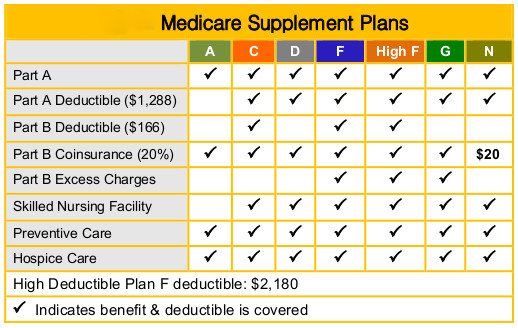

The following chart shows some sample monthly premiums for the Gerber Life graded benefit final expense plan:
As you can see, the monthly premium for a $10,000 final expense plan for a 60 year old male is $56.65. For a 60 year old female, the monthly premium is $46.48 per month. Again, these rates will never increase and the plan cannot be canceled for any reason as long as the premiums are paid.
Sample Rates For a Level Benefit Final Expense Plan
United of Omaha Life Insurance Company offers a level benefit final expense plan, and their application is a simple one that has 10 health questions. If you answer “No” to every question, you would be eligible for their level benefit product. With their plan, if you are between the ages of 45 and 85, you can choose from $2,000 to $40,000 in life insurance.
The monthly premium for a $10,000 level benefit final expense plan for a 60 year old male is $42.76. For a 60 year old female, the premium is $32.87 per month. Again, these rates will never increase and the plan cannot be canceled for any reason as long as the premiums are paid.
Which Final Expense Plan (Level Benefit or Graded Benefit) Has the Best Rates?
If you are in relatively good health and you don’t have any serious medical conditions, you should first apply for a level benefit final expense plan because the rates would be less than the rates for a graded benefit final expense plan. For example, the monthly premium for a United of Omaha Life Insurance Company $10,000 level benefit final expense plan for a 60 year old male and female is currently $42.76 and $32.87 per month, respectively, compared to $56.65 and $46.48 per month for the Gerber Life graded benefit final expense plan. As you can see, the level benefit rates are more competitively priced than the graded benefit rates.
Again, final expense is probably everyone’s least favorite insurance topic, but it is something that should be taken into consideration, without emotion, as a financial planning tool, and nothing more. Remember, it’s peace of mind.
For more information or to get a quote, please give me a call at (760) 525-5769.
Today, there are 10 standardized Medicare Supplement plans (Plans A through N). The coverage for these plans is the same no matter which insurance company you have. For example, the coverage and benefits for Plan F is exactly the same at Aetna, Cigna, Blue Shield, Stonebridge, Blue Cross, etc., so it’s much easier to shop around and compare plans and prices today.
As you can see in the following chart, Plan F provides the most extensive Medicare Supplement coverage. (The plans with the empty boxes indicate coverage that is not included with that particular plan.)
Of the 10 standardized Medicare Supplement plans (aka “Medigap” plans), Plan F is considered to be the best plan because it provides the most comprehensive coverage. Plan F pays for all of the coinsurance, copayments, and deductibles not paid for by Medicare.
Plan F pays for the following benefits:
Medicare Part A Hospital Deductible (Currently $1,216 per benefit period) *
Medicare Part A Hospital Coinsurance
Medicare Part B Deductible (Currently $147 per year)
Medicare Part B Coinsurance
Medicare Part B Excess Charges
Hospice Care Coinsurance or Copayments
Skilled Nursing Facility Care Coinsurance
Charges for First Three Pints of Blood
Foreign Travel Emergencies
* A benefit period begins on the first day you receive service as an inpatient in a hospital and ends after you have been out of the hospital and have not received skilled care in any other facility for 60 days in a row. Therefore, there can be multiple Part A hospital deductibles in one calendar year.
Which is Better, Plan F or Plan G?
Plan F and Plan G include the following benefits:
Freedom to choose any doctor or hospital that accepts Medicare patients.
Benefits start immediately with no waiting period for pre-existing conditions.
There are no networks and no referral needed.
No cancellation for age, health or the number of claims you file.
Covers 100% of all Medicare allowable excess charges.
Coverage that expands automatically with any future changes in Medicare.
Virtually eliminates all claims paperwork for you.
30-day, no-risk free look guarantees your satisfaction or you get your money back.
Medicare Plan G Is Identical To Plan F Except For the Part B Deductible
Medicare Plan G provides the same identical coverage as Plan F except it does not cover the $147 Part B calendar year deductible (in bold above). That is the only difference between the two plans. They are exactly the same in every other way! Plan F and Plan G are the only two Medicare Supplement plans that pay 100% of any excess charges, so there would rarely be any unexpected out-of-pocket expenses. (Excess charges are additional expenses incurred outside of the Medicare-approved charge. For example, if you go to a doctor that charges more than the Medicare-approved amount.)
Why Would I Choose Medicare Plan G Over Plan F?
The decision to go with Plan G depends on whether the annual savings will exceed the $147 Part B deductible. For example, if your Plan G premiums are $30 per month less than the Plan F premiums, then you will save $360 per year in premiums ($30 x 12 = $360). If you are healthy, and you didn’t go to a doctor that year, you would have saved $360 on your premiums. If you had to pay the $147 Part B deductible, then you still would have saved $213 for the year in premiums ($360 – $147 = $213). On the other hand, if your annual premium savings would be just slightly more than, equal to, or less than $147 per year, then you are unquestionably better off with Plan F.
The Likelihood of Future Rate Increases is Less With Plan G Than With Plan F
Under federal law, Plan F falls under certain Guaranteed Issue (GI) requirements while Plan G doesn’t. For example, if someone has their health insurance with an employer plan or if they are on a Medicare Advantage plan and they loose their coverage, in most cases, they are guaranteed the right to switch to Plan F, regardless of their health and without medical underwriting.
Plan G is not a guaranteed issue plan. Consequently, the overall pool of people with Plan G are healthier than those on Plan F, and the quantity of submitted medical claims is lower with Plan G. Rate increases are often a result of too much GI business, so “F” plans have historically had greater and more frequent rate increases than “G” plans. That’s not a guarantee that “G” plans won’t have future rate increases, but if they do, the increases will more than likely be smaller.
Make the Switch!
The Only Potential Risk That I See With Plan G…
The only potential risk that I see for the future is that nobody knows for sure what the Part B deductible for Medicare will be in the future. Between 2011 and 2012, the Part B deductible actually went down from $162 per year to $140 per year. For the last few years, from 2013 through 2015, the Part B deductible has been stable and remained the same at $147 per year.
Here is the history of Medicare Part B deductibles:
2017 — $183
2016 — $166
2015 — $147
2014 — $147
2013 — $147
2012 — $140
2011 — $162
2010 — $155
2009 — $135
2008 — $135
2007 — $131
2006 — $124
2005 — $110
1991 through 2004 the Part B deductible was $100
1982 through 1990 the Part B deductible was $75
1973 through 1981 the Part B deductible was $60
1966 through 1972 the Part B deductible was $50
As you can see, the historical Part B deductible rates have been relatively stable over the years. For me, it wouldn’t be an issue if I could otherwise save $200 to $300 per year by having a Plan G Medicare Supplement. On the other hand, many of my clients can afford to pay for the best and most comprehensive plan, Plan F, and they don’t want the uncertainty of not knowing for sure what the future will bring. Saving $200 to $300 per year isn’t always a big enough motivator for many to warrant switching from Plan F to Plan G. Then again, many retirees are on tight budgets and fixed incomes, and if that is the case, I would unquestionably recommend that they switch from Plan F to Plan G if they can save money on their premiums.
The California Birthday Rule
With the California Birthday Rule, you are guaranteed the right to switch plans every year within 30 days after your birthday, regardless of your health and without underwriting, if another company is offering the same plan or a lesser plan for less money. In other words, if you have Plan F, you can switch to Plan F with a different company if their rates are lower, or you could switch from Plan F to Plan G with a different company since Plan G is considered to have less benefits (the $147 Part B deductible) than Plan F. Rates vary significantly from one company to the next for the same identical plan and coverage, so it’s important to shop around every year.
Please let me know if you have any questions or comments!
If you or someone that you know would like a Medicare Supplement quote, please let me know, or click here to visit my website. Or, you can compare Medicare Supplement prices on your own by clicking the “Get A Quote” button below.
I’m in the process of taking some Medicare certification courses, and I came across some important information that you (or a friend or family member) may not be aware of. Did you know that under your Medicare Part B benefits, you are entitled to certain preventive services and screenings, and there is no cost-sharing for most of these services? Please take a few minutes and check these out. You may find some benefits that you didn’t realize you were entitled to!
Preventive Services Include the Following:
One-time “Welcome to Medicare” physical exam
Annual wellness visit after 12 mos. enrolled in Part B
Abdominal aortic aneurysm screening – one time, with referral
Alcohol misuse screening – every 12 months for certain individuals
Bone mass measurement – every 24 months for certain conditions
Cardiovascular screening blood tests – every five years for all persons
Colorectal cancer screening – four different tests, vary in frequency
Depression Screening – every 12 months
Diabetes screenings – up to two per year for those with risk factors
Diabetes self-management training – for persons with diabetes
Glaucoma testing – once per year for those at high risk
HIV Screening
Intensive Behavioral Therapy for Cardiovascular Disease – one face-to-face visit annually in a primary care setting
Mammogram (Breast Cancer Screening) – annual screening for most women
Medical nutrition therapy – for those with diabetes/kidney disease or kidney transplant
Obesity Screening and counseling – for certain individuals
Pap test and pelvic examination – every 24 mos. for all women; every 12 mos. for those at high risk
Prostate cancer screening – every 12 mos. for men over age 50
Screening for Sexually Transmitted Infections (STIs) and High Intensity Behavioral
Counseling to Prevent STIs – for certain individuals
Smoking cessation counseling – for any illness related to tobacco use
Other Part B Items and Services:
Ambulance services
Ambulatory surgical center fees
Blood
Cardiac rehabilitation–for certain situations
Chiropractic services–for limited situations
Clinical research studies – some costs of certain care in approved studies
Defibrillator (implantable automatic)
Diabetic supplies
Durable medical equipment – restricted to certain suppliers in some areas
Emergency room services
Eyeglasses after cataract surgery – limits apply
Foot exams and treatment for certain diabetics
Hearing and balance exams (no hearing aids)
Home health services in certain situations
Kidney dialysis and disease education – certain situations
Mental health care (outpatient) – limits apply
Occupational and physical therapy – limits apply
Pulmonary rehabilitation for COPD
Prosthetic/Orthotic items
Second surgical opinions
Speech-language pathology services
Telehealth services in some rural areas
Tests like X-rays, MRIs, CT scans
Transplant physician services and drugs
The Following Items Are Not Covered by Medicare Part A & B:
Acupuncture
Dental care/dentures
Cosmetic surgery
Custodial care
Health care while traveling outside the US – exceptions apply
Hearing aids
Orthopedic shoes
Outpatient prescription drugs (covered under Part D)
Routine foot care
Routine eye care and eyeglasses
Some screening tests and labs
Vaccines, except as previously listed (those not covered under Part B are covered under Part D)
Syringes and insulin unless used with an insulin pump (covered under Part D)
IMPORTANT WARNING REGARDING YOUR MEDICARE COVERAGE!
If you are on Medicare and you need to be admitted to a hospital, DO NOT let the hospital admit you with the words “UNDER OBSERVATION.” Insist on being admitted as “IN-PATIENT.” Otherwise, there is a good chance that you will be responsible for most or all of the hospital expenses, and you will be prevented from accessing nursing home care, rehabilitative care, etc. Click here to watch a recent NBC news television broadcast regarding this problem.
I Specialize in Medicare Supplement Insurance!
For an INSTANT Medicare Supplement insurance quote in California or Washington state, or for more information about long-term care (LTC) insurance, linked-benefit plans, critical care, etc., please call or visit my website.